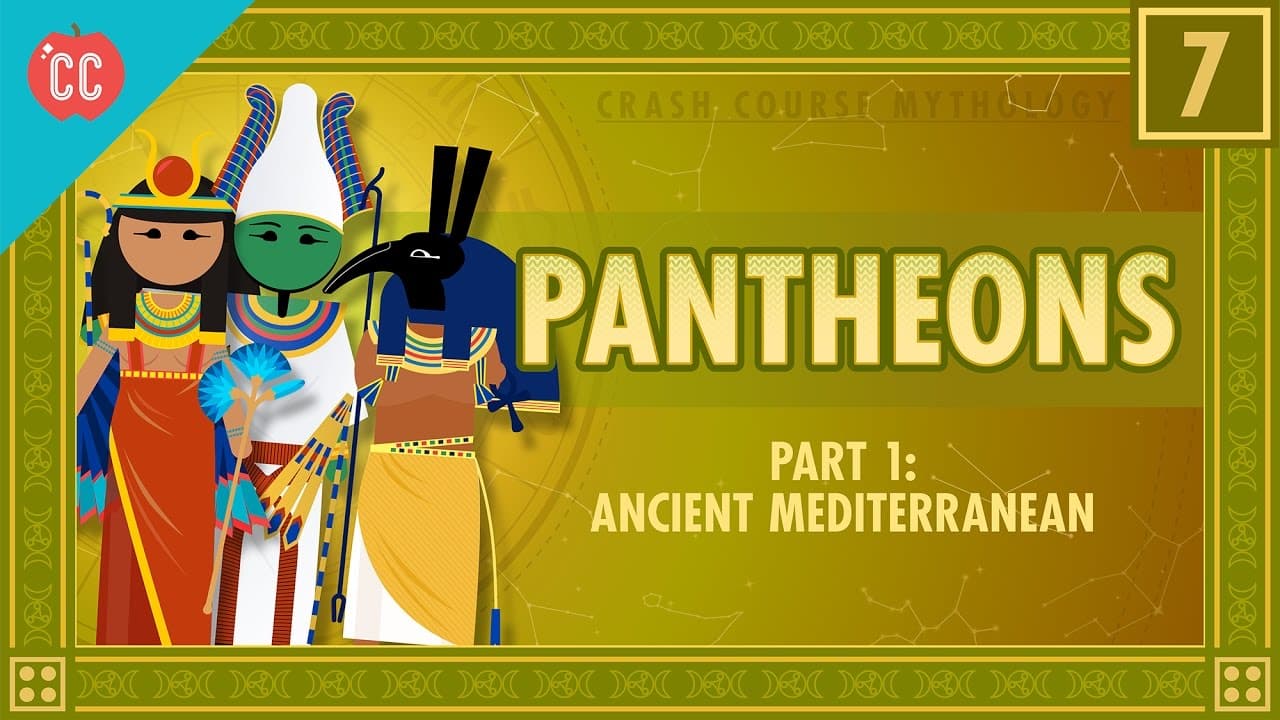
Pantheons of the Ancient Mediterranean: Crash Course World Mythology #7
TL;DR
Ancient Mediterranean pantheons reveal how cultures understood nature, existence, creation, and death through interconnected families of gods. Crash Course World Mythology #7 compares Sumer’s nature-centered divine family with Egypt’s variable, regionally defined pantheon, including the nine-god Ennead established at Heliopolis by 2700 BCE. Read on for the relationships, sources, and cultural interpretations behind both systems.
Transcript
Hey there, I’m Mike Rugnetta and this is Crashcourse Mythology and today we’re going to start looking at pantheons. Pantheons are families of gods, and those families are complicated. Really complicated. A whole tangle of grandparents and parents and uncles and aunts and nieces and nephews and a couple of children of mortal women who were raped and... Read More
Key Insights
- Gods embody desired transcendence: David Leeming describes gods as personified projections of the mythmaker’s dream of overcoming physical laws that lead to death and disintegration. This interpretation connects divine immortality with a distinctly human concern. Gods do more than populate stories, because their enduring existence expresses a response to mortality and bodily decay.
- Creation links gods with life: Within creation stories and other myths, gods represent the creative force that brings life into being and continues to sustain it. Their functions therefore address both origins and ongoing existence. A pantheon can connect the beginning of the world with the natural processes that keep that world operating after creation.
- Divinity personifies two domains: Mythological gods may personify aspects of nature as well as aspects of human nature. The transcript gives the sun and winds as natural examples, while impatience and love illustrate human qualities. Reading which domains receive gods can therefore reveal what a tradition selected as significant enough to represent through divine personalities.
- Pantheons encode cultural self-understanding: Leeming calls pantheons ontological and teleological because they address existence and ultimate cause. To read a pantheon is consequently to investigate how a culture understood itself and the cosmos. The family structure and divine responsibilities become evidence for interpreting cultural priorities, rather than merely a catalog of supernatural characters.
- Sumer begins with elemental forces: The Sumerian genealogy starts with Ki, the earth goddess, An, the sky god, and Nammu, goddess of primal waters. Air enters through Ninlil and Enlil, followed by lunar and solar deities in later generations. This sequence supports the episode’s view that forces of nature dominate the pantheon’s organization.
- Natural authority outweighs emotion: The episode contrasts Sumerian gods of earth and sky with gods connected to actions and emotions such as love. Among the original Mesopotamian gods discussed, only Enki, as trickster, and Inanna, also associated with love, rule aspects of human nature. Their limited number makes the pantheon’s emphasis on natural phenomena especially visible.
- Kinship connects cosmic responsibilities: Divine roles are arranged through ancestry, marriage, and sibling relationships rather than presented as an unrelated list. The air gods produce the Moon God, while Enki and the reed goddess create the Moon Goddess. Those lunar deities then produce Utu, Inanna, and Ereshkigal, linking the sun, heaven, earth, and underworld within one family.
- Animals complicate Sumerian interpretation: Sirtur is a sheep goddess who gives birth to Dumuzi, a shepherd, while Ereshkigal’s husband is Gugalanna, the Bull of Heaven. These figures may recall Mesopotamia’s earlier life as herders despite the Fertile Crescent’s agricultural associations. The bull could instead, or additionally, evoke masculinity or farming.
- Egypt resists one definitive genealogy: The Egyptian pantheon changes according to who recorded a myth, where it was told, and when it circulated. Sources are also fragmentary and distributed across thousands of years. Any simplified family of Egyptian gods is therefore a selected framework, not a claim that every Egyptian place and period followed an identical system.
- Plutarch shapes a central account: The most complete source identified for the Isis and Osiris story is not Egyptian but the Greek biographer Plutarch. He wrote in the first and second centuries CE, after Egypt had become Hellenized and Romanized. His version assigns Greek names to Egyptian gods, including calling Thoth Hermes, revealing how transmission affected presentation.
- Regional worship changes leadership: The episode primarily follows the gods worshipped at Heliopolis, where Atum or Ra heads the group. It also notes that Amun led the pantheon in Thebes. These different centers demonstrate why geography matters when describing Egyptian religion and why one list of gods cannot represent every local arrangement without qualification.
- The Ennead provides a focus: For clarity, the episode selects the Ennead, the Nine Gods forming the core of Egyptian religious belief discussed here. It was established at Heliopolis by 2700 BCE and appears in the Pyramid Texts, described as possibly the world’s oldest surviving collection of religious texts. Even this framework excludes Thoth and gives its leading deity several names.
Install to Summarize YouTube Videos and Get Transcripts
Explore YouTube Video Summarizer or Get YouTube Transcript Extractor
Questions & Answers
Q: What are pantheons, and what can they reveal about a culture?
Pantheons are complicated families of gods associated with cultures usually described as polytheistic. Their gods may personify natural forces, human qualities, or the creative power that brings and sustains life. David Leeming argues that pantheons help people make sense of existence and assign ultimate cause. Reading their relationships and responsibilities can therefore reveal how a culture understood itself and the cosmos.
Q: Who are the principal gods in the Sumerian pantheon described here?
The genealogy begins with Ki, goddess of earth, An, god of sky, and Nammu, goddess of primal waters. Their descendants include Enki, Ningikuga, Ninlil, Enlil, Nanna, and Ningal. The later generation contains Utu, Inanna, and Ereshkigal, while Gugalanna, Dumuzi, and Sirtur enter through marriage and parentage. Together, their roles connect natural forces, animals, human qualities, and the underworld.
Q: How does the Sumerian pantheon reflect Mesopotamian priorities?
The pantheon gives prominent roles to earth, sky, primal waters, air, the moon, and the sun. By contrast, only Enki and Inanna among the original gods discussed govern aspects of human nature. This imbalance suggests that natural phenomena took precedence over human actions and emotions in these myths. The divine family’s structure makes those environmental priorities visible through both genealogy and assigned responsibilities.
Q: What might the sheep and bull signify in Sumerian mythology?
Sirtur is a sheep goddess and the mother of Dumuzi, who is a shepherd. Gugalanna is the Bull of Heaven and is identified as Ereshkigal’s husband. Their presence may recall an earlier Mesopotamian way of life centered on herding, despite the Fertile Crescent’s association with agriculture. The bull may also represent masculinity or farming, illustrating that the same pantheon can support several interpretations.
Q: Why is there no standard Egyptian pantheon?
Egyptian myths differ according to their author, location, and historical period. The surviving material is fragmentary and spread across thousands of years, making a single definitive arrangement difficult. Worship also varied geographically, with Atum or Ra heading the Heliopolitan group and Amun leading in Thebes. Simplifying the tradition therefore requires choosing one particular group while acknowledging other versions.
Q: What is the Egyptian Ennead?
The Ennead is the nine-god pantheon selected in the episode as a manageable core of Egyptian religious belief. It was established at Heliopolis by 2700 BCE and appears in the Pyramid Texts. Those texts may be the oldest surviving set of religious texts in the world. The framework offers clarity amid conflicting traditions, although it does not include every important deity, including Thoth.
Q: Why is Plutarch important to the Isis and Osiris story?
Plutarch provides the most complete source identified in the transcript for the story of Isis and Osiris. He was a Greek biographer writing in the first and second centuries CE, long after Egypt had become Hellenized and then Romanized. His account uses Greek names for Egyptian gods, such as Hermes for Thoth. This matters because the surviving version reflects later cultural transmission as well as Egyptian mythology.
Q: Why does Egypt’s leading creator god have several names?
The deity at the top of the selected Egyptian pantheon is identified as Atum, Re, Ra, Khepri, Amun, or sometimes Amun-Ra. The name used depends partly on where in Egypt the tradition is located. Atum is described as the great eye of the heavens and of creation. The multiple names demonstrate the regional and historical complexity that makes simplification necessary in presenting the pantheon.
Summary & Key Takeaways
-
Defining pantheons and their purpose: Mike Rugnetta introduces pantheons as complicated families of deities belonging to cultures usually considered polytheistic. Gods are generally immortal and may personify natural forces or human qualities, including the sun, winds, impatience, and love. Drawing on David Leeming, the episode presents pantheons as metaphors through which people make sense of existence, assign ultimate causes, explain how the world arose, and express their culture’s understanding of itself and the cosmos.
-
Beginning with ancient Sumer: Instead of starting with Greek or Egyptian gods, the episode turns first to one of the oldest pantheons preserved in records, the divine family of ancient Sumer in Mesopotamia. Its earliest figures represent major natural forces: Ki is earth, An is sky, and Nammu embodies primal waters. Their descendants extend this natural pattern through deities associated with air, reeds, the moon, the sun, heaven, earth, and the underworld.
-
Tracing the Sumerian family: An and Nammu produce Enki, the trickster god, and Ningikuga, goddess of reeds. An and Ki produce the air deities Ninlil and Enlil, whose child is Nanna, the Moon God. Enki and Ningikuga create Ningal, the Moon Goddess. Ningal and Nanna then have Utu, the sun god, Inanna, the Great Goddess of Heaven and Earth, and Ereshkigal, Queen of the Underworld.
-
Interpreting Mesopotamian priorities: The Sumerian pantheon suggests that natural phenomena such as earth and sky took precedence over human actions and emotions such as love. Only Enki and Inanna among the original gods described here govern aspects of human nature. The presence of the sheep goddess Sirtur and Gugalanna, the Bull of Heaven, may recall an earlier herding life. Alternatively, the bull may symbolize masculinity, farming, or both, showing why pantheons permit multiple readings.
-
Navigating Egyptian complexity: Egypt has no single standard pantheon because myths vary by author, place, and period, while surviving sources are fragmentary and span thousands of years. Plutarch’s account of Isis and Osiris comes from the first and second centuries CE, after Egypt was Hellenized and Romanized, and uses Greek names for Egyptian gods. The episode therefore focuses on Heliopolis and its Ennead, established by 2700 BCE, while acknowledging Amun’s leadership in Thebes and Akhenaton’s attempted monotheism.
Read in Other Languages (beta)
Share This Summary 📚
Summarize YouTube Videos and Get Video Transcripts with 1-Click
Try YouTube Summary with ChatGPT & Claude or YouTube Transcript Generator
Explore More Summaries from CrashCourse 📚




Summarize YouTube Videos and Get Video Transcripts with 1-Click
Try YouTube Summary with ChatGPT & Claude or YouTube Transcript Generator