How Did the White House Respond to the Shooting?
TL;DR
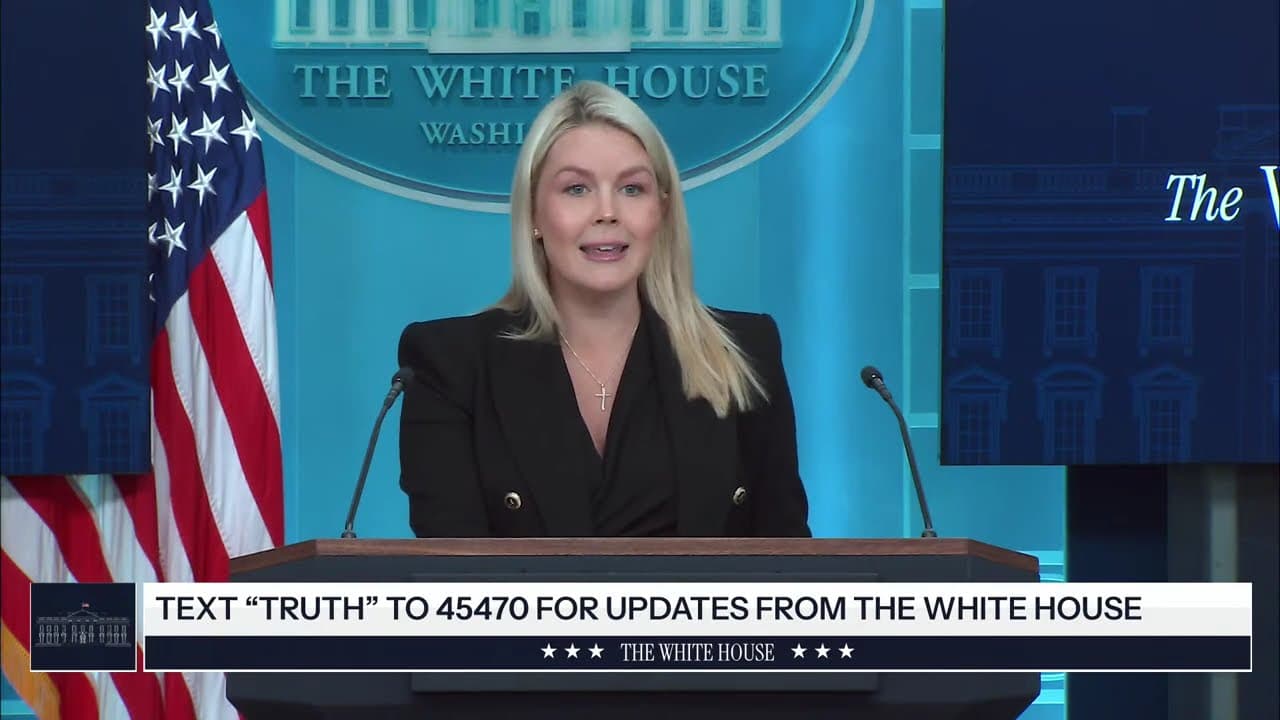
The White House said President Trump retained confidence in the Secret Service after the reported shooting and announced an early-week security meeting involving senior officials. Press Secretary Karoline Leavitt praised the agents’ response, called for peaceful political disagreement, linked heightened risks to hostile rhetoric, and urged Congress to restore Department of Homeland Security funding after a reported 73-day lapse.
Transcript
Good afternoon everyone. Later today, President Trump and the First Lady will welcome King Charles and Queen Camila for a state visit here at the White House. First lady Melania Trump has led all of the preparation for the state visit which will honor the longstanding and special relationship between the United States and the United Kingdom. As I t... Read More
Key Insights
- The White House’s immediate response was to praise the Secret Service for rapidly moving senior officials to safety and stopping the alleged attacker at the established security perimeter. Leavitt said President Trump continued to trust the agency while his staff reviewed security operations and procedures.
- A Secret Service agent was reportedly struck in the chest and protected by a bulletproof vest. Leavitt said the agent returned to the White House afterward, and President Trump spoke with the agent before the press briefing to confirm that he was safe.
- President Trump’s reaction was described by Leavitt as calm and determined during and after the reported attack. She said he resisted efforts to end the dinner, wanted to return to the stage, and later emphasized peaceful resolution of political disagreements.
- The administration’s stated security review will involve White House Chief of Staff Susie Wilds, senior Department of Homeland Security leaders, Secret Service officials, and the White House operations team. Leavitt said the meeting would examine protection ahead of several major events.
- Political disagreement must remain peaceful, according to the administration’s central message. Leavitt identified debate, peaceful protest, and voting as the proper ways to resolve disputes and argued that bullets and other violence have no legitimate role in American political life.
- Leavitt attributed the danger surrounding Trump to sustained hostile rhetoric from commentators, Democratic elected officials, and some media figures. This was presented as the administration’s interpretation of the alleged attacker’s manifesto and the broader political environment, rather than as an independently established finding.
- Department of Homeland Security funding was presented as an urgent security requirement because the Secret Service operates within DHS. Leavitt said the department had remained unfunded for 73 days and argued that the situation imposed a dangerous burden on agents protecting senior officials.
- The Secret Service’s conduct was characterized as professional and courageous despite political and funding pressures. Leavitt highlighted an agent who reportedly jumped onto the stage without knowing the attacker’s position, placing his body between the perceived danger and the president.
- More videos from this channel:
- More from this channel: The White House
Install to Summarize YouTube Videos and Get Transcripts
Explore YouTube Video Summarizer or Get YouTube Transcript Extractor
Questions & Answers
Q: How did the White House respond to the reported shooting?
The White House publicly thanked the Secret Service and other law enforcement personnel, emphasized that President Trump continued to trust his protective detail, and announced a review of security arrangements. Leavitt said an early-week meeting would bring together Chief of Staff Susie Wilds, senior Department of Homeland Security leaders, Secret Service officials, and the White House operations team.
Q: What did the Secret Service reportedly do during the attack?
According to Leavitt, Secret Service personnel quickly moved the president, first lady, vice president, and cabinet members out of the room. She said agents stopped the alleged attacker at the security perimeter after he tried to charge through it. She also described one agent jumping onto the stage to shield the president despite uncertainty about the attacker’s location.
Q: Was anyone injured during the reported assassination attempt?
Leavitt said a Secret Service agent took a bullet to the chest but survived because of a bulletproof vest. She described the agent as trying to remain on duty and said he later returned to the White House. Before the briefing, President Trump reportedly spoke with the agent to check on his condition and was assured that he was safe.
Q: Why did Karoline Leavitt return before her maternity leave?
Leavitt said she had expected an earlier media appearance to be her last before maternity leave, but returned because she considered it important to explain the administration’s response to the reported assassination attempt. She described her position as public service and said her role required her to speak for President Trump and the White House during a serious national event.
Q: What message did the briefing give about political disagreement?
The briefing argued that intense political disputes must be handled through debate, peaceful protest, and voting rather than violence. Leavitt said Americans can disagree fiercely while remaining peaceful. She also relayed President Trump’s call for the country to recommit to resolving differences peacefully and to unite around shared national values after the reported attack.
Q: How did Leavitt connect political rhetoric to violence?
Leavitt argued that years of hostile rhetoric about President Trump, his family, supporters, and staff had helped legitimize political violence. She specifically criticized comparisons portraying him as a fascist, a threat to democracy, or similar to Hitler. This causal connection was the administration’s claim, based partly on its reading of the alleged attacker’s manifesto.
Q: Why did the briefing focus on Department of Homeland Security funding?
Leavitt said the Secret Service is part of the Department of Homeland Security and had been directly affected by a reported 73-day funding lapse. She characterized restoring funding as a national emergency, arguing that agents already face extensive protective responsibilities and that continued congressional obstruction could increase risks to officials, law enforcement personnel, and the public.
Q: What future events did Leavitt cite as security concerns?
Leavitt identified the World Cup, America 250, the 2028 Olympics, and a presidential election as major upcoming responsibilities that would place additional demands on the Secret Service. She used those events to support the administration’s argument that Congress should fund the Department of Homeland Security and reduce the operational burden on personnel assigned to protect national leaders and public gatherings.
Summary & Key Takeaways
-
Press Secretary Karoline Leavitt said she returned before maternity leave because of the reported assassination attempt at the White House Correspondents Association dinner. She described being seated beside President Trump and the first lady when shots were fired, praised the president’s composure, and thanked law enforcement officers for moving officials to safety.
-
Leavitt strongly condemned political violence and argued that repeated hostile descriptions of Trump and his supporters had helped normalize aggression. She called for political differences to be resolved through debate, peaceful protest, and voting. Her remarks included criticism of Democratic officials, media figures, social media rhetoric, and a late-night television host.
-
The briefing connected presidential security to the reported 73-day lapse in Department of Homeland Security funding. Leavitt praised the Secret Service while warning that its responsibilities include major future events. She also announced an early-week meeting involving the White House chief of staff, senior DHS leaders, Secret Service representatives, and the operations team.
Read in Other Languages (beta)
Share This Summary 📚
Summarize YouTube Videos and Get Video Transcripts with 1-Click
Try YouTube Summary with ChatGPT & Claude or YouTube Transcript Generator
Explore More Summaries from The White House 📚

Summarize YouTube Videos and Get Video Transcripts with 1-Click
Try YouTube Summary with ChatGPT & Claude or YouTube Transcript Generator