What Makes Saturn Unique in Our Solar System?
TL;DR
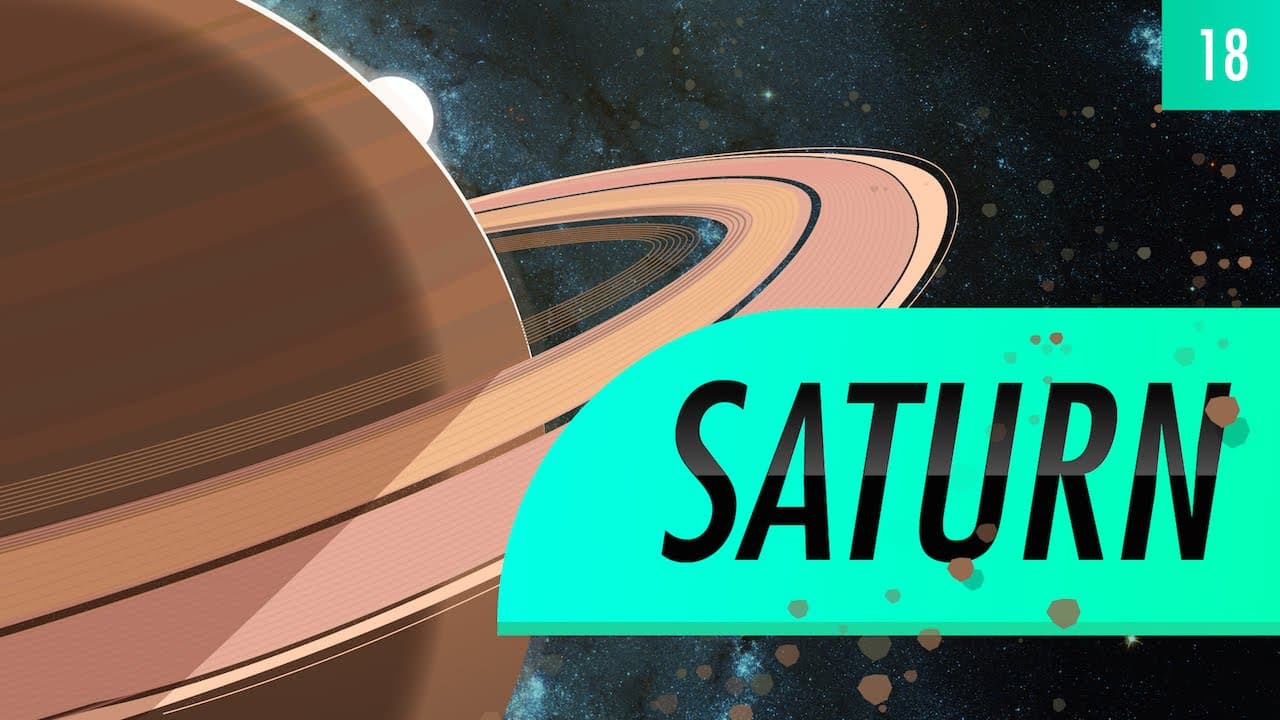
Saturn is a gas giant known for its stunning rings composed of ice particles. Its rapid rotation makes it oblate, and its atmosphere hosts unique features like a hexagonal storm at the north pole. Saturn's moons, such as Titan and Enceladus, are intriguing for their potential to harbor life, with Titan having lakes of methane and Enceladus featuring water geysers.
Transcript
This episode of Crash Course is brought to you by Squarespace. So now we’ve come to the last of the naked eye planets in the solar system: Saturn. It’s the second largest planet, but ironically the least dense. In fact, if you could find a bathtub big enough, Saturn would float in it! But it would leave a ring. OK, that’s the oldest joke in astrono... Read More
Key Insights
- Saturn is the least dense planet in the solar system, with a density about two-thirds that of water.
- Saturn's rapid rotation causes it to be oblate, making it wider at the equator than at the poles.
- The planet's rings are composed of countless small ice particles, forming a thin, flat disk around Saturn.
- Saturn's rings are divided into several main sections, with gaps created by gravitational interactions with its moons.
- Titan, Saturn's largest moon, has a thick atmosphere and lakes of liquid methane, making it unique among moons.
- Enceladus, another moon of Saturn, has water geysers that suggest an underground ocean, raising the possibility of life.
- Saturn's north pole features a massive hexagonal storm, a phenomenon caused by the planet's atmospheric dynamics.
- Saturn has over 60 known moons, each with unique characteristics, contributing to its status as a fascinating astronomical object.
Install to Summarize YouTube Videos and Get Transcripts
Explore YouTube Video Summarizer or Get YouTube Transcript Extractor
Questions & Answers
Q: How does Saturn's rapid rotation affect its shape?
Saturn's rapid rotation causes it to be oblate, meaning it is wider at the equator than at the poles. This is due to the centrifugal force generated by its fast rotation, which stretches the planet outward at the equator. As a result, Saturn's equatorial diameter is about 10% greater than its polar diameter.
Q: What are Saturn's rings made of?
Saturn's rings are made of countless small particles of ice, which are very nearly pure water ice. These particles range in size from tiny grains to larger chunks and orbit Saturn independently. The rings are incredibly thin relative to their width, averaging about ten meters thick despite spanning 250,000 kilometers across.
Q: Why are there gaps in Saturn's rings?
Gaps in Saturn's rings are caused by gravitational interactions with its moons. These moons create resonances that can clear out particles from specific regions within the rings. For example, the Cassini Division, a prominent gap between the A and B rings, is influenced by the moon Mimas, which exerts gravitational forces that remove particles from this area.
Q: What makes Titan unique among Saturn's moons?
Titan is unique because it is the only moon in the solar system with a substantial atmosphere, thicker than Earth's, composed mainly of nitrogen. It also has lakes of liquid methane on its surface, and these features, along with its size—larger than Mercury—make Titan a key focus for studying the potential for life in environments vastly different from Earth.
Q: What evidence suggests Enceladus might harbor life?
Enceladus has water geysers that erupt from its south pole, suggesting the presence of a subsurface ocean kept liquid by tidal forces from Saturn. The Cassini spacecraft detected organic molecules in the plumes, indicating the potential for life. This subsurface ocean, combined with the presence of organic compounds, makes Enceladus a compelling candidate for harboring life.
Q: What is the hexagonal storm on Saturn, and how does it form?
The hexagonal storm on Saturn is a massive, six-sided vortex located at the planet's north pole. It forms due to atmospheric dynamics involving a spinning fluid, with the planet's rapid rotation contributing to its shape. This phenomenon is similar to Earth's jet streams but on a much larger scale, spanning about 20,000 kilometers across.
Q: How do Saturn's rings compare in thickness to common objects?
Saturn's rings are incredibly thin, averaging about ten meters thick. To put this in perspective, if Saturn were scaled down to the size of a piece of paper, the rings would be thinner than the paper by a factor of ten thousand. This extraordinary thinness is due to the way the particles in the rings orbit in a flat, disk-like formation.
Q: Why is Saturn often called the crown jewel of the solar system?
Saturn is referred to as the crown jewel of the solar system due to its stunning visual appearance and unique features. Its iconic rings, diverse moons, and atmospheric phenomena like the hexagonal storm make it a captivating object for both amateur and professional astronomers. The planet's beauty and scientific intrigue inspire awe and curiosity among those who observe it.
Summary & Key Takeaways
-
Saturn, the least dense planet in our solar system, is famous for its stunning rings made of ice particles. Its fast rotation makes it oblate, and its atmosphere hosts a unique hexagonal storm at the north pole. The rings are divided into sections by gravitational interactions with moons, creating gaps.
-
Titan, Saturn's largest moon, has a dense atmosphere and lakes of methane, making it a subject of interest for scientists exploring the potential for life. Enceladus, another moon, features water geysers, suggesting an underground ocean and raising the possibility of life beneath its icy surface.
-
With over 60 moons, each possessing unique features, Saturn offers a wealth of scientific interest. Its rings, moons, and atmospheric phenomena, like the hexagonal storm, make it a visually stunning and scientifically rich object, inspiring astronomers and space enthusiasts alike.
Read in Other Languages (beta)
Share This Summary 📚
Summarize YouTube Videos and Get Video Transcripts with 1-Click
Try YouTube Summary with ChatGPT & Claude or YouTube Transcript Generator
Explore More Summaries from CrashCourse 📚




Summarize YouTube Videos and Get Video Transcripts with 1-Click
Try YouTube Summary with ChatGPT & Claude or YouTube Transcript Generator