How unique are AI agent identities in digital workflows?
TL;DR
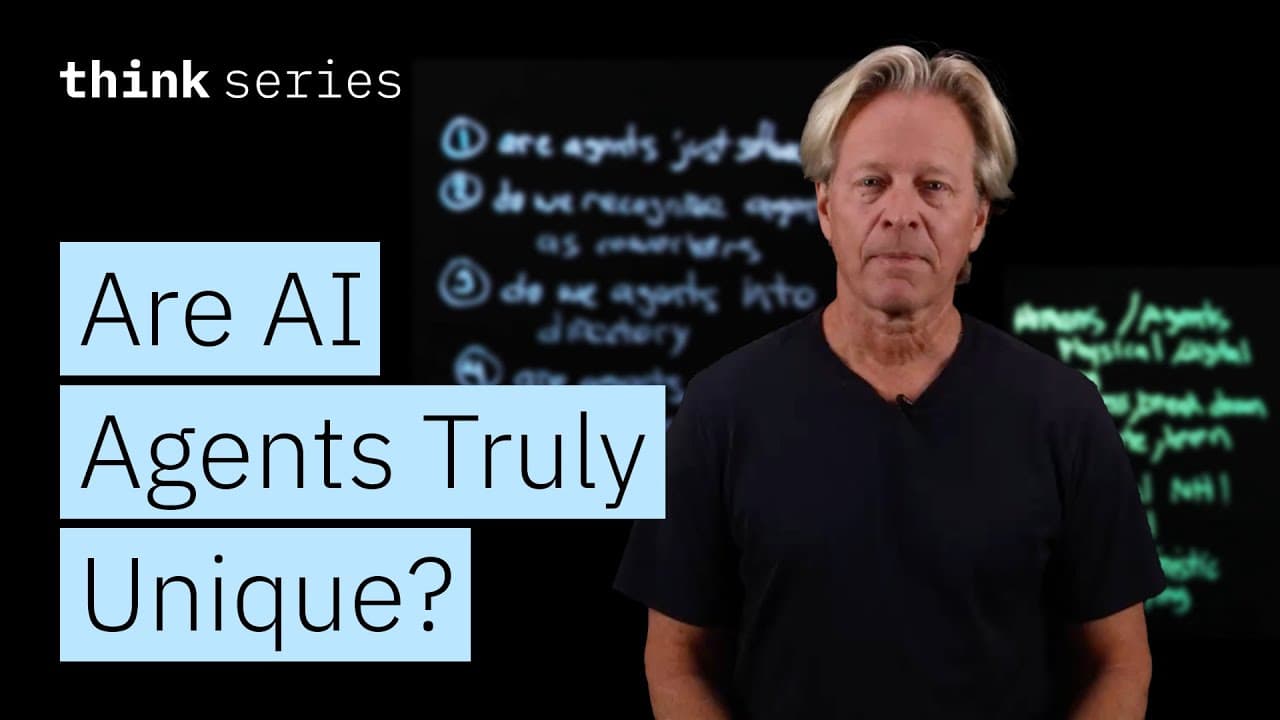
Agents increasingly resemble human workers in how they assess, break down, execute, and learn from tasks within organizations. They are more than just software, prompting governance questions about persistence, directory entries, and whether they should be treated as coworkers. The discussion invites input on how to shape future agent governance and identity management.
Transcript
Howdy, everyone. We're going to do something a little bit different today. We're still going to talk about AI and agents, and we've had a lot of conversations about that. But when we start thinking about AI and AI identities, there's actually some open questions that are still being debated out amongst companies and out in the industry. So I want t... Read More
Key Insights
- Agents are digital and non physical, but their task evaluation and execution can resemble human workflows and decision making.
- The speaker asks whether agents should be treated as coworkers and integrated into HR like entities within an organization.
- There is a question of whether agents should be included in corporate directories, impacting identity governance and access management.
- Agents may be persistent or ephemeral, raising cost and provisioning considerations for IT infrastructure.
- The potential growth of agents could multiply beyond human workers, stressing current identity and access governance systems.
- Governance questions focus on how to manage agent identities, entitlements, and lifecycle in a scalable way.
- The discussion promotes open conversation rather than debate, encouraging community input on agent identity practices.
- The speaker emphasizes that agents are not just software but evolving entities with implications for governance and workflow design.
Install to Summarize YouTube Videos and Get Transcripts
Explore YouTube Video Summarizer or Get YouTube Transcript Extractor
Questions & Answers
Q: What makes AI agents different from traditional software
AI agents are digital like software but they also engage in learning, assessment, and task planning, which gives them human like behavior during task execution. This combination of software foundations and adaptive capabilities raises questions about how we should classify them, interact with them in teams, and govern their access and lifecycle within an enterprise.
Q: Should AI agents be recognized as coworkers
Recognizing AI agents as coworkers would mean integrating them into team workflows and potentially HR processes. This would affect how performance, accountability, and collaboration are managed, and it raises questions about how to measure outcomes, assign responsibility for results, and ensure fair treatment of humans and machines operating together.
Q: Should agents be placed in the directory
Placing agents in a directory could streamline governance, entitlements, and access controls by treating agents as entities with defined identities. However, this also expands the scope of identity governance and requires policies for provisioning, de provisioning, auditing, and ongoing validation to prevent misconfigurations and security risks.
Q: Are agents persistent or ephemeral
The persistence of agents affects resource usage, cost, and governance. Persistent agents may continually consume compute, storage, and network resources, while ephemeral agents can be spun up for specific tasks and shut down afterward. Deciding persistence involves balancing operational needs, cost, and control over lifecycle.
Q: Does current IGA meet the needs of agent proliferation
Current identity governance and administration systems are primarily built around human identities, so rapid agent scale could strain governance. Evaluating if IGA can handle thousands of agent identities, entitlements, and validations is essential, potentially requiring new models for agent lifecycle, approval workflows, and automated compliance checks.
Q: What governance questions should we focus on first
Initial governance questions should focus on whether agents are software or something more, whether they should be coworkers, their directory placement, and their persistence model. These foundations influence access control, auditing, lifecycle management, and the ability to scale with minimal risk to operations.
Q: How should agents be evaluated in workflows
Agents should be evaluated by how accurately and reliably they execute tasks, how they adapt to changing prompts, and how they learn from outcomes. Establishing metrics for accuracy, transparency, and accountability helps compare performance with human workers and informs governance decisions about usage and scope.
Q: What is the purpose of inviting open conversation
The open conversation aims to gather diverse perspectives on agent identity, governance, and integration into workflows. By collecting feedback, organizations can shape practical policies, reduce risk, and build consensus on how to manage agent identities at scale while remaining aligned with organizational goals.
Summary & Key Takeaways
-
The video argues that AI agents blend software and human-like behavior in task execution, prompting a rethink of identity and governance in organizations.
-
It covers whether agents are simply software, whether they should be treated as coworkers, and how they should appear in identity directories and governance models.
-
It invites broad feedback on how persistent or ephemeral agents should be, and how current IGA systems might need to adapt to large-scale agent adoption.
Read in Other Languages (beta)
Share This Summary 📚
Summarize YouTube Videos and Get Video Transcripts with 1-Click
Try YouTube Summary with ChatGPT & Claude or YouTube Transcript Generator
Explore More Summaries from IBM Technology 📚


Summarize YouTube Videos and Get Video Transcripts with 1-Click
Try YouTube Summary with ChatGPT & Claude or YouTube Transcript Generator