How to Break Bad Habits and Build Good Ones
TL;DR
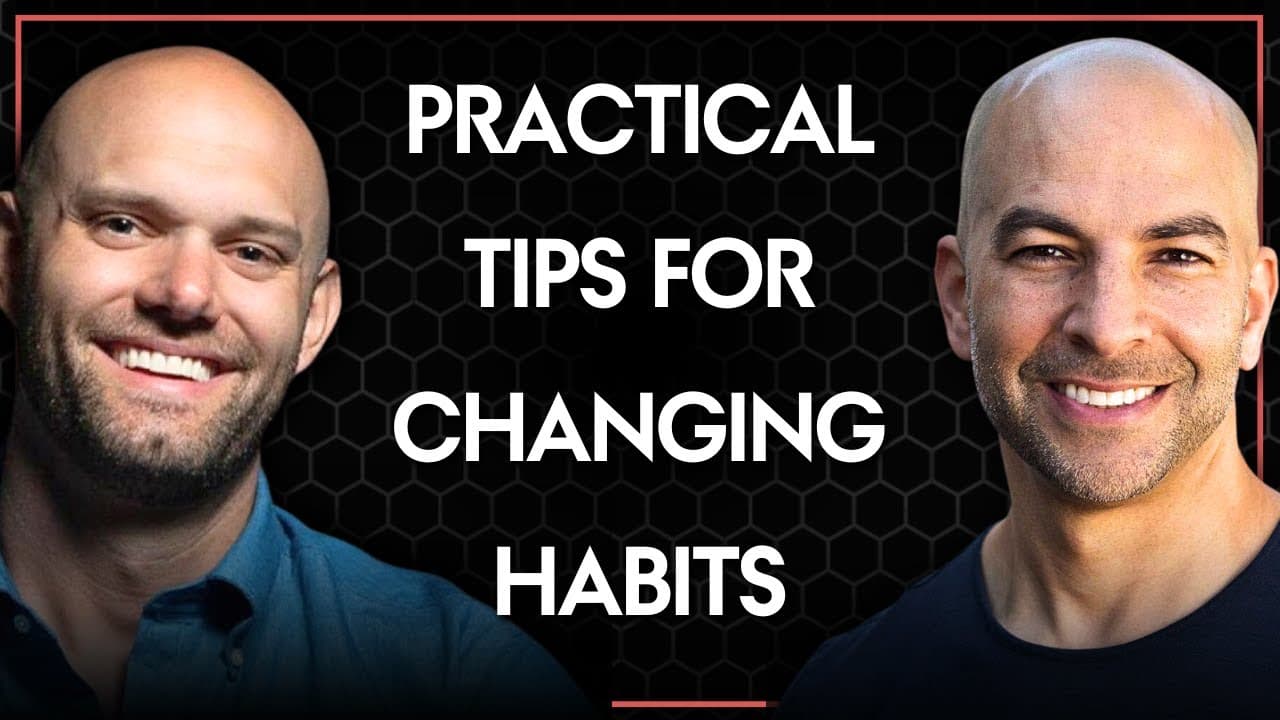
There are three ways to break a bad habit: eliminate it entirely (cold turkey), curtail it to a desired degree, or replace it with another behavior. James Clear recommends focusing instead on building good habits, which naturally crowd out bad ones, and redesigning your environment so good choices become the obvious, easy path.
Transcript
now how often is a certain Behavior the combination of breaking a habit and creating a habit again it seems like a lot of the ones we default into talking about are the hard ones like nutrition we all eat we're all going to eat all the time it's not something you can opt out of or into you just you know we all eat so presumably if a person says aga... Read More
Key Insights
- There are three ways to break a bad habit: eliminate it entirely by going cold turkey, curtail the behavior to a desired degree (such as drinking a beer once a week instead of nightly), or replace it with a substitute like water.
- Building new good behaviors necessarily displaces old ones, so James Clear focuses on establishing positive habits rather than breaking bad ones, because good habits crowd out bad ones like a growing plant soaking up sunlight from its neighbor.
- Habit change is partly a zero-sum game because everyone has only 24 hours per day, so inserting a workout from 6 to 7 p.m. automatically means you are not watching Netflix during that hour, crowding out the bad behavior without directly targeting it.
- A single habit like smoking is often a collection of about a dozen separate habits, each with its own cue, craving, response, and reward, so effective change requires intervening at each specific instance rather than treating it as one behavior.
- Environment acts as an invisible hand driving behavior, functioning like gravity or water a fish cannot see, so cues in your surroundings prompt habits without conscious awareness.
- About 90% or more of Vietnam War soldiers addicted to heroin recovered after returning home because they left behind the environmental cues that prompted the habit, unlike typical rehab patients sent back to the same place where they got addicted.
- When people are busy, low on energy, or exhausted, they choose the most obvious option in their environment, the path of least resistance, so designing spaces to make good choices obvious is critical.
- Individual environmental changes rarely move the needle, but collectively making a dozen or more small adjustments to how your office, living room, and kitchen are laid out creates a space where you naturally work and thrive.
Install to Summarize YouTube Videos and Get Transcripts
Explore YouTube Video Summarizer or Get YouTube Transcript Extractor
Questions & Answers
Q: What are the three ways to break a bad habit?
According to James Clear, there are three ways to break a bad habit. First, you can eliminate it entirely by going cold turkey and never doing it again. Second, you can curtail the behavior to a desired degree, such as drinking a beer once a week instead of every night at dinner. Third, you can replace the behavior with a substitute, like drinking water instead of beer. He views breaking and building habits as two sides of the same coin.
Q: Why does James Clear focus on building good habits instead of breaking bad ones?
James Clear focuses on building good habits because establishing new positive behaviors necessarily displaces old ones. He compares it to two plants: as one grows and spreads its leaves, it crowds out the other by soaking up more sunlight and resources. He also prefers this mindset because it gives him a reason to keep improving even once he has good habits, continually looking for the higher-leverage action rather than just resisting bad behavior.
Q: How is habit change a zero-sum game?
Habit change is partly zero-sum because everyone has only 24 hours in each day. If someone usually watches Netflix for three hours each evening and decides to insert a workout from 6 to 7 p.m., by definition they are not watching Netflix during that hour. This crowds out the bad behavior simply by focusing on building the workout habit, even without consciously thinking about reducing TV time at all.
Q: Why is smoking better understood as a collection of habits rather than one habit?
Smoking is helpful to divide into the specific instances in which it happens because it may actually be a collection of about a dozen habits throughout the day. Someone might smoke during the morning commute, around 10:30 on a break with a coworker, and after dinner on the porch. Each of these has its own cue, craving, response, and reward, so you have to intervene in roughly 12 different places, creating a separate solution for each one.
Q: How can you intervene at different smoking cues?
Different smoking instances need different solutions. For the morning commute, a cup of coffee might provide the wake-up effect instead of a cigarette. But that may not work for the 10:30 session with a coworker, where you might need an e-cigarette to keep the socialization of feeling like you are smoking with a friend. James Clear suggests taking it in stages and breaking each instance down to a degree where it is easier to have a clear line of attack.
Q: How does environment influence our habits?
Environment acts like an invisible hand that drives our behavior, similar to a fish swimming in water that does not realize the water is there. Most people are not aware of the cues around them, like getting into the car signaling a change that prompts lighting up a cigarette. Environment works like a form of gravity that pulls on you; you can resist it for a day, week, or month, but eventually it drains you and sucks you back in.
Q: What does the Vietnam War heroin example teach about addiction and environment?
During the Vietnam War, many soldiers became addicted to heroin and drugs, raising fears about returning addicted soldiers. However, 90% or more ended up fine because they did not go back to the place where they got addicted; they returned home to friends and family without the same signals prompting the habit. This contrasts with typical drug addicts who detox in rehab, then get sent back to the same environment where they got addicted, making recovery much harder.
Q: Where should you start when changing behavior according to James Clear?
James Clear recommends starting with either the first law, making it obvious, or the third law, making it easy. Making it easy means scaling habits down so you are more likely to complete the task. Making it obvious means creating an environment where good choices are right in front of you as the path of least resistance. While one environmental change rarely moves the needle, collectively making dozens of small choices about how your office, living room, and kitchen are laid out lets you thrive in that space.
Summary & Key Takeaways
-
James Clear identifies three ways to break a bad habit: eliminate it entirely through cold turkey, curtail the behavior to a desired degree, or replace it with an alternative. He prefers focusing on building good behaviors, which displace bad ones since our time and energy are limited.
-
Complex habits like smoking are actually collections of about a dozen distinct habits, each tied to a specific cue such as the morning commute, a 10:30 break with a coworker, or after dinner. Each instance needs its own tailored intervention and solution.
-
Environment functions as an invisible force shaping behavior. Vietnam soldiers recovered from heroin addiction after leaving the cues behind, while rehab patients relapse returning to old settings. Clear recommends making good habits obvious and easy through many small environmental design choices.
Read in Other Languages (beta)
Share This Summary 📚
Summarize YouTube Videos and Get Video Transcripts with 1-Click
Try YouTube Summary with ChatGPT & Claude or YouTube Transcript Generator
Explore More Summaries from Peter Attia MD 📚





Summarize YouTube Videos and Get Video Transcripts with 1-Click
Try YouTube Summary with ChatGPT & Claude or YouTube Transcript Generator