How to Prevent Common Agentic AI Failures
TL;DR
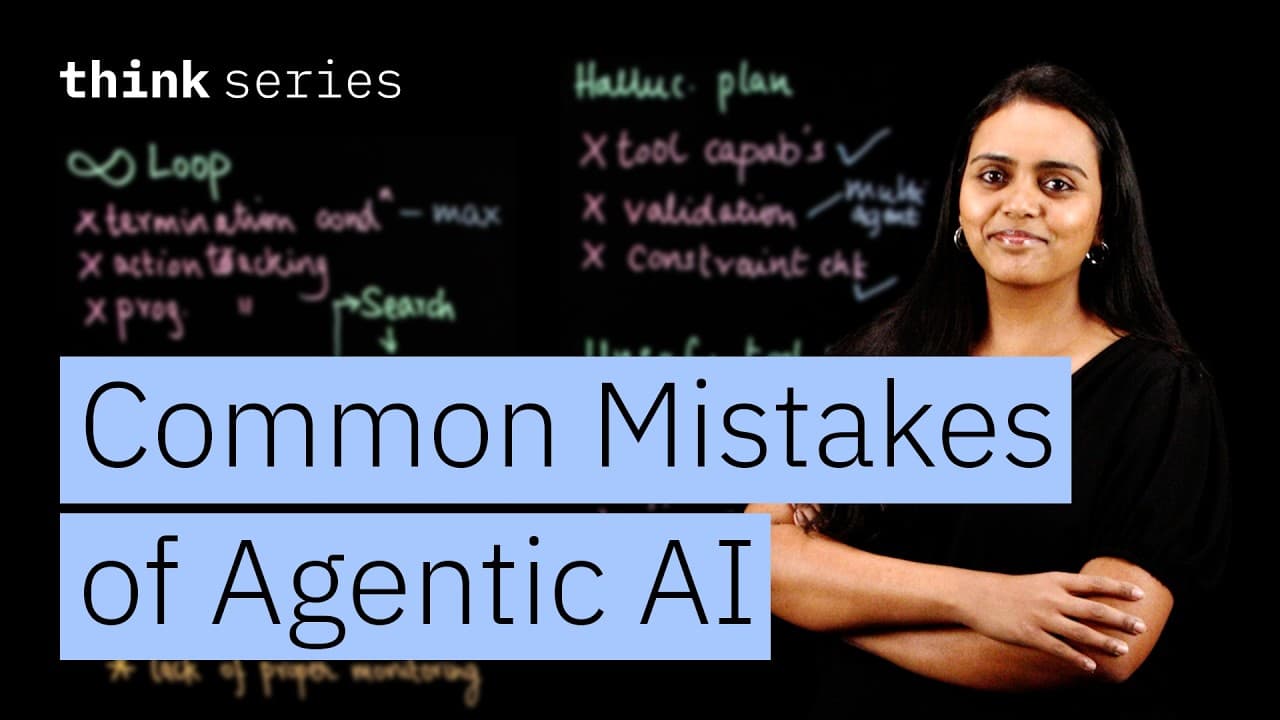
Reliable agentic AI depends more on system design than on blaming model hallucinations. Prevent infinite loops with termination and progress tracking, stop hallucinated plans through capability checks and validation, and reduce unsafe tool use with limited permissions, access tiers, and approval workflows. These controls address failures caused by excessive autonomy, weak constraints, and insufficient monitoring.
Transcript
When an agentic AI system fails, the most common reaction we get is the model probably hallucinated. Now it's quite understandable why we come to that conclusion. Because in the past, the large language models have been known to be extremely inconsistent. They are probabilistic models. They're not deterministic. But in the last couple of years, the... Read More
Key Insights
- Agentic AI is a larger cyclical system that observes, plans, acts, and evaluates outcomes, not simply a language model connected to tools. This broader architecture can produce system-level failures that are different from the inconsistencies traditionally associated with chatbot applications.
- Infinite loops occur when an agent repeats similar planning, searching, and evaluation steps without meaningful progress toward its goal. A missing document can trigger this behavior because the agent keeps interpreting vague search results as a reason to replan and retry.
- Termination conditions are explicit limits that tell an agent when to stop trying. Maximum retries, maximum steps, or maximum runtime can prevent endless execution, reduce wasted compute, and control rising API costs when a requested outcome cannot be achieved.
- Action tracking is a way to compare current agent actions with previous attempts. If repeated searches use substantially similar criteria, the system can recognize that the approach has not changed and stop spending resources on equivalent retries.
- Progress tracking is necessary to determine whether retries are producing better outcomes. When each attempt returns results of similar quality, the system can detect stagnation and terminate or change course instead of continuing an ineffective cycle.
- Hallucinated planning is the creation of a plausible plan that cannot be executed with available capabilities. An agent may propose using an unconfigured travel API or sending an email without an address or email tool because it assumes access instead of checking constraints.
- Plan validation is a safeguard between planning and execution. A verifier agent or a human reviewer can check whether proposed actions are feasible, while clear tool descriptions, schemas, limitations, and instructions to request clarification reduce unsupported capability assumptions.
- Unsafe tool use is a technically valid action that produces risky, destructive, or unintended consequences. Least-agency permissions, approval workflows, human review, and separate read, write, and delete access tiers reduce the chance that an agent exceeds its intended authority.
Install to Summarize YouTube Videos and Get Transcripts
Explore YouTube Video Summarizer or Get YouTube Transcript Extractor
Questions & Answers
Q: Why do agentic AI systems fail?
Agentic AI systems can fail because of excessive autonomy, insufficient constraints, weak monitoring, or flaws in system design. Their observe, plan, act, and evaluate cycles create more possible failure modes than simple chatbot applications. The transcript identifies three common examples: infinite loops, plans based on unavailable capabilities, and technically valid tool actions that are risky, destructive, or unintended.
Q: How can infinite loops in AI agents be prevented?
Infinite loops can be prevented by defining explicit termination conditions, such as a maximum number of retries, a maximum number of steps, or a maximum runtime. Systems should also compare new actions with earlier actions and measure whether results improve. If retries repeat similar searches or fail to produce better outcomes, the agent should stop instead of consuming more compute and API resources.
Q: What causes an AI agent to enter an infinite loop?
An infinite loop occurs when an agent repeatedly performs similar tasks without meaningful progress and lacks a rule for stopping. It may keep replanning because it cannot determine that the requested result, such as a nonexistent document, is unavailable. Missing action tracking and progress tracking also allow equivalent searches and consistently weak results to continue without detection.
Q: What is hallucinated planning in agentic AI?
Hallucinated planning occurs when an agent creates a plan that appears plausible but cannot be executed with its actual tools, permissions, or available information. For example, it might propose booking a flight through a travel API that was never configured or sending a confirmation email without an email address or email tool. The plan looks coherent but rests on unsupported capability assumptions.
Q: How can hallucinated planning be reduced?
Hallucinated planning can be reduced by clearly defining every tool's capabilities, limitations, and schema. Planning and execution should be separated so that a verifier agent or human reviewer can assess feasibility before actions begin. Constraints should be explicit, and the agent should be instructed to ask for clarification when required information or capabilities are missing instead of making assumptions.
Q: When should a human review an AI agent's plan?
A human should review an agent's plan when the proposed actions are serious, high risk, potentially destructive, or otherwise require stronger validation before execution. Human review can replace or supplement a verifier agent between planning and action. It is also valuable in approval workflows for sensitive tool use, ensuring that consequential actions are checked before the system commits them.
Q: What is unsafe tool use by an AI agent?
Unsafe tool use occurs when an agent executes an action that is technically permitted but risky, destructive, or unintended. Examples include deleting active database records instead of outdated records or sending autonomous emails whose content has not been reviewed. Common causes include overprivileged tools, missing approval workflows, and failure to distinguish between read, write, and delete access.
Q: How should tool permissions be designed for AI agents?
Tool permissions should follow the principle of least agency, giving each tool only the privileges needed for its assigned work. Tools should be separated into access tiers based on whether they can read, write, or delete data. High-risk actions should require approval and, when appropriate, human review. This permission design limits unintended actions and reduces potentially damaging outcomes.
Summary & Key Takeaways
-
Agentic AI is a cyclical system that observes, plans, acts, and evaluates results, rather than merely a language model with tools. Its complexity creates failure modes beyond those seen in simple chatbots. When modern agents fail, flaws in system design, constraints, permissions, validation, or monitoring may be more likely causes than model inconsistency.
-
Infinite loops occur when an agent repeatedly plans, acts, and evaluates without meaningful progress. Hallucinated planning occurs when an agent proposes plausible steps that cannot be executed with its available tools or information. Both failures can be reduced through explicit stopping rules, action tracking, progress measurement, capability definitions, constraint checks, and plan validation.
-
Unsafe tool use occurs when an agent performs a technically valid action that is risky, destructive, or unintended. Mitigation begins with permission design, including least agency, separate read, write, and delete access, and approvals for high-risk actions. Reliable agents require engineering discipline, appropriate constraints, monitoring, and human review where necessary.
Read in Other Languages (beta)
Share This Summary 📚
Summarize YouTube Videos and Get Video Transcripts with 1-Click
Try YouTube Summary with ChatGPT & Claude or YouTube Transcript Generator
Explore More Summaries from IBM Technology 📚




Summarize YouTube Videos and Get Video Transcripts with 1-Click
Try YouTube Summary with ChatGPT & Claude or YouTube Transcript Generator