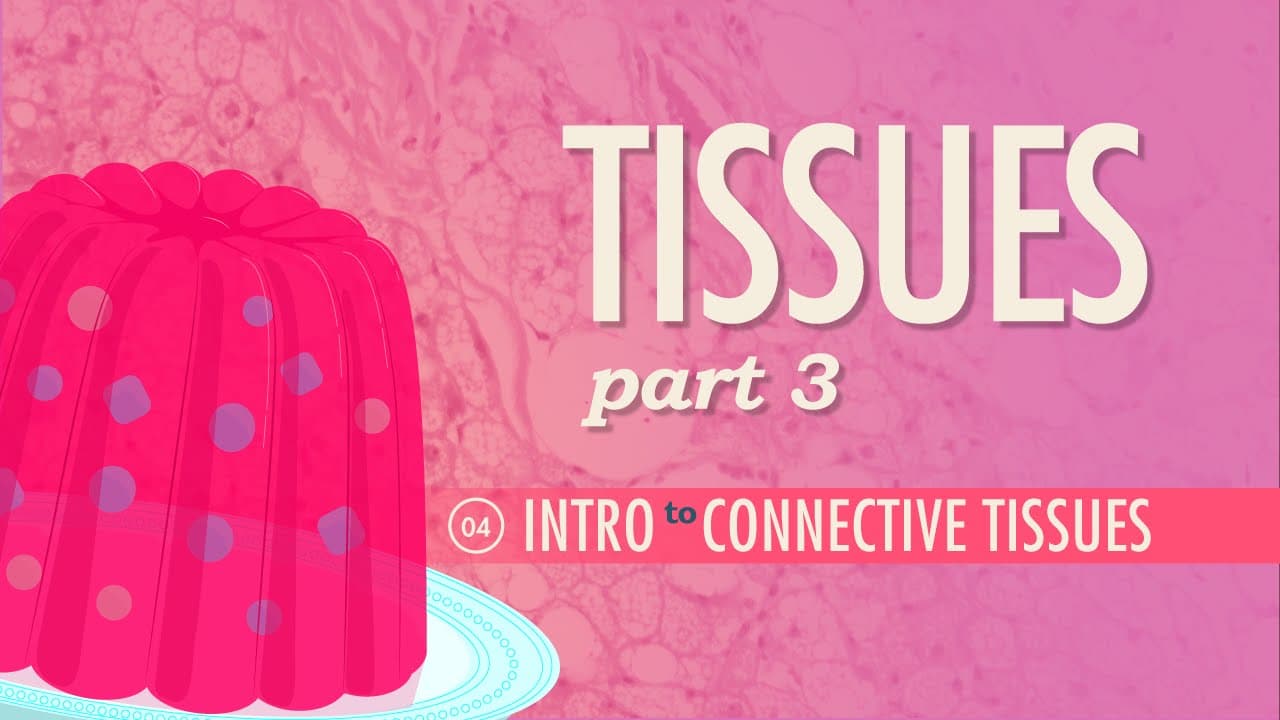
Crash Course Anatomy & Physiology #4: What Are Connective Tissues? Tissues, Part 3
TL;DR
Connective tissues are the body’s most abundant and diverse tissue type, providing support, protection, insulation, storage, and transport. The four main classes are connective tissue proper, cartilage, bone, and blood, and all develop from mesenchyme and contain an extracellular matrix. Their varied structures explain how they can form skeletons, hold organs in place, and carry nutrients, so read on to understand what unites them.
Transcript
Flo Hyman had always been a tall girl. I mean... really tall. By her 12th birthday, she was already six feet, and by 17 she’d topped out at just over 6’5’’. Initially self-conscious about her stature, she learned to use it to her advantage when she started playing volleyball. She attended the University of Houston as the school’s first female schol... Read More
Key Insights
- Connective tissues are the most abundant and diverse tissue type in the body, providing structural support, protection, and transport of nutrients.
- All connective tissues share a common origin from mesenchyme, a type of embryonic tissue that is loose and fluid.
- The extracellular matrix, mostly nonliving material, is a crucial component of connective tissues, consisting of ground substance and fibers.
- Connective tissues have varying degrees of vascularity; for example, cartilage is avascular, while skin tissue is rich in blood vessels.
- There are four main classes of connective tissues: proper, cartilage, bone, and blood, each with unique functions and structures.
- Marfan Syndrome is a genetic disorder affecting connective tissues, leading to weakened structures and potential life-threatening complications.
- Proteoglycans and glycosaminoglycans in the ground substance help form a flexible, supportive structure by trapping water and forming a glue-like matrix.
- Connective tissue cells exist in immature (-blast) and mature (-cyte) phases, with the former building the matrix and the latter maintaining it.
Install to Summarize YouTube Videos and Get Transcripts
Explore YouTube Video Summarizer or Get YouTube Transcript Extractor
Questions & Answers
Q: What are connective tissues in the human body?
Connective tissues are the most abundant and diverse of the four tissue types. They include structures and materials that support, bind, protect, insulate, store fuel, and transport substances throughout the body.
Q: What are the four main classes of connective tissue?
The four main classes are connective tissue proper, cartilage, bone, and blood. Proper connective tissue includes the tissue found in ligaments and supporting the skin, as well as fat.
Q: What characteristics do all connective tissues share?
All connective tissues develop from mesenchyme, have varying degrees of vascularity, and consist mostly of a nonliving extracellular matrix. These shared traits identify them as related despite their very different appearances and functions.
Q: What is the extracellular matrix in connective tissue?
The extracellular matrix is the mostly nonliving material between connective tissue cells. It is more important to connective tissue structure than what is inside the cells and is made mostly of ground substance and fibers.
Q: What is ground substance in connective tissue?
Ground substance is the watery, rubbery, unstructured material that fills spaces between cells. It protects delicate cells from their surroundings and remains flexible because it is mostly made of large starch and protein molecules mixed with water.
Q: How vascular are connective tissues?
Connective tissues have different degrees of vascularity, meaning blood flow. Most cartilage is avascular and has no blood vessels, while dense irregular connective tissue in the skin contains many blood vessels.
Q: What functions do fat, bone, cartilage, tendons, and blood perform?
Fat provides insulation and fuel storage while helping hold the kidneys and eyeballs in place. Bones, tendons, and cartilage bind, support, and protect organs, while blood transports hormones, nutrients, and other materials throughout the body.
Q: How does Marfan Syndrome affect connective tissue?
Marfan Syndrome is a genetic disorder involving a defect that substantially weakens connective tissue over time. It can affect bones, cartilage, tendons, blood vessel walls, joints, eyes, lungs, and the heart, and a weakened aorta can tear.
Summary & Key Takeaways
-
Definition: Connective tissue is the body’s most abundant and diverse tissue type, supporting, binding, protecting, insulating, storing fuel, and transporting materials.
-
Number: Four main classes of connective tissue are proper, cartilage, bone, and blood.
-
Definition: All connective tissues develop from mesenchyme, a loose and fluid embryonic tissue whose cells can move from place to place.
-
Compare: Most cartilage is avascular, while dense irregular connective tissue in the skin contains many blood vessels.
-
Definition: The extracellular matrix is mostly nonliving material between connective tissue cells and is more important than the contents of those cells.
-
Definition: Ground substance is a watery, rubbery, unstructured material that fills spaces between cells and protects them from their surroundings.
-
Compare: Skin is mostly connective tissue, while the brain contains very little because it is almost entirely nervous tissue.
-
Definition: Fat is proper connective tissue that provides insulation, stores fuel, holds kidneys in place, and helps keep eyeballs in their sockets.
-
Definition: Blood is connective tissue that transports hormones, nutrients, and other materials throughout the body.
-
Who: Flo Hyman died at age 31 from an aortic tear caused by undiagnosed Marfan Syndrome.
-
When: Flo Hyman helped her team win a silver medal at the 1984 Olympics and died during a game in 1986.
-
Definition: Marfan Syndrome is a genetic connective tissue disorder that weakens tissue over time and can cause serious problems in joints, eyes, lungs, and the heart.
Read in Other Languages (beta)
Share This Summary 📚
Summarize YouTube Videos and Get Video Transcripts with 1-Click
Try YouTube Summary with ChatGPT & Claude or YouTube Transcript Generator
Explore More Summaries from CrashCourse 📚

Summarize YouTube Videos and Get Video Transcripts with 1-Click
Try YouTube Summary with ChatGPT & Claude or YouTube Transcript Generator