How Does Google Gemini 2.5 Flash Image Work?
TL;DR
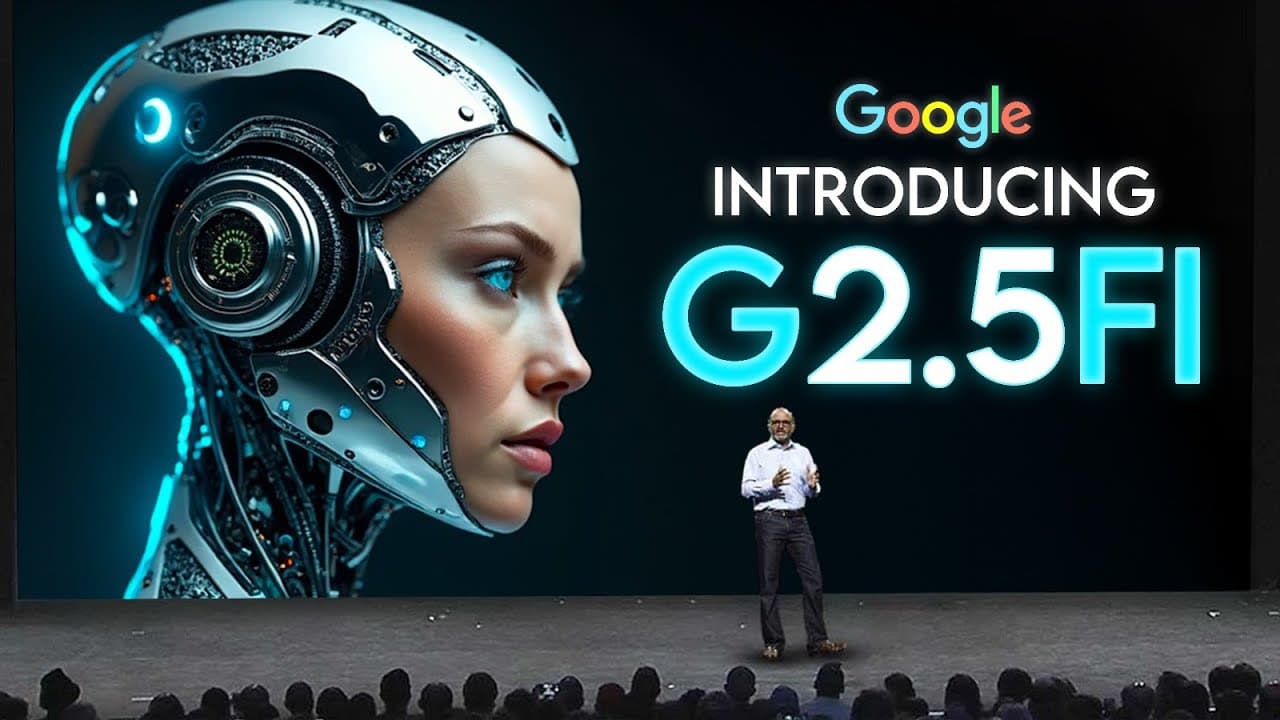
Google Gemini 2.5 Flash Image works by combining image generation and prompt-based editing with broader Gemini world knowledge, helping it preserve characters, reconstruct unseen object angles, and match lighting, reflections, shadows, and visual styles. Available through the Gemini API, Google AI Studio, and Vertex AI, it costs roughly 4 cents per generated image. Read on for specific examples, access details, and practical uses.
Transcript
Google just unveiled the real identity of NanoBanana, and it's every bit as insane as the rumors made it sound. Gemini 2.5 Flash image. That's the official name behind the so-called Nano Banana. And this thing actually understands the world. It knows how objects should look from every angle. It nails physics and reflections. It keeps characters loc... Read More
Key Insights
- Gemini 2.5 Flash Image is Google's latest AI model, known for its character consistency and real-world understanding.
- The model offers prompt-based editing, eliminating the need for manual masking or selection tools.
- It is integrated with Google AI Studio and Vertex AI, making it accessible for developers and enterprises.
- Pricing is competitive, costing about 4 cents per image, undercutting competitors like OpenAI.
- The model supports complex edits, such as style transfer and surreal image creation, with high accuracy.
- It includes an invisible synth ID watermark for provenance, ensuring images can be identified as AI-generated.
- Gemini 2.5 outperforms competitors in character preservation, object manipulation, and creative tasks.
- There is speculation about a potential higher-resolution version, possibly named Gemini 2.5 Pro.
Install to Summarize YouTube Videos and Get Transcripts
Explore YouTube Video Summarizer or Get YouTube Transcript Extractor
Questions & Answers
Q: How does Google Gemini 2.5 Flash Image work?
Gemini 2.5 Flash Image uses broader Gemini world knowledge to interpret subjects and requested changes rather than merely manipulating existing pixels. This lets it generate unseen sides of objects, maintain identities across images, and account for details such as interfaces, lighting, reflections, and shadows.
Q: What is Nano Banana, and how is it related to Gemini 2.5 Flash Image?
Nano Banana was the community nickname for the secretive image model whose outputs circulated before its release. Google later revealed that its official name is Gemini 2.5 Flash Image, and the nickname remained associated with it.
Q: How does Gemini 2.5 Flash Image maintain character consistency?
The model can take one character and place that character in multiple environments while preserving their identity. The transcript says this supports storytelling, product shots from different angles, and full catalogs that require the same subject throughout.
Q: What can users change with prompt-based editing?
Users can describe an edit instead of masking or manually selecting image regions. Demonstrated changes include blurring backgrounds, removing clothing stains or an entire person, recoloring black-and-white images, and altering a person's pose.
Q: How does Gemini 2.5 Flash Image use real-world knowledge?
When asked to flip a phone, the model can generate the device's opposite side rather than simply rotating its pixels. In demonstrations, it reproduced details such as the back of an iPhone, its apps, interface, icons, and operating-system appearance.
Q: How much does Gemini 2.5 Flash Image cost?
The stated price is $30 per 1 million output tokens. A generated image uses about 1,290 tokens, bringing the estimated cost to roughly 4 cents per image, compared with around 19 cents per generation for OpenAI's native image generation in the transcript.
Q: Where can developers and enterprises access Gemini 2.5 Flash Image?
The model is available through the Gemini API and Google AI Studio for developers. Enterprise customers can access it through Vertex AI.
Q: What practical image tasks can Gemini 2.5 Flash Image perform?
The model can create several product angles from one image, restore old photographs, colorize black-and-white shots, remove backgrounds, and make contextually smart YouTube thumbnails. It can also transfer styles while preserving identity, such as rendering the same real person as anime and then as a 3D character.
Q: What resolution does Gemini 2.5 Flash Image generate?
Gemini 2.5 Flash Image outputs are still around 1,024 by 1,024. The model can capture complex surreal concepts, but it may struggle with ultra-fine details at that resolution.
Q: Is Gemini 2.5 Flash Image better than other AI image generators?
Gemini 2.5 Flash Image outperformed competitors in almost every benchmark category discussed in the video. It led in character preservation, object manipulation, creative tasks, product recontextualization, infographics, and environment edits, but GPT-4o image generation and Qwen Image Edit still had an edge in stylization.
Q: How fast is Gemini 2.5 Flash Image for photo editing?
Some Gemini 2.5 Flash Image edits take under 40 seconds, according to the video. Comparable work could normally take hours in Photoshop, while a complete illustrated storybook demo took about 10 minutes.
Summary & Key Takeaways
-
Google's Gemini 2.5 Flash Image, nicknamed Nano Banana, is an advanced AI model that excels in maintaining character consistency and understanding real-world objects. It offers prompt-based editing and style transfer, making it a powerful tool for developers and enterprises. With competitive pricing, it challenges existing AI models in the market.
-
The model is integrated with Google AI Studio and Vertex AI, providing easy access for developers. It supports complex and creative edits, such as surreal image creation and style transfer, while maintaining high accuracy. An invisible synth ID watermark ensures AI-generated images can be identified for provenance.
-
Gemini 2.5 outperforms competitors in key areas like character preservation and object manipulation. It is significantly cheaper than rivals, costing about 4 cents per image, making it an attractive option for businesses. Speculation about a higher-resolution version suggests further advancements in the future.
Read in Other Languages (beta)
Share This Summary 📚
Summarize YouTube Videos and Get Video Transcripts with 1-Click
Try YouTube Summary with ChatGPT & Claude or YouTube Transcript Generator
Explore More Summaries from AI Revolution 📚
Summarize YouTube Videos and Get Video Transcripts with 1-Click
Try YouTube Summary with ChatGPT & Claude or YouTube Transcript Generator