Introduction to Python: Data Types and Arrays
TL;DR
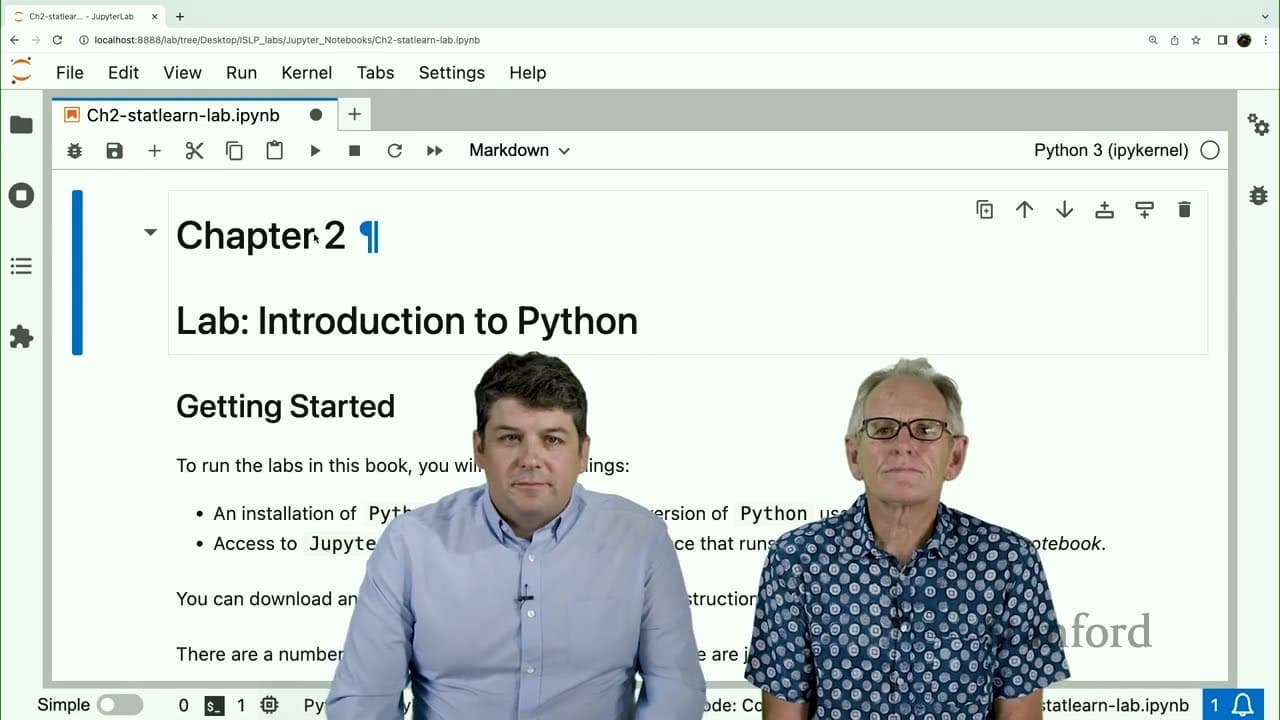
Discover the foundational concepts of Python such as data types including strings, lists, and numeric arrays. This video emphasizes the use of the NumPy library for numerical operations and highlights the importance of object attributes and methods in Python programming.
Transcript
okay so here is our first lab um this is this lab introduces some basic uh Concepts in Python um Python's a very popular programming language and and many if any of you have taken any programming classes prior to this class uh in statistical learning you'll likely have seen some python already um so that's also a warning to say that this is not a c... Read More
Key Insights
- 🥼 Python is a widely used programming language, and prior programming experience is beneficial for understanding the lab content.
- 📦 Numpy is a commonly used package in Python for numerical computations, offering efficient operations on arrays and matrices.
- 💁 In Python, objects have attributes and methods that provide additional information and functionality.
- 👻 The reshape method allows for restructuring arrays to different dimensions, but be cautious of referencing versus copying when modifying arrays.
Install to Summarize YouTube Videos and Get Transcripts
Explore YouTube Video Summarizer or Get YouTube Transcript Extractor
Questions & Answers
Q: What are some standard types of objects in Python?
Python has various types of objects, including strings, numbers, lists, and arrays. Each object type has its own set of operations and characteristics.
Q: How can we access help for a specific function in Python?
To access help for a function, you can use the question mark notation after the function name in Jupyter notebooks. This will display the function's documentation, called a docstring, providing information about its usage and parameters.
Q: What is the difference between concatenation and addition when working with strings in Python?
When adding two strings in Python, the result is concatenation, where the two strings are combined into one. This is different from addition with numbers, where the values are summed element-wise.
Q: What are numpy and pandas, and how do they relate to Python?
Numpy is a numerical library in Python, used for efficient computations with arrays and matrices. Pandas is a library for data analysis, providing data structures such as dataframes. These libraries extend Python's functionality for scientific and data-related tasks.
Summary & Key Takeaways
-
This lab introduces basic concepts in Python, focusing on numeric objects, strings, lists, and arrays.
-
Python is a popular programming language used in statistical learning, and prior programming experience is beneficial.
-
The lab uses the numpy package for numerical computations and pandas for structured data analysis.
Read in Other Languages (beta)
Share This Summary 📚
Summarize YouTube Videos and Get Video Transcripts with 1-Click
Try YouTube Summary with ChatGPT & Claude or YouTube Transcript Generator
Explore More Summaries from Stanford Online 📚
Summarize YouTube Videos and Get Video Transcripts with 1-Click
Try YouTube Summary with ChatGPT & Claude or YouTube Transcript Generator