How to Perform Inference in Bayesian Networks
TL;DR
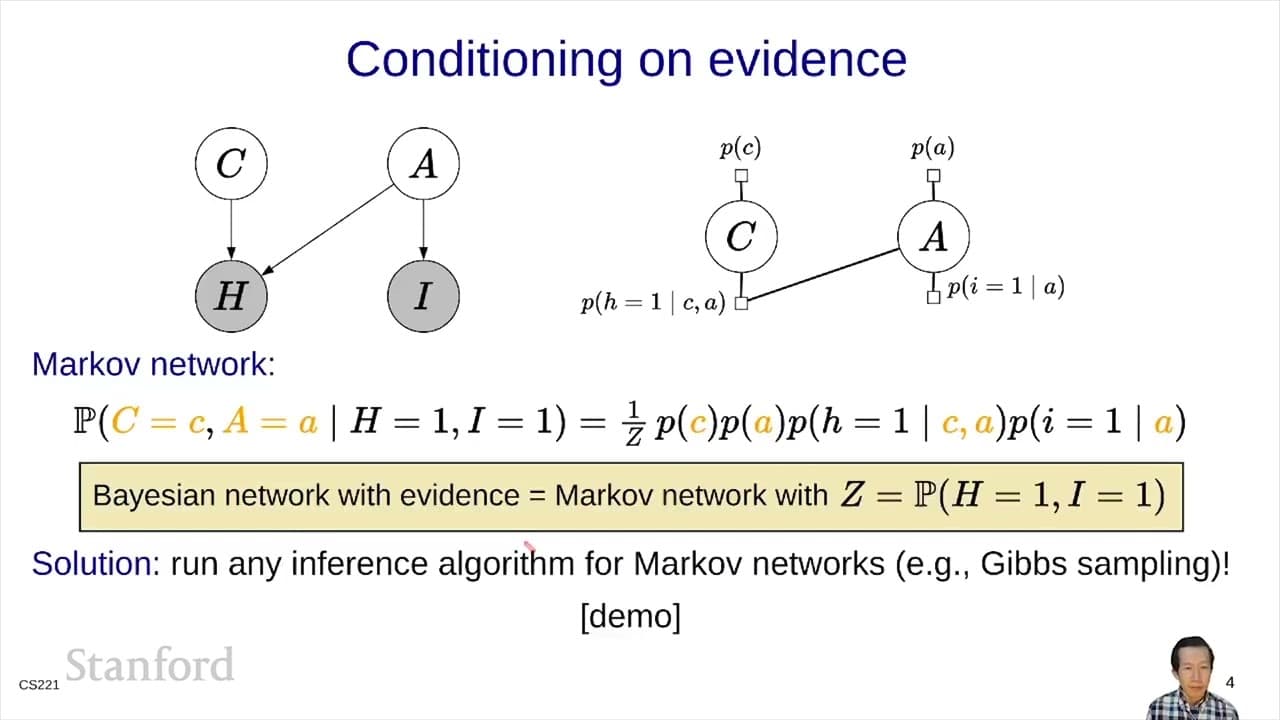
Convert Bayesian networks into Markov networks for efficient probabilistic inference. Key steps include conditioning on evidence and optimizing by removing unobserved leaves and disconnected components. This approach allows for applying various inference techniques, such as Gibbs sampling.
Transcript
hi in this module i'm going to talk about the general strategy for performing probabilistic inference injection networks so recall that the bayesian network consists of a set of random variables for example cold allergies cough and hgi and then the bayesian network defines a direct acyclic graph over these random variables that capture the qualitat... Read More
Key Insights
- 😒 Bayesian networks can be converted into Markov networks, enabling the use of various inference algorithms.
- 🧑🏭 Conditioning on evidence involves substituting the values of evidence variables into the factors.
- 🧑🏭 Unobserved leaves, such as variables not part of the evidence, can be removed from the factor graph.
- 🧑🏭 Disconnected components in the factor graph can also be discarded to optimize inference.
- 👻 Markov networks allow probabilistic inference through techniques like Gibbs sampling.
- 🧑🏭 The joint distribution of variables in a Bayesian network can be represented as factors in a factor graph.
- 📈 Markov networks provide a more intuitive approach to inference and graph operations.
Install to Summarize YouTube Videos and Get Transcripts
Explore YouTube Video Summarizer or Get YouTube Transcript Extractor
Questions & Answers
Q: What is a Bayesian network and how is it defined?
A Bayesian network is a graphical model that represents a set of random variables and their dependencies. It consists of a directed acyclic graph and local conditional distributions for each variable given its parents.
Q: How can a factor graph be derived from a Bayesian network?
The joint distribution of the variables in a Bayesian network can be factorized using the local conditional distributions. Each local conditional distribution becomes a factor, and the factors are connected in a factor graph.
Q: How can conditioning on evidence be incorporated into the inference process?
To condition on evidence, the values of the evidence variables are substituted into the factors. The resulting factor graph only includes the variables that are not part of the evidence.
Q: What can be done to optimize the inference process in Bayesian networks?
Unobserved leaves, such as variables that are not part of the evidence, can be removed from the factor graph. Additionally, disconnected components in the factor graph can be discarded.
Summary & Key Takeaways
-
Bayesian networks consist of random variables and define a qualitative and quantitative relationship between them.
-
The joint distribution of the variables in a Bayesian network can be represented as a factor graph, which can be converted into a Markov network.
-
Conditioning on evidence and removing unobserved leaves and disconnected components can optimize the inference process.
-
Markov networks allow various inference algorithms, such as Gibbs sampling, to be applied.
Read in Other Languages (beta)
Share This Summary 📚
Summarize YouTube Videos and Get Video Transcripts with 1-Click
Try YouTube Summary with ChatGPT & Claude or YouTube Transcript Generator
Explore More Summaries from Stanford Online 📚




Summarize YouTube Videos and Get Video Transcripts with 1-Click
Try YouTube Summary with ChatGPT & Claude or YouTube Transcript Generator