How ITRI Advances Robotics and Smart Manufacturing
TL;DR
ITRI advances intelligent manufacturing by converting applied research into technologies, production systems, and startup opportunities for industry. Its robotics work combines mechanical design, controls, sensors, software, machine vision, reliability testing, and system integration, with particular attention to safer human interaction, easier operation, automated production, electric mobility, autonomous vehicles, and robotic assistance for people with spinal cord injuries.
Transcript
Thank you, Dr., uh, Dasher. I'm, uh... It's my honor today, uh, to stand at, uh, Stanford University and, uh, to, uh, tell you a little bit more about what I, uh, have been doing in, uh, ITRI. Okay. Uh, pe- perhaps you see from the, uh, the poster outside, the name of, uh, the title of my talk, I decide to change a little bit because, uh, uh, the s... Read More
Key Insights
- ITRI is a nonprofit research organization whose purpose is to create economic value through technology research and development. Public funding covers a large share of its operations, while the remaining resources must be earned through industry partnerships and technology transfer.
- Technology transfer is central to ITRI's operating model because the institute cannot retain commercial profits from valuable inventions. Research outcomes are transferred to industry so companies can commercialize them, while ITRI replenishes part of its research budget through those relationships.
- Mission-oriented centers are temporary structures for turning promising technologies into new companies. Researchers are separated from their original laboratories so they can focus on commercialization, after which some join the resulting startups and others return to their former laboratories.
- Advanced manufacturing research is driven partly by an aging society, a shrinking workforce, and rising factory wages. These pressures make automation an increasingly important direction and support the expectation that robots will become more common throughout industrial production.
- Machine tools are strategically important because many products depend on them, even though the machine-tool sector does not represent the largest share of industrial revenue. ITRI therefore studies both advanced machine-tool design and the control technologies needed to operate such equipment.
- Advanced vehicle research focuses on electrified powertrains and changing automotive electronics. The work covers fully electric and hybrid approaches while examining how autonomous vehicles could reshape vehicle systems and create opportunities for an associated industrial supply chain.
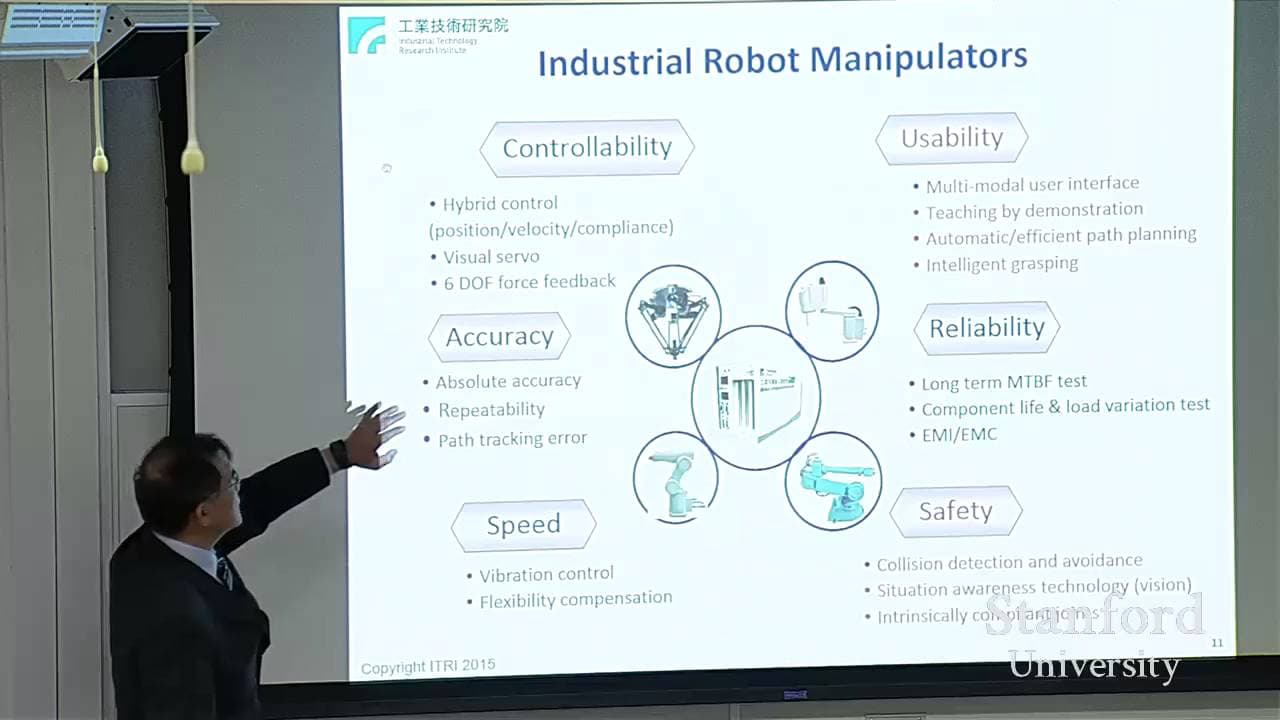
- Robotic system development requires the integration of mechanical structures, motors, electronics, software, sensors, control hardware, and application-specific environments. ITRI supports this process through specialized work in robot design, robot-based production lines, machine vision, system integration, and reliability testing.
- Robot usability and safety are becoming especially important as sensing, computing, and artificial intelligence improve. Traditional industrial robots are separated from workers by fences, while future human-robot collaboration requires better interfaces and safer ways for people and machines to share working environments.
Install to Summarize YouTube Videos and Get Transcripts
Explore YouTube Video Summarizer or Get YouTube Transcript Extractor
Questions & Answers
Q: What is ITRI's role in industrial technology development?
ITRI is a nonprofit research institute that seeks to create economic value through technology research and development. It works across a broad range of industrial fields and connects research with commercial use through partnerships and technology transfer. The institute does not keep inventions primarily to generate its own profit. Instead, it transfers useful technologies to companies that can commercialize them and develop related industries.
Q: How does ITRI connect public research with private industry?
ITRI combines government support with revenue that it must earn from industry. This arrangement creates pressure to produce research that companies can use and to transfer technology beyond the institute. When an invention has commercial value, ITRI passes it to industry rather than building its own profit around it. The model encourages applied research, industrial collaboration, and measurable economic outcomes from technical development.
Q: How does ITRI create startups from promising technologies?
ITRI can move researchers working on a promising trend into a mission-oriented center. Separating the group from its original laboratory allows it to concentrate on forming new companies without the distractions of broader laboratory responsibilities. After startups are established, some researchers may join those companies, while the remaining personnel return to their original laboratories. The approach is intended to support employment and new supply chains.
Q: Why is industrial automation becoming increasingly important?
Industrial automation is becoming more important because aging societies can reduce the available workforce while wages make factory labor increasingly expensive. These conditions create a strong incentive to place more robots in production environments. ITRI treats robotics and automation as major parts of advanced manufacturing research, aiming to develop machines and integrated production systems that can perform useful factory work with suitable accuracy, speed, reliability, usability, and safety.
Q: Why does ITRI invest in machine-tool research?
Machine tools are important because a wide range of manufactured products depends on them, even though the industry's own revenue may not dominate the broader industrial economy. Their strategic role in production makes their underlying technology valuable. ITRI therefore invests in research on advanced machine-tool design and machine-tool control, reflecting the importance that major manufacturing economies place on maintaining strong capabilities in this field.
Q: How is machine vision used to make industrial robots intelligent?
Machine vision gives robots information about their surroundings through cameras and computing. Cameras have become inexpensive, and computing resources are readily available, so production systems can use many visual sensors without excessive cost. ITRI maintains dedicated machine-vision capabilities because vision is expected to play a large role in robot intelligence, helping robotic systems perceive production environments and support more capable automated operations.
Q: What capabilities are needed to build a production-ready robot?
A production-ready robot requires more than a mechanical structure. Engineers must integrate mechanical design, motors, electronics, software, sensors, control hardware, and the surrounding application environment into a functioning system. ITRI also develops robot-based production cells and conducts reliability testing before industrial adoption. Important performance goals include accuracy, speed, controllability, usability, reliability, and safety under the conditions where the robot will actually operate.
Q: How could human-robot collaboration change factory design?
Traditional industrial robots are commonly separated from workers by fences to satisfy safety requirements. Human-robot collaboration would require robots and people to interact more directly, making usability, safety, and the human-robot interface especially important. Improvements in sensors, computing, and artificial intelligence could support this shift, but collaborative systems must still control risks while allowing workers to operate, guide, or work near robotic equipment effectively.
Summary & Key Takeaways
-
ITRI is a nonprofit research institute designed to create economic value through technology research and development. It receives public support but must also earn a large share of its operating resources through industry collaboration and technology transfer. Its technologies are passed to companies because the institute itself is not intended to profit from commercialization.
-
The Mechanical and Systems Research Laboratories concentrate on advanced manufacturing, machine tools, and advanced vehicles. Their work includes machine-tool design and control, robotics, production automation, micro and nanofabrication, electric powertrains, and automotive electronics. These priorities respond to rising labor costs, a shrinking workforce, vehicle electrification, and the emergence of autonomous driving.
-
ITRI's robotics organization connects robot design, robot-based production-line development, machine vision, and reliability testing. Its engineers integrate mechanics, motors, electronics, software, sensors, controls, and application environments. Research addresses established performance requirements such as accuracy and speed while emphasizing usability, safety, human-robot interfaces, collaborative work, and biomedical exoskeleton applications.
Read in Other Languages (beta)
Share This Summary 📚
Summarize YouTube Videos and Get Video Transcripts with 1-Click
Try YouTube Summary with ChatGPT & Claude or YouTube Transcript Generator
Explore More Summaries from Stanford Online 📚




Summarize YouTube Videos and Get Video Transcripts with 1-Click
Try YouTube Summary with ChatGPT & Claude or YouTube Transcript Generator