How to Differentiate Russian and Ukrainian Languages
TL;DR
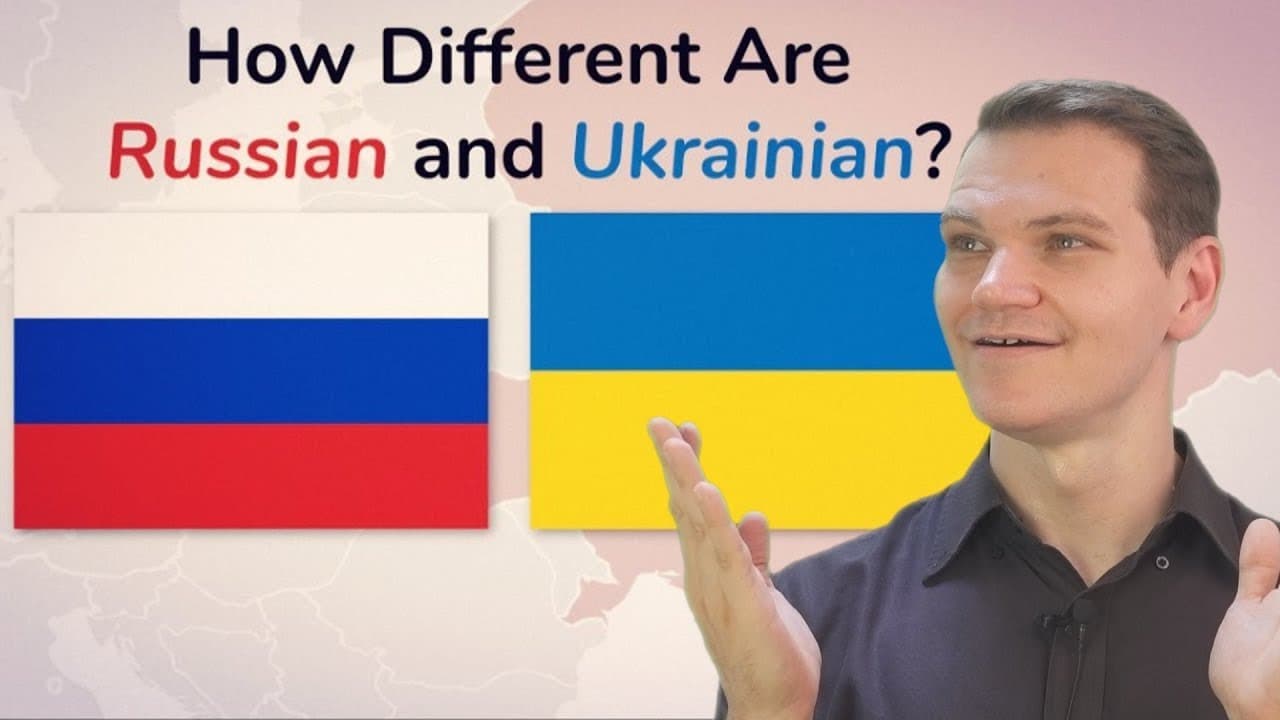
Russian and Ukrainian, despite their shared history, are distinct languages with unique vocabularies, pronunciations, and grammatical structures. While both evolved from Old East Slavic, they diverged due to different historical influences. Many Ukrainians understand Russian due to its prevalence, but the reverse is less common, especially among Russians outside Ukraine.
Transcript
Hello, everyone. Welcome to the Langfocus channel, and my name is Paul. Today, we're going to look at the differences between two languages that many people mistakenly think are the same, Russian and Ukrainian. The misconception that Russian and Ukrainian are the same might stem from the fact that Russian is widely spoken in Ukraine. The numbers di... Read More
Key Insights
- Russian and Ukrainian both originated from Old East Slavic, but historical influences caused them to diverge significantly.
- Ukrainian and Russian share about 62% lexical similarity, which is lower than Ukrainian's similarity with Polish and Belarusian.
- Both languages use the Cyrillic alphabet but have different letters and sounds, such as the Ukrainian 'г' representing 'h'.
- Russian vocabulary has been influenced by Old Church Slavonic, French, and other European languages, while Ukrainian has more Polish influences.
- Ukrainian retains the vocative case, which is largely absent in Russian except in specific contexts.
- Russian and Ukrainian grammar share similarities, but Ukrainian includes additional verb conjugations and a pluperfect tense.
- Ukrainian speakers often understand Russian due to exposure, but Russian speakers, especially outside Ukraine, may struggle with Ukrainian.
- False friends are common between the languages, where similar words have different meanings, such as 'chas' meaning 'time' in Ukrainian and 'hour' in Russian.
Install to Summarize YouTube Videos and Get Transcripts
Explore YouTube Video Summarizer or Get YouTube Transcript Extractor
Questions & Answers
Q: How do Russian and Ukrainian differ in terms of vocabulary?
Russian and Ukrainian share about 62% lexical similarity. Ukrainian has more in common with Polish, Slovak, and Belarusian. Many Ukrainian words have Polish origins, while Russian has borrowed from Old Church Slavonic and European languages. False friends, where similar words have different meanings, are also common.
Q: What are the key differences in the alphabets used by Russian and Ukrainian?
Both languages use the Cyrillic alphabet, but Ukrainian includes additional letters like 'г' for the 'h' sound, which Russian does not have. Russian uses certain letters that Ukrainian does not, such as the soft sign 'ь'. These differences contribute to distinct pronunciations and orthographies.
Q: How do the historical influences on Russian and Ukrainian differ?
Russian was heavily influenced by Old Church Slavonic and later by French and other European languages during Peter the Great's reign. Ukrainian, meanwhile, was influenced by Polish due to historical political control and proximity, especially in Western Ukraine. These influences shaped their vocabularies and linguistic structures.
Q: What grammatical features are unique to Ukrainian compared to Russian?
Ukrainian retains the vocative case, which Russian lacks except in specific contexts. Ukrainian also has a pluperfect tense and additional verb conjugations, such as the imperfective synthetic future tense. These features highlight the grammatical divergence between the two languages despite their shared roots.
Q: Why is there asymmetric intelligibility between Russian and Ukrainian speakers?
Asymmetric intelligibility arises because most Ukrainians are exposed to Russian due to historical and cultural reasons, leading to a better understanding of Russian. Conversely, Russian speakers, especially those outside Ukraine, often lack exposure to Ukrainian, making it harder for them to understand.
Q: What role does the vocative case play in Ukrainian, and how does it compare to Russian?
The vocative case in Ukrainian is used when directly addressing someone or something, a feature largely absent in Russian, which lost it except for specific words. While its usage in Ukrainian is declining, it remains part of the standard language, reflecting a grammatical distinction from Russian.
Q: How do Russian and Ukrainian handle the verb 'to be' in the present tense?
In Russian, the copula 'byt'' (to be) is not used in the present tense, whereas Ukrainian, especially in formal standard speech and western dialects, often includes it. This difference illustrates the variation in how both languages handle present-tense structures, influenced by regional dialects and historical usage.
Q: What are false friends, and how do they affect understanding between Russian and Ukrainian speakers?
False friends are words that look similar in both languages but have different meanings. For example, 'chas' means 'time' in Ukrainian and 'hour' in Russian. These can lead to misunderstandings, highlighting the importance of context and exposure in achieving mutual intelligibility between speakers of the two languages.
Summary & Key Takeaways
-
Russian and Ukrainian, both derived from Old East Slavic, have evolved into distinct languages due to different historical influences. Ukrainian has a higher lexical similarity with Polish and Belarusian than with Russian. Despite sharing the Cyrillic alphabet, their orthographies and pronunciations differ significantly.
-
The languages share grammatical structures, such as noun cases and verb conjugations, but differ in specific forms and usage. Ukrainian retains the vocative case and has additional verb conjugations not found in Russian. Vocabulary differences include numerous false friends.
-
Ukrainian speakers often understand Russian due to its widespread use in Ukraine, but the reverse is less common, leading to asymmetric intelligibility. This linguistic dynamic is influenced by historical, cultural, and political factors unique to the region.
Read in Other Languages (beta)
Share This Summary 📚
Summarize YouTube Videos and Get Video Transcripts with 1-Click
Try YouTube Summary with ChatGPT & Claude or YouTube Transcript Generator
Explore More Summaries from Langfocus 📚
Summarize YouTube Videos and Get Video Transcripts with 1-Click
Try YouTube Summary with ChatGPT & Claude or YouTube Transcript Generator