What Is the Busy Beaver Problem in Turing Machines?
TL;DR
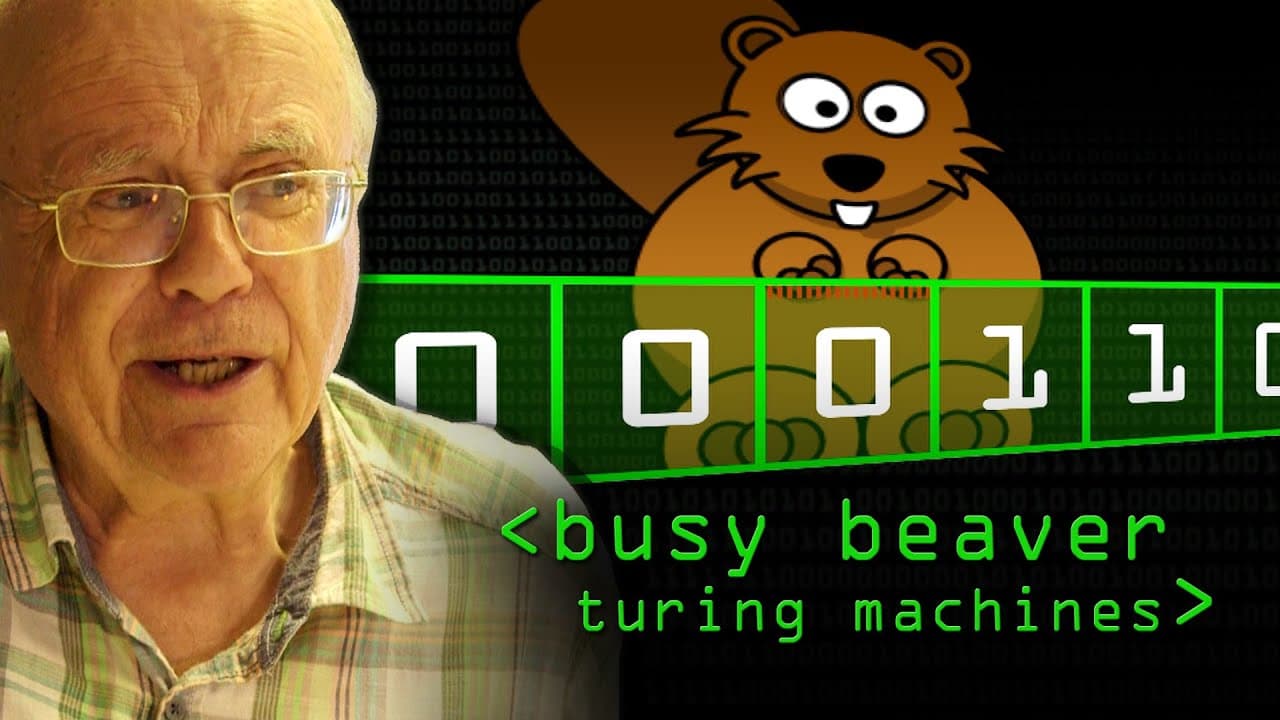
The Busy Beaver problem asks for the maximum number of ones a Turing machine can print on its tape before it halts. As the number of states in the machine increases, the complexity and number of possible configurations grow exponentially, making it a challenging computational problem that showcases the limits of computation.
Transcript
the video that I want to do today is a direct follow-up of the one I did a few weeks ago with Sean so what misguidedly entitled the most difficult program to compute question mark it was of course all about the Ackermann function today I want to show to you the busy beaver problem of the busy beaver game and it is far worse than Ackerman it was inv... Read More
Key Insights
- 🎰 The Busy Beaver problem is a challenging computational problem that explores the productivity of Turing machines.
- 💗 The complexity of the problem grows exponentially with the number of cards in a Turing machine configuration.
- 💗 The Busy Beaver problem demonstrates that some computational problems can grow faster than any computable function.
- 👋 Finding the best solution to the Busy Beaver problem requires extensive exploration and analysis of different Turing machine configurations.
- ❓ The problem highlights the limitations and potential undecidability of certain computational problems.
- 🦡 The Busy Beaver problem serves as a teaching example to illustrate the worst-case scenarios in computer programs.
- 🎰 Despite its seemingly pointless nature, the problem provides valuable insights into the behavior and potential complexity of Turing machines.
Install to Summarize YouTube Videos and Get Transcripts
Explore YouTube Video Summarizer or Get YouTube Transcript Extractor
Questions & Answers
Q: What is the Busy Beaver problem?
The Busy Beaver problem revolves around determining the maximum number of ones that can be printed on a tape by a Turing machine before it halts. It measures the productivity of the machine.
Q: Why is the Busy Beaver problem important in the context of Turing machines?
The Busy Beaver problem illustrates the behavior and limitations of Turing machines. It demonstrates how some Turing machines can loop indefinitely, while others can produce a finite number of ones before halting.
Q: How does the complexity of the Busy Beaver problem change with the number of cards in a Turing machine?
As the number of cards in a Turing machine increases, the complexity of the Busy Beaver problem grows exponentially. Finding the best solution becomes more challenging due to the larger number of possible machine configurations.
Q: How does the Busy Beaver problem compare to Ackermann functions?
The Busy Beaver problem grows faster than any computable function, including Ackermann functions. It leads to exponentially larger numbers and demonstrates the potential complexity of certain computational problems.
Summary & Key Takeaways
-
The Busy Beaver problem is related to Turing machines and asks for the maximum number of ones printed on the tape by a given machine.
-
Turing machines are formulated as a game, and the goal is to find the Turing machine that prints the most ones before halting.
-
The number of possible Turing machines for a specific number of cards grows exponentially, and finding the best solution becomes more complex with each additional card.
Read in Other Languages (beta)
Share This Summary 📚
Summarize YouTube Videos and Get Video Transcripts with 1-Click
Try YouTube Summary with ChatGPT & Claude or YouTube Transcript Generator
Explore More Summaries from Computerphile 📚





Summarize YouTube Videos and Get Video Transcripts with 1-Click
Try YouTube Summary with ChatGPT & Claude or YouTube Transcript Generator