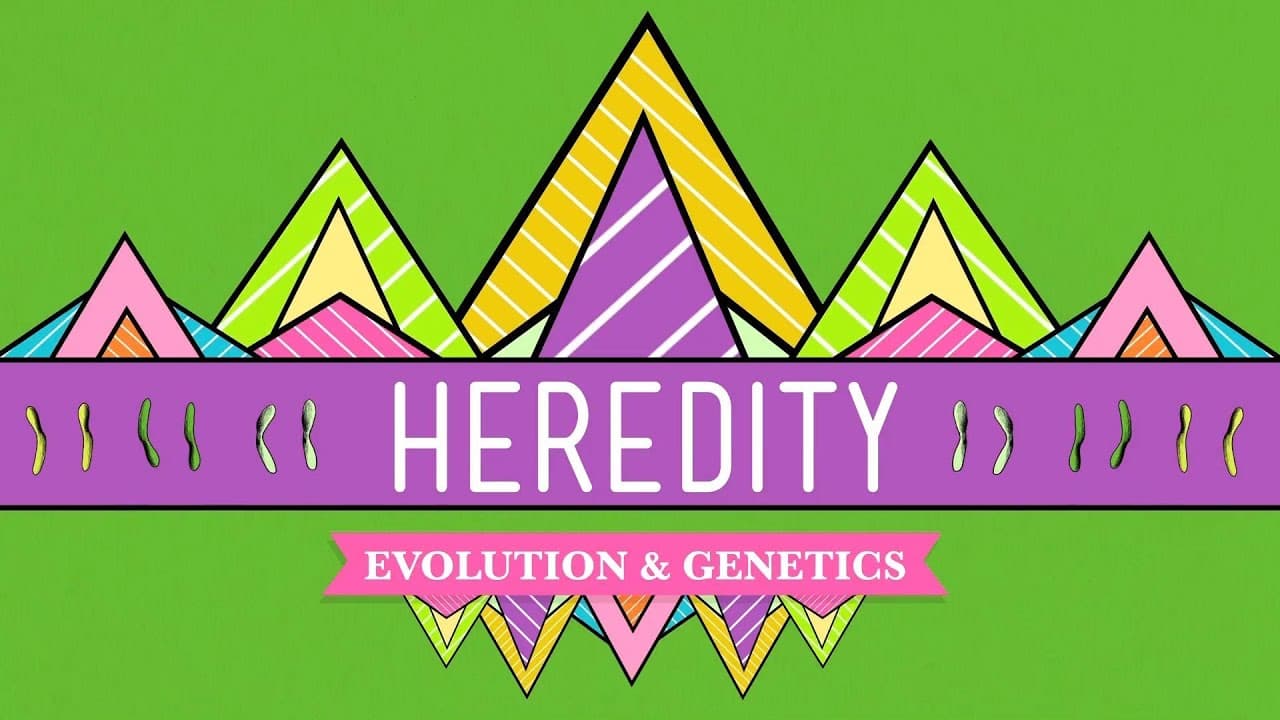
How Does Heredity Work?, Crash Course Biology #9
TL;DR
Heredity works by passing genetic traits from parents to offspring through DNA organized into chromosomes. Human cells have 23 chromosome pairs, and offspring inherit one version, or allele, of a gene from each parent. Gregor Mendel’s pea-plant experiments revealed predictable inheritance patterns involving dominant and recessive alleles. Read on to understand chromosomes, genes, Mendelian traits, polygenic traits, pleiotropy, and sex-linked inheritance.
Transcript
So, I have this brother, John. You may have heard of him. JOHN: Hi there! HANK: As it happens, John and I have the exact same parents. JOHN: Yes, Mom and Dad Green. HANK: And since we have the same parents, it's to be expected that John and I would have similar physical characteristics because the source of our DNA is exactly the same. JOHN: Hank a... Read More
Key Insights
- Heredity is the transmission of genetic traits from parents to offspring.
- Gregor Mendel's experiments with pea plants revealed patterns of inheritance.
- Chromosomes are structures that carry DNA from parents to children.
- A gene is a DNA segment that determines a specific trait.
- Mendelian traits are determined by a single gene, such as pea flower color.
- Polygenic traits involve multiple genes working together to express a trait.
- Pleiotropic genes affect multiple traits, like earwax consistency and body odor.
- Sex-linked inheritance involves traits linked to sex chromosomes, affecting gender-specific traits.
Install to Summarize YouTube Videos and Get Transcripts
Explore YouTube Video Summarizer or Get YouTube Transcript Extractor
Questions & Answers
Q: What is heredity in genetics, and how does it work?
Heredity is the passing of genetic traits from parents to offspring. DNA is organized into chromosomes, and genes are sections of DNA that contain information determining traits. Offspring inherit genetic material from both parents.
Q: What did Gregor Mendel discover about heredity?
In the mid-1800s, Austrian monk Gregor Mendel crossed pea plants and observed which traits were passed on. His experiments showed that inheritance follows particular patterns and provided a framework for understanding how traits move from one generation to another.
Q: What are chromosomes and genes?
Chromosomes are the form DNA takes so it can be passed from parent to child, and human cells have 23 pairs. A gene is a section of DNA at a specific chromosome location that contains information determining a trait.
Q: What is the difference between diploid and haploid cells?
Somatic cells are diploid, meaning they contain two chromosome sets, with one inherited from each parent. Gametes, sperm and egg cells, are haploid and contain only one set. Two complementary haploid cells can join to provide the chromosome pairs needed for offspring.
Q: What is a Mendelian trait?
A Mendelian trait is a single trait determined by a single gene. Pea-flower color is one example studied by Mendel, while human earwax consistency is another. The earwax gene is located on chromosome 16.
Q: How are wet and dry earwax inherited?
A person receives one earwax-determining allele from each parent, and the allele each parent passes on is random. One version produces wet earwax and another produces dry earwax. At one exact position in the gene sequence, glycine corresponds to wet earwax and arginine to dry earwax.
Q: How do polygenic and pleiotropic traits differ?
A polygenic trait reflects the combined activity of multiple genes. Pleiotropy is the reverse type of relationship: one gene influences the expression of multiple traits. Most physical traits described here are polygenic, while single-gene traits are comparatively uncommon.
Q: How do dominant and recessive alleles affect inheritance?
When two alleles determine the outcome of a specific trait, one may be dominant and the other recessive. The dominant allele masks the recessive allele when both are present. A recessive trait is expressed when no dominant allele suppresses it.
Summary & Key Takeaways
-
Heredity involves the passing of traits from parents to offspring, primarily through chromosomes and genes. Gregor Mendel's work with pea plants laid the groundwork for understanding how traits are inherited, revealing patterns like dominant and recessive alleles. A single gene can influence multiple traits, known as pleiotropy, and sex-linked inheritance explains certain gender-specific traits.
-
Chromosomes carry genetic information from parents to offspring, with humans having 23 pairs. Genes, located on chromosomes, determine specific traits, while some traits are influenced by multiple genes, termed polygenic. Mendelian traits are governed by a single gene, such as earwax consistency, which is determined by alleles inherited from each parent.
-
Sex-linked inheritance involves traits linked to the sex chromosomes, with men having XY and women XX chromosomes. Certain traits, like early balding, are linked to the X chromosome and are more commonly expressed in men. Understanding heredity helps explain the genetic basis for many physical and physiological traits.
Read in Other Languages (beta)
Share This Summary 📚
Summarize YouTube Videos and Get Video Transcripts with 1-Click
Try YouTube Summary with ChatGPT & Claude or YouTube Transcript Generator
Explore More Summaries from CrashCourse 📚



Summarize YouTube Videos and Get Video Transcripts with 1-Click
Try YouTube Summary with ChatGPT & Claude or YouTube Transcript Generator