How Does Semi-Supervised Learning Work?
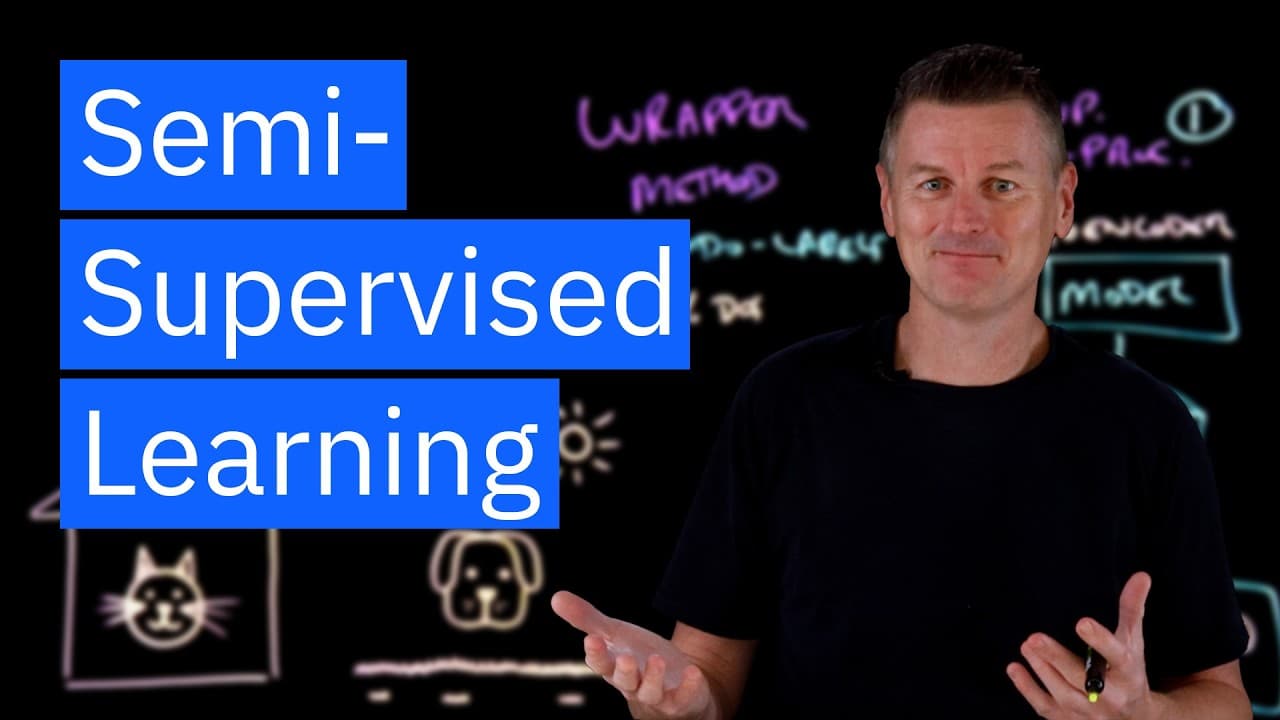
TL;DR
Semi-supervised learning combines scarce labeled examples with abundant unlabeled data to expand training context and help a model generalize better. Techniques include assigning high-confidence pseudo-labels, extracting useful features with an autoencoder, grouping similar samples through clustering, and sending uncertain cases to human annotators through active learning.
Transcript
What is semi-supervised learning? Well, let me give you an example. So consider building an AI model that can classify pictures of cats and dogs. If you give the model a picture of an animal, it will tell you if that picture shows a cat or if it shows a dog. Now, we can build a model like that using a process called supervised learning, not semi ju... Read More
Key Insights
- Semi-supervised learning is a training approach that incorporates unlabeled data alongside labeled examples. It is useful when labeled data is scarce but unlabeled data is relatively abundant, allowing the model to gain more training context without requiring every example to be manually annotated.
- Supervised learning is dependent on labeled examples that provide ground truth. During training, a model identifies distinguishing patterns, evaluates its predictions with a loss function, and adjusts its weights using techniques such as gradient descent to improve future classifications.
- Data labeling is a potentially expensive bottleneck because it requires manual work. Basic classification labels identify whether an image contains a cat or dog, while image segmentation labels require precise pixel boundaries, and specialized fields such as genetic sequencing or protein classification also require domain expertise.
- Overfitting is a failure to generalize from training data to new, unseen examples. If cats are mostly photographed indoors and dogs outdoors in a limited dataset, a model may incorrectly use the setting instead of meaningful animal features when making its classifications.
- The wrapper method is an iterative process that trains a base model on labeled data and uses it to assign pseudo-labels to unlabeled samples. High-confidence pseudo-labels are combined with ground-truth labels, and the larger dataset is used to retrain the model.
- Pseudo-labels are model-generated labels that are typically probabilistic rather than deterministic. A prediction can include a confidence level, such as an 85% probability that an image shows a dog, and only high-confidence predictions are treated like ground truth during retraining.
- Unsupervised pre-processing is a method that uses an autoencoder to create compact, meaningful image representations. By extracting features such as edges, shapes, and textures from unlabeled images, it can help a supervised model generalize more effectively from limited labeled data.
- Active learning is a human-in-the-loop method that sends low-confidence, ambiguous samples to human annotators. It focuses manual labeling on examples the model cannot classify reliably, and it can be combined with feature extraction, clustering, pseudo-labeling, and iterative retraining.
Install to Summarize YouTube Videos and Get Transcripts
Explore YouTube Video Summarizer or Get YouTube Transcript Extractor
Questions & Answers
Q: What is semi-supervised learning?
Semi-supervised learning is a method that trains an AI model with both labeled and unlabeled data. The labeled examples provide ground truth, while the more abundant unlabeled examples expand the available training context. This combination is intended to create a better-fitting model and reduce dependence on the time-consuming manual work required to label every sample.
Q: Why is semi-supervised learning useful when labels are scarce?
Semi-supervised learning is useful because producing labels can be tedious, time consuming, and dependent on specialized expertise. Simple image classification requires someone to identify cats and dogs, while image segmentation requires precise pixel boundaries. Genetic sequencing and protein classification demand even more specific expertise, so using abundant unlabeled data reduces the need for additional manual annotation.
Q: How can limited labeled data cause overfitting?
Limited labeled data can cause a model to memorize misleading patterns that happen to appear in its training set. If most cat photos were taken indoors and most dog photos outdoors, the model might associate outdoor scenes with dogs. It could then classify any outdoor image as a dog, even when the image actually contains a cat.
Q: How does the wrapper method use unlabeled data?
The wrapper method begins with a base model trained on labeled data. That model predicts labels for unlabeled samples and attaches confidence levels to those predictions. High-confidence pseudo-labels are combined with the original ground-truth examples, and the model is retrained on the enlarged dataset. Repeating this cycle can improve subsequent pseudo-label quality as classification improves.
Q: What is a pseudo-label in semi-supervised learning?
A pseudo-label is a label predicted by a model for an otherwise unlabeled example. It is typically probabilistic, meaning it includes a confidence level rather than presenting the classification as completely certain. For example, the model might report an 85% chance that an image contains a dog. High-confidence pseudo-labels can be used during retraining like ground-truth labels.
Q: How does an autoencoder support semi-supervised learning?
An autoencoder supports unsupervised pre-processing by learning compact and meaningful representations of images. It captures essential features such as edges, shapes, and textures from unlabeled examples. Those extracted features can then support supervised training, helping a model generalize more effectively even when the available set of manually labeled examples is limited.
Q: How do clustering methods label unlabeled examples?
Clustering methods apply the assumption that similar data points are likely to belong to the same class. An algorithm such as K-means groups labeled and unlabeled points according to similarity. If unlabeled examples occupy the same cluster as labeled cat images, those unlabeled examples can receive cat pseudo-labels and contribute to the model's training data.
Q: When should active learning involve human annotators?
Active learning should involve human annotators when a model assigns low-confidence pseudo-labels and cannot reliably classify particular samples. Instead of asking people to label the entire dataset, the method refers only ambiguous examples for manual review. This concentrates human effort where it is most needed and is especially valuable when annotation requires specialized domain expertise.
Summary & Key Takeaways
-
Supervised learning trains a model on labeled examples, using a loss function to evaluate predictions and techniques such as gradient descent to update model weights. Labels may identify an entire image as a cat or dog, or mark precise object boundaries through image segmentation, making annotation potentially tedious and time consuming.
-
Limited labeled data can cause overfitting, where a model performs well on its training data but fails on unseen examples. A model might associate outdoor backgrounds with dogs if training photos show cats indoors and dogs outdoors. Semi-supervised learning adds unlabeled examples to provide broader context without requiring every sample to be manually labeled.
-
Semi-supervised techniques can work together as a training pipeline. Unsupervised pre-processing extracts meaningful features, clustering groups similar labeled and unlabeled samples, and wrapper methods retrain models using confident pseudo-labels. Active learning then directs ambiguous, low-confidence samples to human annotators, concentrating specialized manual effort where the model needs it most.
Read in Other Languages (beta)
Share This Summary 📚
Summarize YouTube Videos and Get Video Transcripts with 1-Click
Try YouTube Summary with ChatGPT & Claude or YouTube Transcript Generator
Explore More Summaries from IBM Technology 📚

Summarize YouTube Videos and Get Video Transcripts with 1-Click
Try YouTube Summary with ChatGPT & Claude or YouTube Transcript Generator