How to Reverse Continuous-Time Signal Waveforms
TL;DR
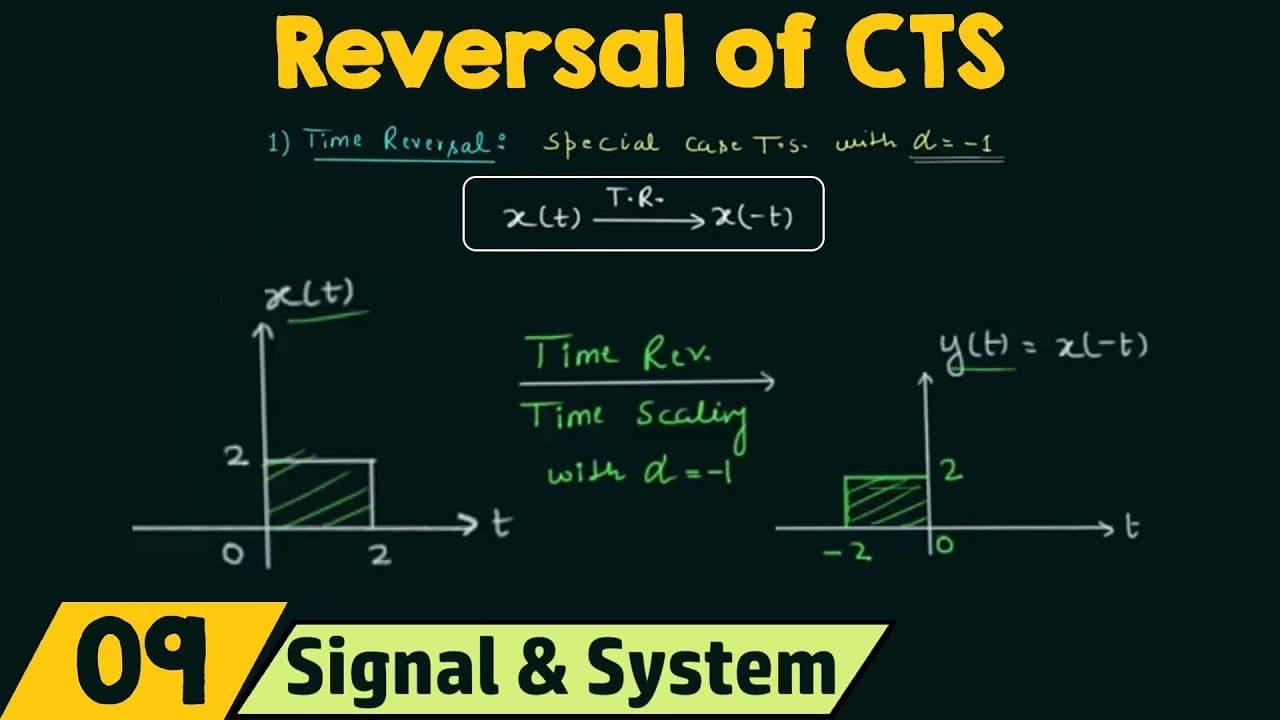
Reverse a continuous-time waveform in time by replacing t with -t, which reflects x(t) about the y-axis while preserving its amplitudes. Time reversal is time scaling with α = -1; amplitude reversal instead produces -x(t), reflecting the waveform about the x-axis without changing its time positions. Read on for the interval calculations, folding method, and the crucial difference between these two operations.
Transcript
in this lecture I will explain reversal of continuous time signals there are two types of reversals there are two types of reversals and the first type is time reversal the first type is time reversal and the second type is amplitude reversal time reversal is a special case of time scaling with Alpha equal to minus1 time reversal is a special case ... Read More
Key Insights
- Time reversal is the transformation of x(t) into x(-t), obtained by replacing every occurrence of the time variable t with -t. It changes the waveform's time locations while preserving all original amplitude values.
- Time reversal is a special case of time scaling in which the scaling factor alpha equals -1. Starting from y(t) = x(alpha t), substituting alpha = -1 directly gives the reversed signal y(t) = x(-t).
- The geometric result of time reversal is reflection about the y-axis. A waveform located on the positive-time side moves to the corresponding negative-time side, making the new waveform a mirror image of the original.
- Time reversal is also called folding or reflection because x(-t) can be drawn by folding the graph of x(t) about the y-axis. This graphical method avoids repeating the full piecewise calculation for every problem.
- Multiplying or dividing an inequality by -1 reverses its inequality sign. This rule converts the time conditions of x(t) into the correct conditions for x(-t), such as moving the interval from 0 through 2 to -2 through 0.
- Amplitude reversal is the transformation of x(t) into -x(t). It is a special case of amplitude scaling with beta equal to -1, based on the general scaling relation y(t) = beta x(t).
- The geometric result of amplitude reversal is reflection about the x-axis. Time positions remain unchanged, while each amplitude is multiplied by -1, so an amplitude of 2 becomes -2 over the same time interval.
- The distinction between the reversals is the axis of reflection. Time reversal folds a waveform about the y-axis and preserves amplitude values, while amplitude reversal folds it about the x-axis and preserves the original time positions.
Install to Summarize YouTube Videos and Get Transcripts
Explore YouTube Video Summarizer or Get YouTube Transcript Extractor
Questions & Answers
Q: What is time reversal of a continuous-time signal?
Time reversal transforms x(t) into x(-t) by replacing t with -t. It preserves the signal’s amplitude values but reverses their time positions, producing a reflection about the y-axis.
Q: How is time reversal related to time scaling?
The general time-scaling relation is y(t) = x(αt). Setting α = -1 gives y(t) = x(-t), so time reversal is a special case of time scaling.
Q: How do you draw the time-reversed waveform x(-t)?
Reflect the waveform x(t) about the y-axis. Each point moves to the corresponding location on the opposite side of t = 0 while retaining the same amplitude.
Q: Why is time reversal also called folding or reflection?
The graph of x(-t) is the mirror image of x(t) about the y-axis. Therefore, the operation can be performed graphically by folding or reflecting the original waveform around that axis.
Q: How does time reversal affect a rectangular signal from t = 0 to t = 2?
If x(t) has amplitude 2 from t = 0 through t = 2 and is zero elsewhere, x(-t) has amplitude 2 from t = -2 through t = 0. The rectangle moves to the negative-time side without changing its amplitude.
Q: Why do inequality signs reverse when calculating x(-t)?
The time conditions for x(-t) contain -t, so they are divided by -1 to solve for t. Multiplying or dividing an inequality by a negative number reverses its direction, converting the interval from 0 through 2 to -2 through 0.
Q: What is amplitude reversal of a continuous-time signal?
Amplitude reversal transforms x(t) into -x(t) by multiplying every amplitude by -1. It is amplitude scaling with β = -1, and it reflects the waveform about the x-axis while leaving all time positions unchanged.
Q: What is the difference between time reversal and amplitude reversal?
Time reversal produces x(-t), preserves amplitude values, and reflects the waveform about the y-axis. Amplitude reversal produces -x(t), preserves time positions, and reflects the waveform about the x-axis; for example, an amplitude of 2 becomes -2 over the same interval.
Summary & Key Takeaways
-
Time reversal is performed by replacing the time variable t with -t, so an original signal x(t) becomes x(-t). It is time scaling with the scaling factor alpha equal to -1. The resulting waveform has the same amplitudes but appears as the original waveform's mirror image about the y-axis.
-
For a rectangular signal with amplitude 2 from t = 0 through t = 2 and zero elsewhere, time reversal moves the nonzero interval to t = -2 through t = 0. Dividing inequalities by -1 reverses their directions, which algebraically explains the waveform's reflection about the y-axis.
-
Amplitude reversal changes x(t) into -x(t) by applying amplitude scaling with beta equal to -1. Time locations remain unchanged, while every amplitude is multiplied by -1. Thus, a value of 2 becomes -2 over the same interval, and the waveform is reflected about the x-axis.
Read in Other Languages (beta)
Share This Summary 📚
Summarize YouTube Videos and Get Video Transcripts with 1-Click
Try YouTube Summary with ChatGPT & Claude or YouTube Transcript Generator
Explore More Summaries from Neso Academy 📚





Summarize YouTube Videos and Get Video Transcripts with 1-Click
Try YouTube Summary with ChatGPT & Claude or YouTube Transcript Generator