What Are Intelligent Agents in AI?
TL;DR
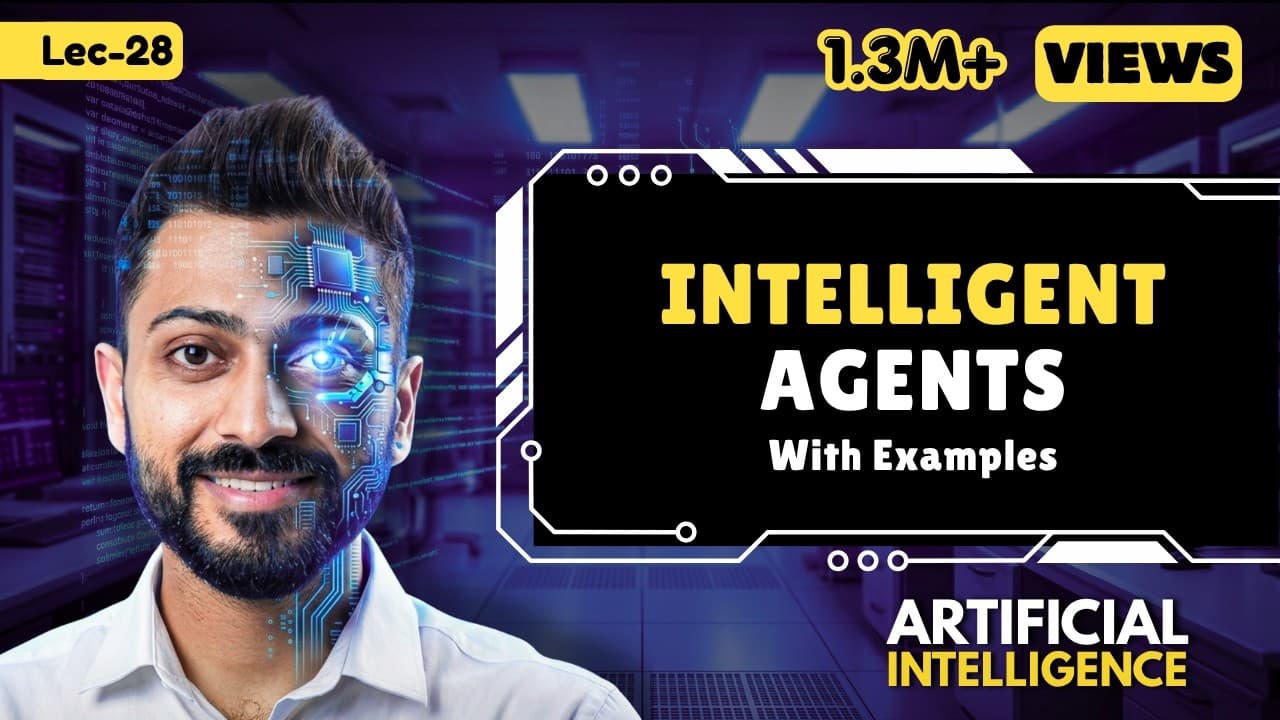
Intelligent agents in AI are entities like humans, machines, or programs that perceive their environment through sensors and act upon it using effectors. They aim to achieve high performance and rational actions through a process of perception, decision-making, and action. This concept is crucial for developing autonomous systems like robots and self-driving cars.
Transcript
Hello friends! Welcome to Gate Smashers In today's video we're going to discuss What is an agent? or you can say it Intelligent agent because main aim of Artificial intelligence is to how can we build intelligent agent? and it is one of the most important topics in AI So first if we talk about what is an agent? Agent is anything like Human Being is... Read More
Key Insights
- An agent is an entity that perceives its environment and acts upon it.
- Intelligent agents can be humans, machines, or programs.
- Agents use sensors to perceive the environment and effectors to perform actions.
- The PEAS model (Performance, Environment, Actions, Sensors) categorizes agent design.
- High performance and rational actions are primary goals of intelligent agents.
- Autonomous systems, like self-driving cars, rely on intelligent agent principles.
- Different types of agents include simple reflex, model-based, goal-based, utility-based, and learning agents.
- Intelligent agents aim to optimize actions based on past and current perceptions.
Install to Summarize YouTube Videos and Get Transcripts
Explore YouTube Video Summarizer or Get YouTube Transcript Extractor
Questions & Answers
Q: How do intelligent agents perceive their environment?
Intelligent agents perceive their environment using sensors, which can be physical devices like cameras and microphones in machines or natural senses like eyes and ears in humans. These sensors collect data from the environment, which the agent then processes to make informed decisions and perform actions.
Q: What is the PEAS model in intelligent agents?
The PEAS model stands for Performance, Environment, Actions, and Sensors. It is a framework used to design intelligent agents by defining their objectives (performance), the context they operate in (environment), the tasks they can perform (actions), and the means through which they perceive their surroundings (sensors).
Q: What are the main goals of intelligent agents?
The main goals of intelligent agents are to achieve high performance and rational actions. This involves making decisions that optimize outcomes based on current and historical perceptions. Intelligent agents aim to operate autonomously, efficiently, and effectively, ensuring that their actions are both appropriate and beneficial within their environment.
Q: What types of intelligent agents exist in AI?
In AI, intelligent agents are categorized into five main types: simple reflex agents, model-based reflex agents, goal-based agents, utility-based agents, and learning agents. Each type has different capabilities and complexities, ranging from basic reflex actions to sophisticated learning and decision-making processes.
Q: How do intelligent agents perform actions?
Intelligent agents perform actions using effectors, which are mechanisms that allow them to interact with and alter their environment. Actions are based on decisions made from processing sensory inputs, and can range from physical movements in robots to computational outputs in software programs.
Q: What role do intelligent agents play in autonomous systems?
Intelligent agents are fundamental to autonomous systems, providing the ability to perceive, decide, and act independently. They enable systems like self-driving cars and robots to operate without human intervention by processing environmental data and executing actions that achieve desired outcomes efficiently and safely.
Q: Why is perception important for intelligent agents?
Perception is crucial for intelligent agents as it provides the necessary information about the environment, enabling them to make informed decisions. Without accurate and timely perception, agents cannot effectively assess situations or determine appropriate actions, leading to suboptimal or incorrect outcomes.
Q: How do intelligent agents use historical data?
Intelligent agents use historical data to enhance decision-making by comparing current situations with past experiences. This allows them to identify patterns, predict outcomes, and choose actions that have previously led to successful results, thereby improving their performance and achieving more rational and optimized actions.
Summary & Key Takeaways
-
Intelligent agents are systems that perceive their environment through sensors and act upon it using effectors. They aim for high performance and rational actions by processing perceptions and making decisions. This framework is essential for developing autonomous systems like robots and self-driving cars, which operate independently by sensing their surroundings and executing appropriate actions.
-
The PEAS model is crucial for designing intelligent agents, focusing on performance, environment, actions, and sensors. This model helps in creating agents that can operate autonomously, making decisions based on current and historical data. Intelligent agents are categorized into types such as simple reflex, model-based, goal-based, utility-based, and learning agents.
-
Intelligent agents in AI strive to achieve optimized and rational actions. They use a combination of current and past perceptions to make decisions and perform actions that alter their environment. This concept is fundamental in artificial intelligence, enabling the creation of machines that can function autonomously like humans.
Read in Other Languages (beta)
Share This Summary 📚
Summarize YouTube Videos and Get Video Transcripts with 1-Click
Try YouTube Summary with ChatGPT & Claude or YouTube Transcript Generator
Explore More Summaries from Gate Smashers 📚





Summarize YouTube Videos and Get Video Transcripts with 1-Click
Try YouTube Summary with ChatGPT & Claude or YouTube Transcript Generator