How AI Empowers Patients in Healthcare
TL;DR
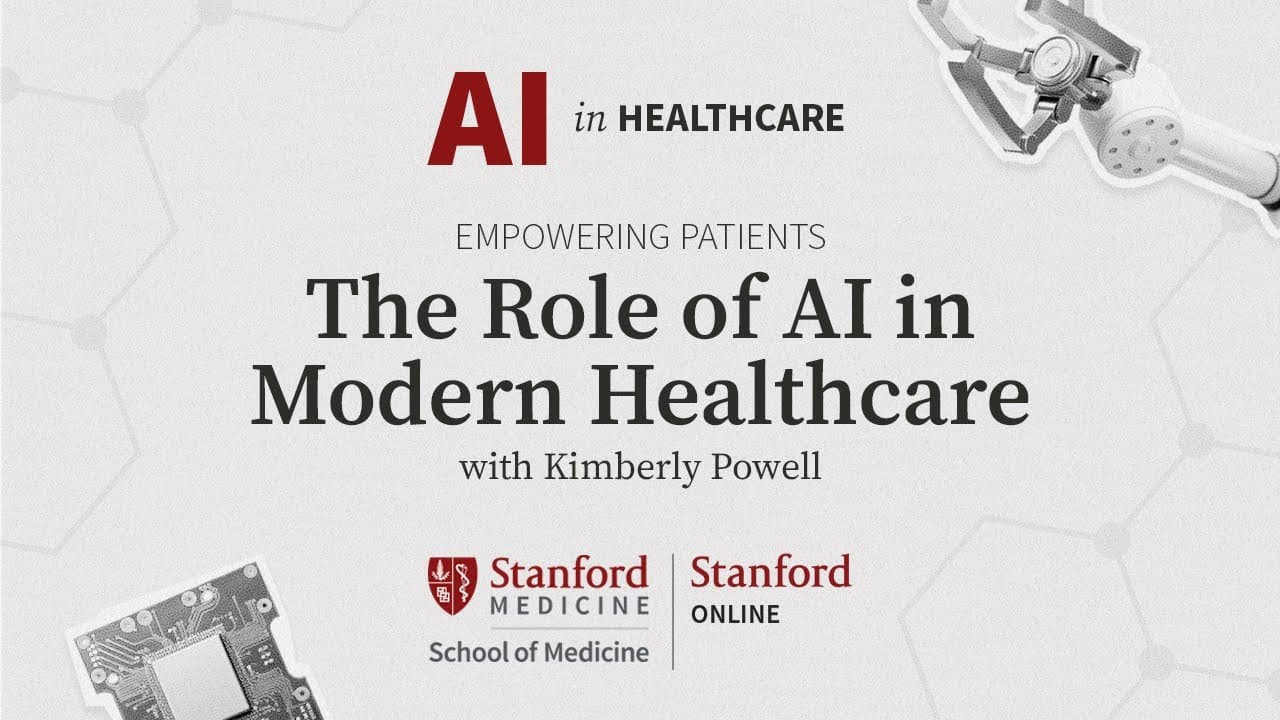
AI advancements are transforming healthcare by empowering patients through more sophisticated interactions and personalized care. These technologies offer new tools for clinicians and patients, such as chat models that understand context and robotics that enhance clinical efficiency. The integration of AI in healthcare aims to improve patient outcomes, streamline operations, and address challenges like privacy and compliance.
Transcript
JUSTIN NORDEN: Welcome back to the Stanford Healthcare AI podcast. We're so excited to be joined by Kimberly Powell, who's been leading healthcare efforts at NVIDIA for almost the last two decades. We'll get into a lot more of what that means in a second. But unless you're living under a rock, NVIDIA is the largest company ever today, over $4 trill... Read More
Key Insights
- AI models are increasingly used by patients to understand their health data, improving their engagement during clinical visits.
- Large language models introduce reasoning and memory, enabling more personalized patient care.
- Health queries are shifting from traditional search engines to AI models, reflecting a change in patient behavior.
- The integration of AI with EHR systems can streamline clinical workflows and enhance decision-making.
- NVIDIA is leading efforts to enable AI models to run efficiently in local environments, addressing privacy concerns.
- Vision and ambient listening systems are emerging as crucial tools in healthcare settings.
- Robotics and digital agents are expected to revolutionize hospital operations and surgical procedures.
- AI is poised to democratize healthcare, making advanced tools accessible to patients and clinicians alike.
Install to Summarize YouTube Videos and Get Transcripts
Explore YouTube Video Summarizer or Get YouTube Transcript Extractor
Questions & Answers
Q: How does AI empower patients in healthcare?
AI empowers patients by providing sophisticated tools that enhance their understanding of health data and improve engagement during clinical visits. Large language models introduce reasoning and memory, allowing for personalized interactions and more informed decision-making. This shift enables patients to be more proactive in managing their health, ultimately leading to better outcomes.
Q: What role do large language models play in patient care?
Large language models play a crucial role in patient care by offering reasoning and memory capabilities, which allow for more personalized and context-aware interactions. These models can remember patient-specific information, ask relevant questions, and provide tailored advice, enhancing the overall quality of care and patient engagement.
Q: Why are health queries shifting from search engines to AI models?
Health queries are shifting from traditional search engines to AI models because AI provides more context-aware and personalized responses. Patients find AI models more effective in understanding their specific health concerns, as these models can engage in interactive dialogues and offer insights that are more relevant and tailored to individual needs.
Q: How is NVIDIA contributing to AI advancements in healthcare?
NVIDIA is contributing to AI advancements in healthcare by developing efficient models that can run in local environments, addressing privacy and compliance challenges. They are also leading efforts in robotics and digital tools, enabling the integration of AI with clinical systems to enhance decision-making and streamline operations.
Q: What are the benefits of integrating AI with EHR systems?
Integrating AI with EHR systems offers numerous benefits, including streamlined clinical workflows, enhanced decision-making, and improved patient care. AI can automate data retrieval and analysis, provide context-aware insights, and reduce the administrative burden on healthcare professionals, allowing them to focus more on patient interactions.
Q: How are vision and ambient listening systems used in healthcare?
Vision and ambient listening systems are used in healthcare to monitor patients, track clinical workflows, and provide context-aware insights. These systems enhance the ability to capture and analyze real-time data, improving patient care and operational efficiency. They are crucial for tasks such as patient monitoring, surgical assistance, and workflow optimization.
Q: What impact will robotics have on hospital operations?
Robotics will have a significant impact on hospital operations by automating routine tasks, enhancing surgical precision, and improving overall efficiency. Robots can assist in supply chain management, patient monitoring, and surgical procedures, reducing the workload on healthcare professionals and allowing them to focus on delivering quality patient care.
Q: How is AI democratizing healthcare?
AI is democratizing healthcare by making advanced tools and insights accessible to a broader audience, including patients and clinicians. AI models offer personalized care, improve health literacy, and empower patients to take an active role in managing their health. This accessibility fosters a more informed and engaged patient population, ultimately leading to better health outcomes.
Summary & Key Takeaways
-
AI is reshaping healthcare by empowering patients with personalized interactions and enhancing clinician workflows. Large language models provide reasoning and memory, enabling more contextual patient care. Robotics and digital tools are set to transform clinical settings, offering new efficiencies and improving patient outcomes.
-
The shift from traditional search engines to AI models for health queries indicates a change in patient behavior. NVIDIA is at the forefront of enabling AI models to operate efficiently in local environments, addressing privacy and compliance challenges in healthcare.
-
Vision and ambient listening systems are becoming essential in healthcare, offering new insights and efficiencies. The integration of AI with EHR systems is streamlining clinical workflows, while robotics and digital agents promise to revolutionize hospital operations and surgical procedures.
Read in Other Languages (beta)
Share This Summary 📚
Summarize YouTube Videos and Get Video Transcripts with 1-Click
Try YouTube Summary with ChatGPT & Claude or YouTube Transcript Generator
Explore More Summaries from Stanford Online 📚




Summarize YouTube Videos and Get Video Transcripts with 1-Click
Try YouTube Summary with ChatGPT & Claude or YouTube Transcript Generator