How to iterate over Python dicts with for loop
TL;DR
A for loop iterates over dictionary keys by default. To access values, use dict[key], the values() method, or the keys() method to focus on keys. For both keys and values, use items(). This covers iterating, retrieving values, keys, and combined key-value pairs in Python dictionaries.
Transcript
in this presentation we will understand how for Loop works with the dictionary so without any further delay let's get started the first topic of this presentation is iterating over a dictionary the second topic is accessing values of a dictionary the third topic is accessing keys of a dictionary and the fourth top topic is accessing keys and values... Read More
Key Insights
- Iterating over a dictionary with a for loop yields the dictionary keys, not values, unless you explicitly access values.
- Accessing a value inside the loop can be done via square bracket notation using the current key or by using the values method for direct value iteration.
- The keys method returns the dictionary keys output, and using it in a for loop allows printing or processing only the keys.
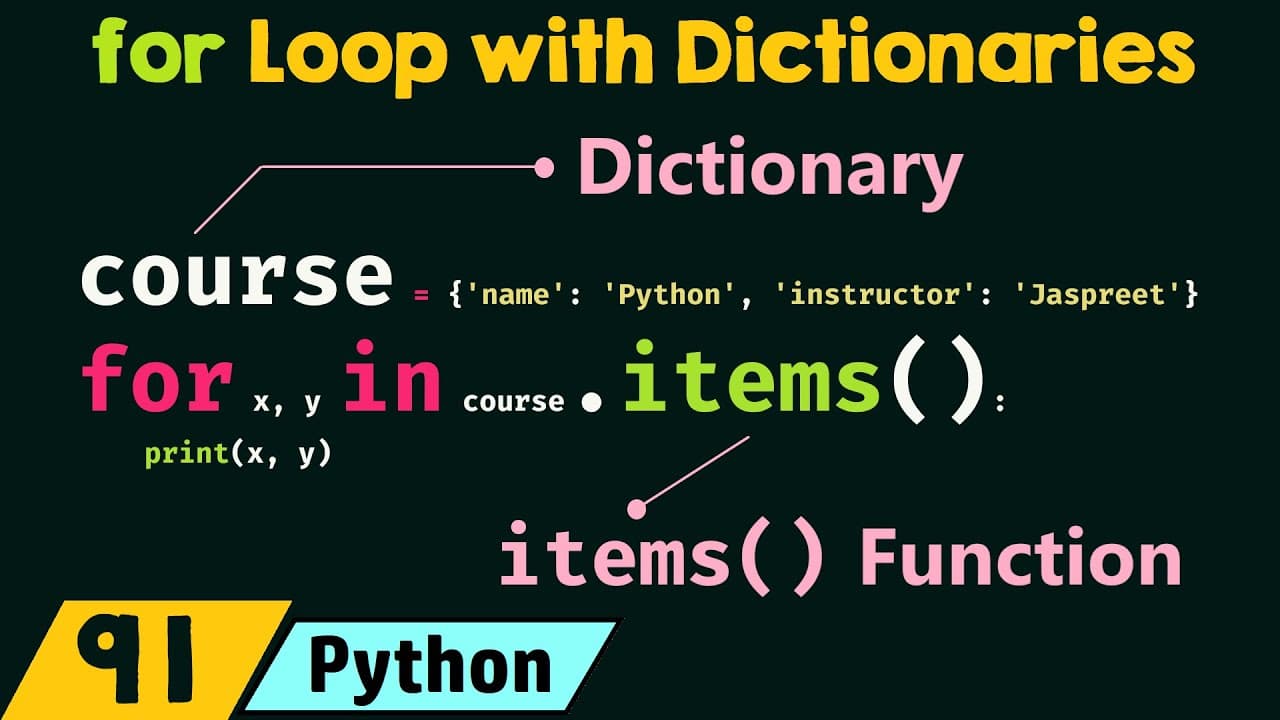
- The items method returns each key-value pair as a two-element tuple, enabling simultaneous access to both key and value in the loop.
- Accessing values via the values method yields just the values in the same order as keys are iterated, useful for value-centric processing.
- Printing in Python separates values with a comma in print, which inserts a space between items when showing key and value together.
- Using for X in dict.keys() clarifies intent to operate on keys, though for X in dict is a shorter equivalent.
- Combining unpacking in the loop for X, Y in dict.items() simplifies access to both elements of each pair in a single step.
Install to Summarize YouTube Videos and Get Transcripts
Explore YouTube Video Summarizer or Get YouTube Transcript Extractor
Questions & Answers
Q: How to start iterating over a dictionary in Python using a for loop
To begin iterating over a dictionary in Python with a for loop, you simply write for key in course where course is your dictionary. In this form, the loop variable receives each dictionary key one at a time, allowing you to access the corresponding value using course[key]. This pattern is the most common way to traverse dictionaries and is demonstrated in the example with the keys name and instructor.
Q: How to print only dictionary keys during iteration
If you want to print only the keys while iterating a dictionary, use for key in course and then print(key). The for loop assigns each key to the loop variable on each pass, so printing the variable outputs the keys such as name and instructor. This isolates key traversal from value retrieval.
Q: How to access a value when iterating over a dictionary with the key
To access a value during iteration, you can use the square bracket notation with the current key, for example print(course[key]). This retrieves the value associated with that key in the dictionary and outputs data such as Python or Just Bre.
Q: What is the values method used for in dictionary iteration
The values method allows you to iterate directly over the values of a dictionary. By using for value in course.values(): print(value), you obtain the values without handling the keys, which is useful when the goal is to process only the stored data such as Python and Just Bre.
Q: How to print only dictionary values during iteration
To print only values, iterate with for value in course.values(): print(value). This keeps focus on the data stored in the dictionary rather than the associated keys, and the output will be lines like Python and Just Bre.
Q: How to print both keys and values together in a loop
To print both keys and values together in a loop, use for key, value in course.items(): print(key, value). The items method yields pairs, so you can unpack them into two loop variables and print them in one step, producing outputs like name Python and instructor Just Bre.
Q: What does the keys method do in dictionary iteration
The keys method returns an iterable of the dictionary keys. When used in a loop like for key in course.keys(): print(key), it explicitly signals that the loop processes only keys, which can improve readability in more complex code.
Q: When would you use for key, value in dict.items()
Using for key, value in dict.items() is the most direct way to access both elements of every dictionary pair in a single loop. This pattern is efficient, clear, and commonly used for tasks that require both the key and its corresponding value, such as formatting or data transformation.
Summary & Key Takeaways
-
In this session, the for loop is shown iterating over a dictionary to print keys, demonstrating that for X in dict yields the dictionary keys one at a time. It also shows how to access values using square bracket notation and the values() method, clarifying different access patterns.
-
The lesson then covers accessing keys with the keys() method, including what is returned and how to print just the keys. Finally, it demonstrates retrieving both keys and values in a single loop using items, with explicit variable unpacking.
-
Overall, the video reinforces practical ways to read, print, and pair dictionary keys with values using common Python idioms for iteration and access.
Read in Other Languages (beta)
Share This Summary 📚
Summarize YouTube Videos and Get Video Transcripts with 1-Click
Try YouTube Summary with ChatGPT & Claude or YouTube Transcript Generator
Explore More Summaries from Neso Academy 📚





Summarize YouTube Videos and Get Video Transcripts with 1-Click
Try YouTube Summary with ChatGPT & Claude or YouTube Transcript Generator