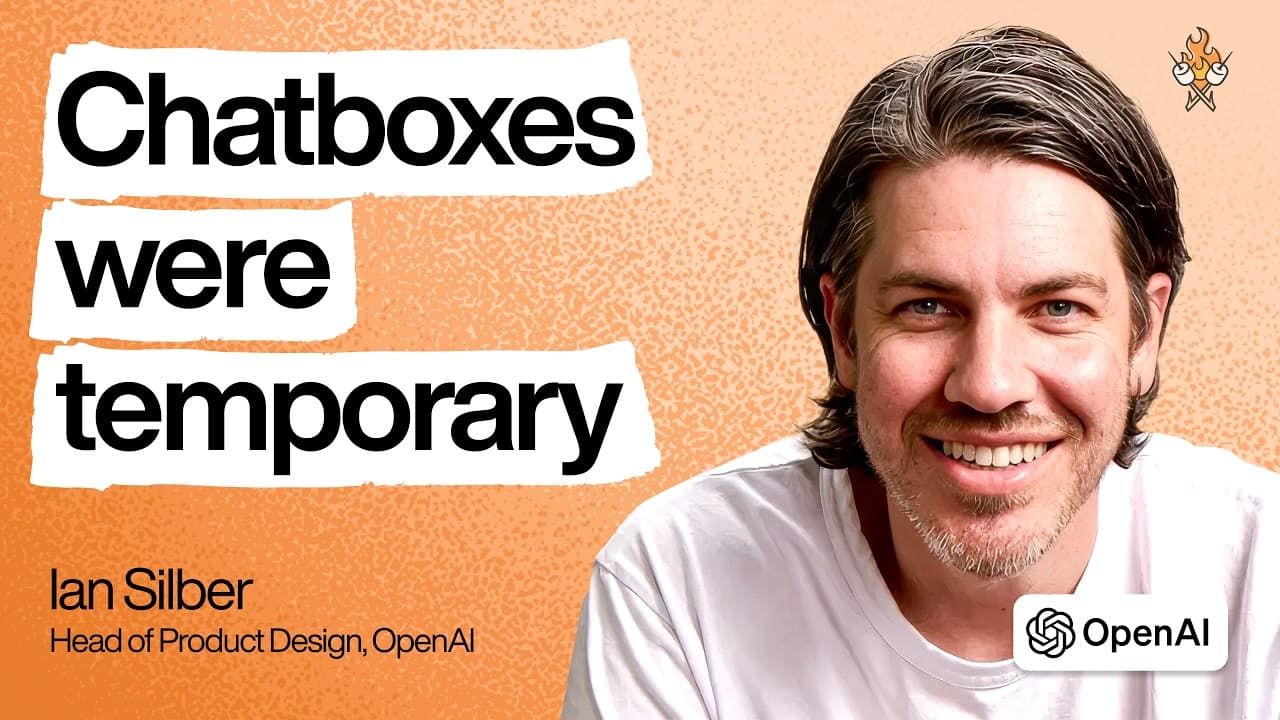
How Will AI Change Product Design and ChatGPT?
TL;DR
Designers can gain more creative agency by using AI throughout their workflow to explore, prototype, and discard ideas faster. AI compresses parts of design but does not eliminate its messy feedback loops, stakeholder alignment, or need for human judgment. Ian Silber argues that curious designers who begin experimenting now are early, not behind.
Transcript
I've been doing this sentiment survey of the tech workforce. Surprisingly, designers are just the most unhappy on every dimension. >> We're unclear right now what is expected of a designer. Someone who might be classically [music] trained in a certain way of working now feeling like, "Oh my gosh, I need to really change everything." >> You believe ... Read More
Key Insights
- • Designer anxiety is closely connected to uncertainty about changing expectations. Classically trained designers may wonder whether they must transform their entire workflow or begin shipping code every day, even though the emerging role of an AI-era designer has not yet been clearly defined.
- • Engineering productivity has increased more visibly than design productivity. Silber says engineers can sometimes achieve 10x or even 100x productivity, while design still requires uncertain exploration, repeated failures, feedback, revision, and organizational alignment that cannot be reduced to a simple binary result.
- • The design process remains messy even when AI accelerates production. Designers can generate and evaluate more ideas quickly, but they still need to discover that promising concepts may fail, incorporate responses from users or colleagues, and repeat the process until the work improves.
- • Curiosity is a central quality OpenAI seeks in designers. The company does not require candidates to arrive with an AI background, but it values people who are interested in exploring new tools and discovering how those tools can change their creative process.
- • Exploration can reduce pressure around AI adoption. OpenAI encourages designers to experiment without framing new tools as a demand to replace everything they already know, allowing them to develop different working methods through experience rather than through a fixed prescription.
- • AI gives designers greater freedom to test bad ideas. Faster prototyping makes it easier to express an early concept, inspect the result, reject weak directions, and continue searching, which Silber associates with stronger thinking, a higher quality bar, and greater individual agency.
- • OpenAI varies its design process according to the product decision. Some ChatGPT features involve trying roughly 100 possibilities, rejecting 99, and shipping one, while other efforts embrace building publicly, taking large swings, and learning quickly from what happens.
- • Chatbots are not presented as the final interface for AI products. The discussion looks beyond current conversational experiences toward the future of ChatGPT, Codex, and AI interaction, while emphasizing that user understanding, invention, and a distinct point of view remain areas of human contribution.
Install to Summarize YouTube Videos and Get Transcripts
Explore YouTube Video Summarizer or Get YouTube Transcript Extractor
Questions & Answers
Q: Why are product designers anxious about AI?
Product designers are anxious because expectations for their role are becoming unclear. Some classically trained designers feel pressure to change everything about how they work or to begin shipping code every day. They also see engineers receiving dramatic productivity gains while design still depends on messy exploration, feedback, revision, and stakeholder alignment, creating uncertainty about how designers should measure their own progress.
Q: Why has AI increased engineering productivity more than design productivity?
Engineering tasks can sometimes produce relatively binary outcomes, and coding agents often complete clearly specified work effectively. Silber says this can give engineers 10x or sometimes 100x productivity. Design is less direct: an idea can look promising and still fail after prototyping or feedback. Designers must explore alternatives, discard work, revise concepts, and align multiple people before reaching an acceptable result.
Q: How can product designers use AI in their workflow?
Product designers can use AI at every stage to help think through ideas, produce prototypes, and explore alternative directions. Silber suggests taking an initial concept and placing it directly into an agent such as Codex or Claude to see what it produces. The result does not need to become the final product. Its value may be revealing possibilities, weaknesses, or a different way to proceed.
Q: Does faster AI prototyping eliminate the traditional design process?
Faster prototyping does not eliminate the core uncertainty of design. AI can compress the time needed to express and test more ideas, but designers still have to judge the results, discard weak concepts, collect feedback, revise their assumptions, and build alignment. The process remains fluid because producing an artifact quickly is different from determining whether it solves the right problem well.
Q: What qualities does OpenAI seek when hiring product designers?
OpenAI looks for designers who are curious about AI tools and willing to explore how those tools can affect their work. Silber says an AI background is not required. The company supports experimentation and treats itself as a research lab, so designers benefit from comfort with uncertainty, openness to unfamiliar methods, and a willingness to test ideas rather than follow one fixed design process.
Q: How does OpenAI decide how much design iteration a feature needs?
OpenAI adjusts its approach according to the feature and the learning opportunity. For certain ChatGPT features, teams obsess over details, try around 100 possibilities, discard 99, and eventually ship one. For other work, the company embraces building publicly, taking larger swings, and learning quickly. The process therefore ranges from concentrated refinement to rapid external experimentation.
Q: Can AI already perform product design work?
Silber says AI is already an incredible product designer, particularly as a partner for thinking, prototyping, and expanding the number of ideas a person can examine. However, the discussion also identifies areas where humans continue to contribute, including understanding users, inventing new directions, and bringing a point of view. AI capability therefore changes the designer's work without making human judgment irrelevant.
Q: Why does Ian Silber call this a strong time to become a designer?
Silber believes the field is still extremely early, so designers who begin experimenting now are not behind. AI gives them more ability to express themselves, test bad ideas, discard unsuccessful work, and move rapidly through alternatives. He reports that designers who embrace these tools often feel more creative and capable of greater impact, while the quality of their thinking and output rises.
Summary & Key Takeaways
-
Product designers report unusual levels of anxiety because expectations for their role are unclear while engineering workflows are changing rapidly. Silber argues that designers should not assume they must abandon their training or ship code constantly. Teams can reduce pressure by encouraging curiosity, shared experimentation, and exploration instead of imposing one required workflow.
-
AI lets designers express ideas, create prototypes, test weak concepts, and discard unsuccessful directions more quickly. However, design remains fluid and difficult because teams must evaluate ideas, gather user or internal feedback, revise their thinking, and align stakeholders. Faster production expands the search space without automatically identifying the right product decision.
-
OpenAI applies different design approaches according to the feature. Some ChatGPT features receive deep attention, with teams trying many options and discarding nearly all of them. Other projects are developed publicly through larger bets and rapid learning. Across both approaches, Silber sees human understanding, invention, and point of view as important design strengths.
Read in Other Languages (beta)
Share This Summary 📚
Summarize YouTube Videos and Get Video Transcripts with 1-Click
Try YouTube Summary with ChatGPT & Claude or YouTube Transcript Generator
Explore More Summaries from Lenny's Podcast 📚



Summarize YouTube Videos and Get Video Transcripts with 1-Click
Try YouTube Summary with ChatGPT & Claude or YouTube Transcript Generator