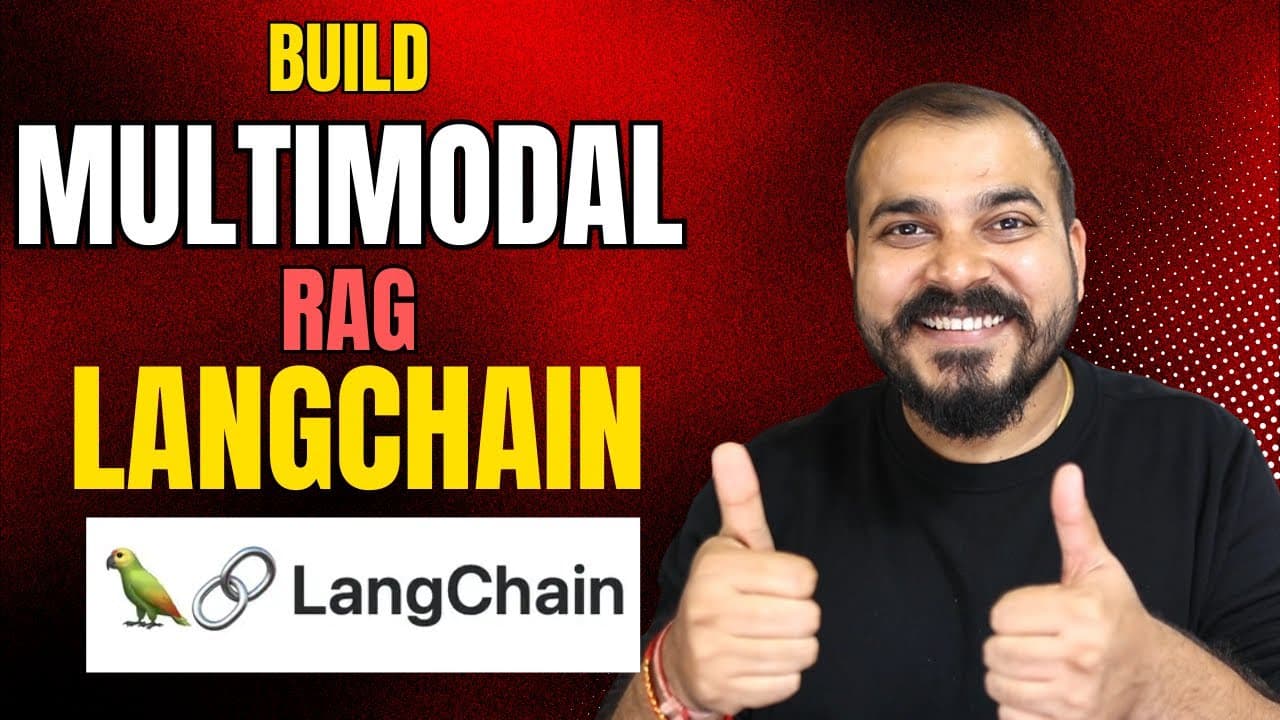
How to build a multi modal RAG with LangChain for PDFs and images
TL;DR
The video shows a end-to-end pipeline for multimodal RAG using LangChain. It explains extracting text and images from a PDF, converting both to embeddings with a CLIP model, storing them in a vector store, and using a retriever to fetch top results for a multimodal LLM like GPT-4 to generate the final answer.
Transcript
Hello guys, welcome to this new amazing module on understanding about multimodel rag. So guys till now specifically if I talk about you know we have discussed about creating different kind of rag applications and in that rag let's say that there are two main important components you know so let's say that I have my vector store and you know in this... Read More
Key Insights
- Extract text and images from a PDF as the first step.
- Convert both text and images into embeddings using a single multimodal model.
- Store embeddings in a vector store for fast retrieval.
- Use a retriever to fetch top K relevant documents for each query.
- Embed the query with a multimodal model to drive retrieval.
- Format retrieved content into a prompt suitable for a multimodal LLM.
- Leverage LLMs that accept image inputs to analyze visual data.
- Consider rerankers and hybrid sparse-dense strategies to improve results.
- More videos from this channel:
- More from this channel: Krish Naik
Install to Summarize YouTube Videos and Get Transcripts
Explore YouTube Video Summarizer or Get YouTube Transcript Extractor
Questions & Answers
Q: What is the first step in building the multimodal RAG pipeline shown?
The first step is to extract text and images from the PDF document. This involves identifying which parts are text and which are images within the document so that both modalities can be processed separately before embedding and storage. This foundational step sets up the data for later stages.
Q: How are text and images converted for retrieval in the pipeline?
Text and images are converted into embeddings using a single multimodal model, specifically a CLIP model. This model maps both text and images into a shared embedding space, enabling uniform vector representations that can be stored in a vector store and used for similarity search during retrieval.
Q: What role does the vector store play in this setup?
The vector store acts as a centralized repository for all embeddings. After text and image embeddings are created, they are stored here so that a retriever can perform similarity search against user queries. This enables efficient retrieval of relevant documents and image data for prompt construction.
Q: What is the purpose of the retriever in the pipeline?
The retriever receives the embedded query, searches the vector store for the top K most similar documents, and returns these candidates for the LLM to use. This step narrows down the information to the most relevant text and image content needed to answer the user query.
Q: Which model is suggested for multimodal reasoning in the video?
A multimodal LLM such as GPT-4 is suggested for handling both text and image inputs. This type of model can reason about visual content in addition to textual information, producing outputs that integrate insights from both modalities.
Q: How is image data prepared for ingestion into the LLM?
Images are prepared by embedding them and, when necessary, encoding them in a suitable format such as base64 for storage or transmission. The combined text and image embeddings are then fed to the LLM in a structured prompt that allows the model to reason about both types of data.
Q: What is CLIP and why is it used in this workflow?
CLIP is a model trained on image and text mappings that provides embeddings for both modalities in a shared space. It is used to generate embeddings for text and images so that retrieval can operate on a unified representation, enabling effective multimodal search and matching.
Q: What considerations are mentioned for improving retrieval quality?
The workflow mentions using rerankers and combining different retrieval strategies, such as sparse and dense matrix methods, to improve the relevance of retrieved documents. These techniques help refine results before they are passed to the LLM for final output.
Summary & Key Takeaways
-
The process starts with a PDF containing text and images, from which text and images are extracted. The text and images are then chunked and embedded, with a CLIP model handling both modalities. These embeddings are stored in a vector store to enable retrieval for queries.
-
A retriever performs a query embedding and retrieves top documents, which are formatted for a multimodal LLM. The LLM, such as GPT-4, is prompted with the retrieved text and image data to generate the final output.
-
The video also discusses using a base64 format for images, combining sparse and dense retrieval techniques, and the potential use of different multimodal LLMs for handling image content alongside text.
Read in Other Languages (beta)
Share This Summary 📚
Summarize YouTube Videos and Get Video Transcripts with 1-Click
Try YouTube Summary with ChatGPT & Claude or YouTube Transcript Generator
Explore More Summaries from Krish Naik 📚



Summarize YouTube Videos and Get Video Transcripts with 1-Click
Try YouTube Summary with ChatGPT & Claude or YouTube Transcript Generator