How Does the Gauntlet Loop Prompting Technique Work in Claude?
TL;DR
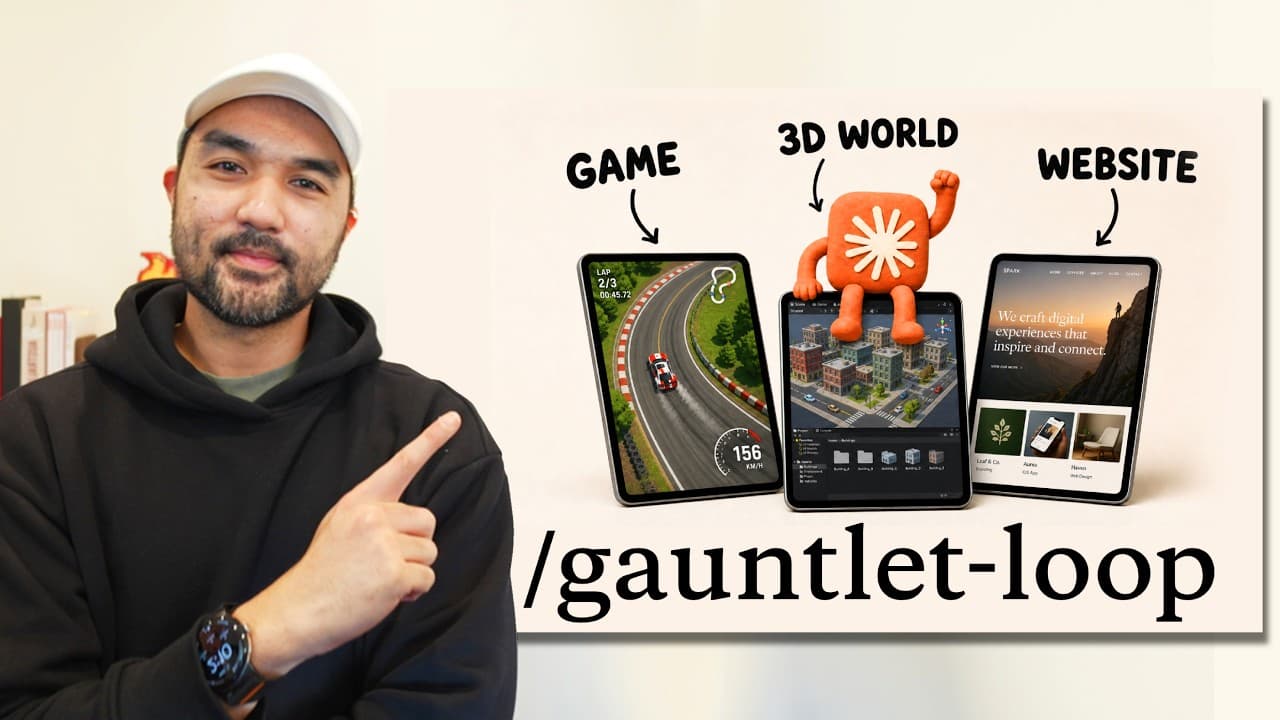
The gauntlet loop is a three-line Claude prompting technique that assigns a task, tells the main agent to fan out work to sub-agents with separate visual critics, and sets a quality bar for stopping. It has produced fully playable games and custom 3D worlds from a single prompt, while illustrating how verification can be delegated to agents. Read on to understand the structure, workflow, benefits, and limitations.
Transcript
There's a new prompting technique for Claude that's been blowing people's minds over the past week. Because in a single prompt, it can build fully playable games and hyper custom 3D worlds like these that even Karpati says might be the future of prompting LLMs. So today, I'll share with you this technique called the gauntlet loop, which might just ... Read More
Key Insights
- The gauntlet loop is a prompting technique that enables AI to create complex outputs with minimal input.
- It involves using sub-agents to handle different tasks, each with a critic to ensure quality.
- This technique can be applied in fields beyond gaming, such as architecture and real estate.
- The gauntlet loop uses a three-line prompt structure: task, build method, and quality bar.
- Sub-agent orchestration allows AI to work autonomously, improving output quality.
- The concept of using a verifier agent to enhance AI output is not new but is now more advanced.
- Gauntlet loop prompts can be time-consuming but result in high-quality, detailed outputs.
- Starting with a strong minimum viable product can help the gauntlet loop optimize effectively.
Install to Summarize YouTube Videos and Get Transcripts
Explore YouTube Video Summarizer or Get YouTube Transcript Extractor
Questions & Answers
Q: What is the gauntlet loop in Claude prompting?
The gauntlet loop is a prompting technique that directs a main agent to fan out work among sub-agents and use separate agents to verify the results. It combines a defined task, a build method, and a stopping standard so the agents keep working toward the requested quality.
Q: What are the three parts of a gauntlet loop prompt?
The first line defines the task, such as building a first-person shooter game. The second specifies the build method, including assigning individual tasks to sub-agents and having separate sub-agents visually check their work. The third establishes the quality bar that determines when the process may stop.
Q: How do sub-agents work in the gauntlet loop?
The main agent fans out separate pieces of work to sub-agents so each can tackle an individual task. Other sub-agents check the results visually, shifting part of the verification work away from the user and into the agent workflow.
Q: What quality bar does the gauntlet loop use?
The quality bar is a standard the agents must satisfy before stopping. In Matt Schumer's example, the instruction was not to stop until every sub-agent was utterly wowed by the quality compared with the actual Call of Duty game.
Q: What can the gauntlet loop create?
The technique has been used to create fully playable games and highly customized 3D worlds from a single prompt. Examples discussed include a first-person shooter, the starting area from Pokémon in 3D, a car-racing simulator, and a Mario Kart-style game.
Q: Why is the gauntlet loop effective?
It makes sub-agent orchestration accessible through a short, structured prompt. By distributing tasks and assigning verification to other agents, it lets the system continue checking and refining work against an explicit quality standard.
Q: How is the gauntlet loop different from ordinary prompting?
With ordinary prompting, the user sends a prompt, reviews the output, and sends another prompt until it meets the desired standard. The gauntlet loop offloads both task execution and part of that verification process to agents operating within a defined loop.
Q: Can the gauntlet loop be useful outside game development?
Yes. The transcript presents game and 3D-world demos as evidence of the underlying capabilities rather than limiting the method to game development. The technique is positioned as a way for users to improve at agentic AI by learning to fan out work across sub-agents.
Q: Do you need extra technical tools to use the gauntlet loop in Claude Code?
No, the gauntlet loop does not require you to learn extra technical tooling in Claude Code. You can use a well-structured prompt that tells the main agent to fan out sub-agents, assign tasks individually, and have separate sub-agents check the work against a defined standard.
Q: Why does the gauntlet loop use a separate evaluator agent?
A separate evaluator agent checks whether the generated work meets the quality standard before the final output reaches you. The transcript says AI models can convince themselves that their own output is good enough, while using another model as an evaluator generally produces better results.
Q: Who shared the gauntlet loop prompting technique?
Matt Schumer shared the gauntlet loop technique and his exact three-line prompt. He used it to create a fully playable game with custom code and no external assets, then explained the process in an article.
Summary & Key Takeaways
-
The gauntlet loop is a powerful AI prompting technique that orchestrates sub-agents to perform tasks and verify outputs, creating complex results like games or 3D models. It uses a structured prompt to ensure high-quality outputs and can be applied in various fields beyond gaming, such as architecture.
-
This technique involves three key components: defining the task, specifying the build method, and setting a quality bar. Sub-agents work together, each with a critic partner, to ensure the final output meets high standards. The gauntlet loop can significantly enhance AI capabilities.
-
By using sub-agent orchestration, the gauntlet loop allows AI to autonomously manage tasks and verify outputs, improving efficiency and quality. While time-consuming, this method can produce detailed and accurate results, making it valuable for complex projects requiring high standards.
Read in Other Languages (beta)
Share This Summary 📚
Summarize YouTube Videos and Get Video Transcripts with 1-Click
Try YouTube Summary with ChatGPT & Claude or YouTube Transcript Generator
Explore More Summaries from Jay E | RoboNuggets 📚

Summarize YouTube Videos and Get Video Transcripts with 1-Click
Try YouTube Summary with ChatGPT & Claude or YouTube Transcript Generator