How to understand data structures and lists in C/C++
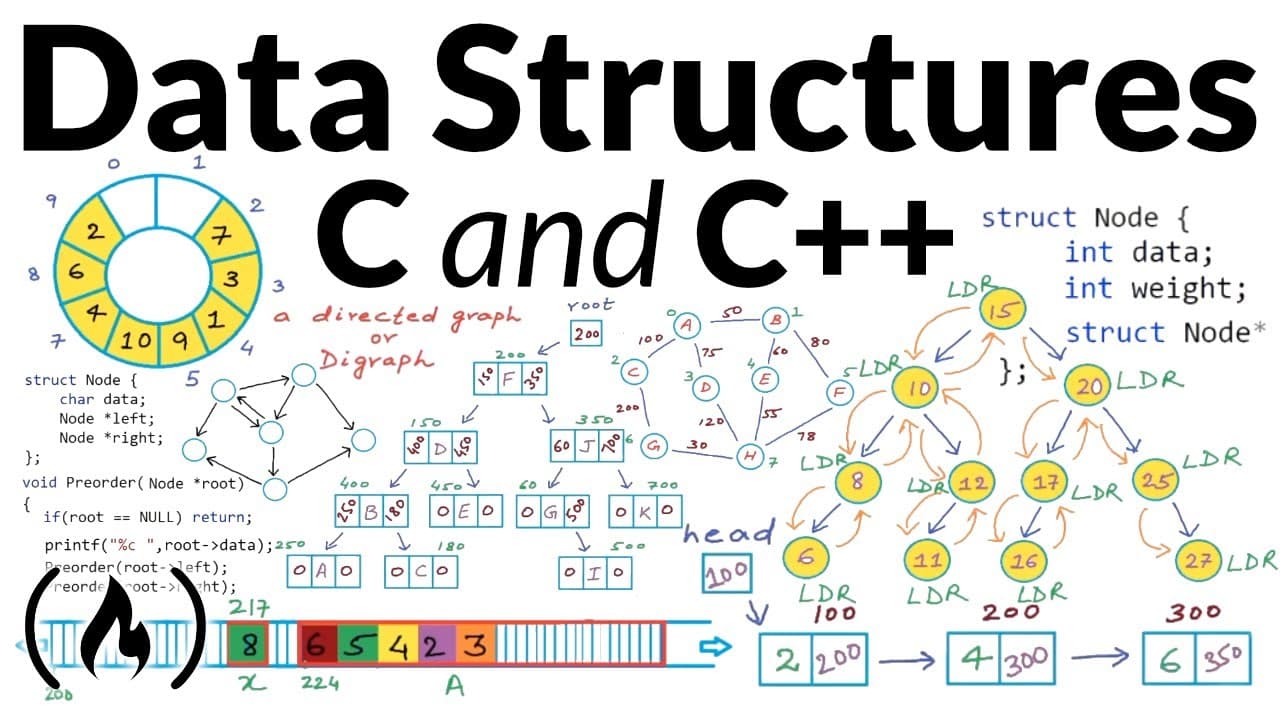
TL;DR
Data structures are ways to store and organize data so operations are efficient. The course introduces abstract data types and concrete implementations, explains why different structures fit different needs, and compares arrays with linked lists while showing C/C++ implementations. It covers foundations, ADT concepts, and practical coding examples.
Transcript
In this lesson and in this series of lessons, we will introduce you to the concept of data structures. Data structure is the most fundamental and building block concept in computer science and good knowledge of data structures is a must to design and develop efficient software systems. Okay, so let's get started. We deal with data all the time and... Read More
Key Insights
- Data structures are formal models that define data storage and operations without tying to a specific implementation.
- Abstract Data Types enable describing what operations exist, not how they are executed, allowing multiple concrete implementations.
- Linked lists are introduced as a contrasting implementation to arrays in terms of efficiency and memory usage.
- The course stresses the need to understand both the mathematical view and the practical programming view of data structures.
- Arrays provide contiguous memory and simplicity, while linked lists enable dynamic memory usage and flexibility for insertions and deletions.
- Understanding when to use lists, stacks, queues, trees, or graphs depends on the most frequent operations and data size.
- ABTs and ADTs are foundational concepts that guide how we design software to handle data efficiently.
- The material emphasizes that data storage decisions must scale with large data while maintaining performance.
- More videos from this channel:
- More from this channel: freeCodeCamp.org
Install to Summarize YouTube Videos and Get Transcripts
Explore YouTube Video Summarizer or Get YouTube Transcript Extractor
Questions & Answers
Q: What is a data structure and why does it matter in software design?
A data structure is a way to store and organize data in a computer so that it can be used efficiently. It matters because choosing the right structure affects how quickly we can search, insert, or delete data and how much memory is consumed. The course explains that data structures are studied as abstract data types and as concrete implementations, guiding better design decisions for software systems.
Q: What is an abstract data type and how is it different from an implementation?
An abstract data type defines the data and the operations that can be performed on that data without providing any implementation details. It differs from an implementation because the same abstract type can be realized in multiple concrete forms, such as arrays or linked lists. This separation helps developers focus on required functionality first and then choose the most suitable implementation based on performance needs.
Q: How does a linked list compare to an array in terms of memory use and operations?
Arrays offer contiguous memory and simple access, which can make some operations straightforward but can limit flexibility when resizing. Linked lists use dynamic memory and nodes that can be created or removed without shifting other elements, improving efficiency for insertions and deletions in many scenarios. The course discusses these tradeoffs to help decide which structure fits a given problem.
Q: What is meant by an abstract data type in practice, with an example?
An abstract data type represents a collection of data and operations such as read, write, insert, or delete, without detailing how those operations are implemented. For example, a list as an ADT defines storing elements, reading elements by position, and modifying elements, while leaving the underlying data structure implementation to be decided later. This enables multiple implementation options like linked lists or arrays.
Q: Why is it important to study data structures as both mathematical models and concrete implementations?
Studying data structures as mathematical models provides a high level view of operations and performance costs, while concrete implementations show how those abstractions are realized in code. This dual approach helps students understand theoretical limits and practical coding techniques, enabling them to optimize for time and space complexity in real programs.
Q: What course contents are covered after the introduction to data structures?
After the introduction, the course covers lists as abstract data types, the concept of linked lists, the comparison between arrays and linked lists, and practical implementations in C and C++. It also promises future material on more structures like stacks, queues, trees, graphs, and further linked list operations such as insertion, deletion, and reversal.
Q: What prerequisites are suggested for understanding the linked list sections?
Prerequisites include a working knowledge of pointers in C or C++ and an understanding of dynamic memory allocation. These concepts are necessary to implement and manipulate linked lists, as the course plans to demonstrate node insertion, deletion, traversal, and reversing operations in code.
Q: How does the course treat the evolution from abstract concepts to code implementations?
The course starts with abstract data types to define what data structures must do, then shows how to implement these abstractions in C or C++. It uses examples like lists and linked lists to illustrate how the same abstract model can be realized in different ways, guiding learners from theory to practical programming skills. This approach helps learners adapt to various problems and data sizes.
Summary & Key Takeaways
-
This summary outlines the course focus on data structures as abstract models and concrete implementations, emphasizing the distinction between abstract data types and real code. It explains why organization matters for efficiency and sets up the contrast between arrays and linked lists with practical C/C++ demonstrations.
-
The second point highlights the role of ADTs, such as lists, and how they define required operations without specifying implementation details. It also notes that implementations can vary while preserving the abstract interface, guiding learners through design choices.
-
The third summary point stresses practical application, showing how to map logical views to code, introduce linked lists, and prepare for more advanced structures like stacks, queues, trees, and graphs in subsequent lessons.
Read in Other Languages (beta)
Share This Summary 📚
Summarize YouTube Videos and Get Video Transcripts with 1-Click
Try YouTube Summary with ChatGPT & Claude or YouTube Transcript Generator
Explore More Summaries from freeCodeCamp.org 📚






Summarize YouTube Videos and Get Video Transcripts with 1-Click
Try YouTube Summary with ChatGPT & Claude or YouTube Transcript Generator