How to build Generative AI apps for developers
TL;DR
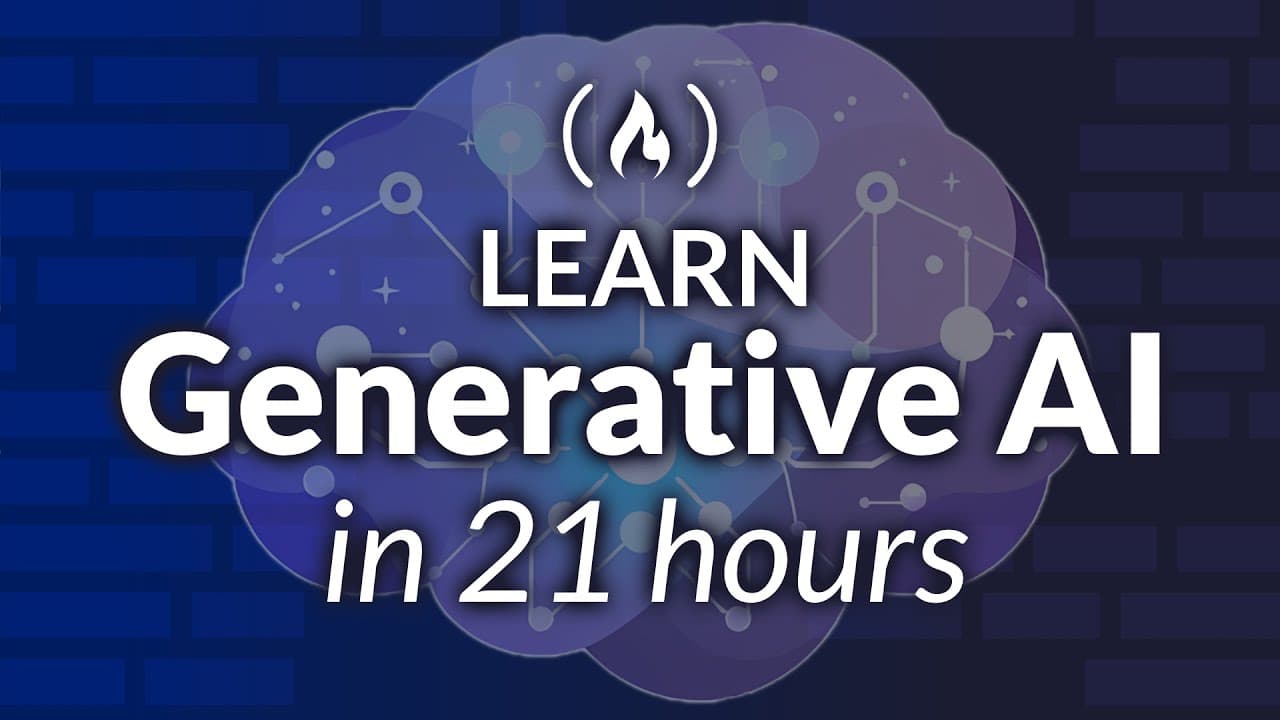
The course covers core Generative AI concepts such as large language models, data preprocessing, fine tuning and retrieval augmented generation. It includes hands on projects with Hugging Face, OpenAI and LangChain, building real world apps like text summarization and custom chatbots. It also teaches AI pipelines, vector databases and deployment on Vertex AI and Bedrock.
Transcript
in this comprehensive generative AI course you'll dive deep into the world of generative AI exploring key Concepts such as large language models data pre-processing and Advanced Techniques like fine-tuning and rag through Hands-On projects with tools like hugging face open Ai and Lang chain you'll build real world applications from text summarizati... Read More
Key Insights
- GenAI concepts are taught from fundamentals to advanced topics.
- Hands on projects use popular tools like Hugging Face, OpenAI and LangChain.
- The curriculum covers data preprocessing and embedding generation.
- Vector databases are used to power knowledge bases for applications.
- Prompt engineering is highlighted as crucial for effective responses.
- End to end pipelines are emphasized, including model deployment.
- Llm architectures and attention mechanisms are explored for deeper understanding.
- Deployment on Vertex AI and Bedrock demonstrates real world scalability.
- More videos from this channel:
- More from this channel: freeCodeCamp.org
Install to Summarize YouTube Videos and Get Transcripts
Explore YouTube Video Summarizer or Get YouTube Transcript Extractor
Questions & Answers
Q: What is GenAI and why is it important for developers
GenAI is a field focused on creating systems that generate new data based on training samples, enabling text, code, images and more. For developers, it provides the foundation to build intelligent apps like chatbots and summarizers, and to deploy scalable AI powered services using modern tooling and platforms. Understanding core concepts helps in designing robust pipelines and responsible AI solutions.
Q: What tools are used in the course for building GenAI apps
The course uses Hugging Face for access to a wide range of models, OpenAI for commercial capabilities and API based experiments, and LangChain for building chains and pipelines. It also covers vector databases for storage and retrieval, enabling efficient knowledge bases. Together these tools allow practical implementation of end to end GenAI applications.
Q: What topics are included in data preprocessing for GenAI
Data preprocessing in GenAI includes cleaning data, representation and vectorization, and preparing data to generate embeddings that power model inputs. The curriculum emphasizes transforming raw data into structured representations suitable for training or retrieval augmented generation, ensuring models receive clean, relevant, and properly formatted inputs.
Q: What is retrieval augmented generation and why is it covered
Retrieval augmented generation, or RAG, combines generated content with a retrieval step from a knowledge base. This approach improves accuracy and freshness of responses by grounding generation in relevant documents. The course covers how to build RAG based apps, integrate with vector databases, and deploy such systems in real world scenarios.
Q: How does the course approach end to end GenAI pipelines
The course guides learners through building end to end pipelines that start with data preprocessing, move to model selection and fine tuning, then integrate with retrieval systems and prompt design, and finally deploy on cloud platforms. This structured approach helps students see how components interact in a real application.
Q: What is covered about large language models in the course
The course introduces large language models, their architectures, and how to work with commercial and open source variants. It discusses how to access and compare models via Hugging Face and OpenAI, and how proper prompting and fine tuning can tailor models to specific tasks like summarization or chatbot functions.
Q: What is emphasized about deployment in the course
Deployment emphasis includes using platforms such as Google Cloud Vertex AI and AWS Bedrock to deploy GenAI powered apps. Learners explore scalable deployment practices, integration with AI pipelines, and considerations for production ready systems, including performance, cost, and maintainability across real world environments.
Q: Who would benefit most from this GenAI course
Developers, data scientists, and engineers aiming to build practical GenAI applications will benefit. The course blends theory with hands on practice, covering data processing, model interaction, and deployment. It is suitable for those who want to create chatbots, summarizers, or AI powered tools and deploy them reliably in professional settings.
Summary & Key Takeaways
-
The course starts with core concepts and practical hands on skills, guiding learners from basics to advanced topics. It emphasizes building end to end AI pipelines and deploying models using major cloud platforms. The teaching style blends theory with real world projects to solidify understanding.
-
Learners explore data preprocessing, embedding generation and vector databases to support knowledge bases for RAG and chatbots. The curriculum includes working with LangChain, LLM architectures and prompting techniques to improve model performance and reliability.
-
By the end, students can apply the learned skills to create and deploy GenAI powered applications in real world settings, leveraging Hugging Face, OpenAI and cloud infrastructure for scalable solutions.
Read in Other Languages (beta)
Share This Summary 📚
Summarize YouTube Videos and Get Video Transcripts with 1-Click
Try YouTube Summary with ChatGPT & Claude or YouTube Transcript Generator
Explore More Summaries from freeCodeCamp.org 📚



Summarize YouTube Videos and Get Video Transcripts with 1-Click
Try YouTube Summary with ChatGPT & Claude or YouTube Transcript Generator