Stanford CS230: Deep Learning | Autumn 2018 | Lecture 2 - Deep Learning Intuition
TL;DR
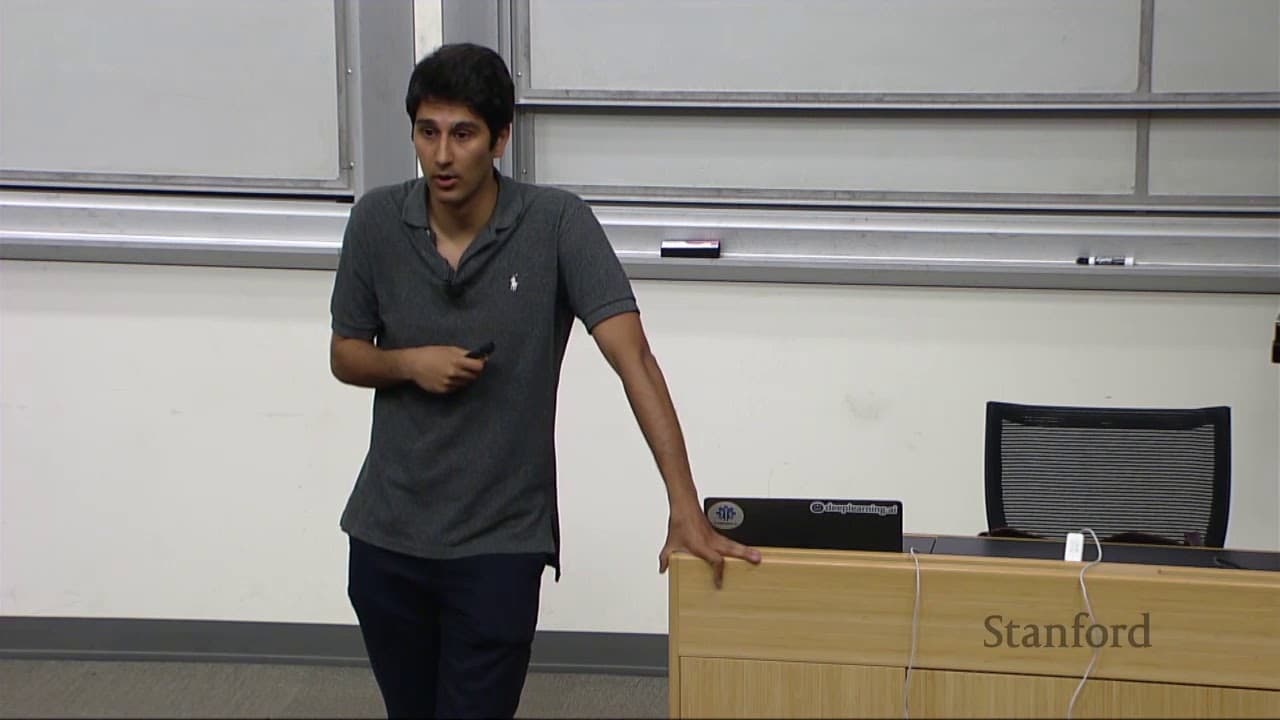
Deep learning projects can be approached systematically by deciding how to collect and label data, select an architecture, and design a loss function for optimization. Stanford CS230 Lecture 2 defines a model as an architecture plus parameters and explains how repeated gradient-based updates reduce loss. Read on to understand the full training loop and the choices that shape a model.
Transcript
Hello everyone? Welcome to the second lecture for CS230. So as I, I said earlier, uh, you can go on menti.com, uh, from your smartphones or your computers, and enter this code, 845709. Uh, we will use this tool for interactive questions during the lecture and we will also use it to, to track attendance. Uh, I'll add it at the end of the lecture, bu... Read More
Key Insights
- 🧑🏭 Deep learning requires thoughtful consideration of various factors, such as data collection, labeling, architecture choice, loss function design, and optimization.
- ❓ The choice of data and labeling approach can greatly impact the performance of a deep learning model.
- ⚾ The architecture, activation functions, optimizers, and hyperparameters should be chosen based on the specific problem and desired outcomes.
- 🦮 Loss functions help guide the training process by providing a measure of performance that the model can optimize.
Install to Summarize YouTube Videos and Get Transcripts
Explore YouTube Video Summarizer or Get YouTube Transcript Extractor
Questions & Answers
Q: What deep learning intuition does Stanford CS230 Lecture 2 teach?
The lecture presents a systematic way to think about deep learning projects. It covers collecting and labeling data, choosing an architecture, designing a loss function, and optimizing the model’s parameters.
Q: What is a model in deep learning?
A model is defined as an architecture plus parameters. The architecture is the chosen design, while the parameters are the numbers that make the function convert an input into an output.
Q: How is a deep learning model trained?
An input is forward propagated through the model to produce an output, which is compared with the ground truth using a loss function. The loss gradient indicates how to update the parameters to lower the loss, and this process is repeated many times.
Q: What does a loss function do in deep learning?
A loss function compares a model’s output with the ground-truth label. Its gradient tells the training process how much to move the parameters so that the loss decreases and recognition improves.
Q: What inputs and outputs can a deep learning model handle?
Inputs can include images, speech, natural language, CSV files, and structured or unstructured data. Outputs can represent binary classification, multiclass classification, or regression, such as identifying a cat, predicting its breed, or estimating its age.
Q: How does logistic regression classify a cat image?
The image is represented as a 3D matrix for the RGB color channels and then flattened into a vector. Logistic regression multiplies that vector by parameter w, adds bias b, and applies a sigmoid function; a properly trained network returns a value above 0.5 to indicate a cat.
Q: How can logistic regression classify several kinds of animals?
The architecture can use several units, with one neuron for each animal, instead of a single output neuron. The lecture calls this multi-logistic regression and illustrates it with giraffe, elephant, and cat classes.
Q: What choices can change in a deep learning project?
Developers can change the input, output, architecture, loss function, and activation functions. They can also select optimizers such as Adam, stochastic gradient descent, batch gradient descent, RMSprop, or momentum and tune hyperparameters including the learning rate and batch.
Summary & Key Takeaways
-
Deep learning is about modeling a function that takes input and provides output, such as classifying whether an image contains a cat or not.
-
Architectures, parameters, and loss functions are crucial components of deep learning models.
-
The choice of data, architecture, activation functions, optimizers, and hyperparameters can all impact the performance of a deep learning model.
Read in Other Languages (beta)
Share This Summary 📚
Summarize YouTube Videos and Get Video Transcripts with 1-Click
Try YouTube Summary with ChatGPT & Claude or YouTube Transcript Generator
Explore More Summaries from Stanford Online 📚


Summarize YouTube Videos and Get Video Transcripts with 1-Click
Try YouTube Summary with ChatGPT & Claude or YouTube Transcript Generator