How to govern AI agent identities effectively?
TL;DR
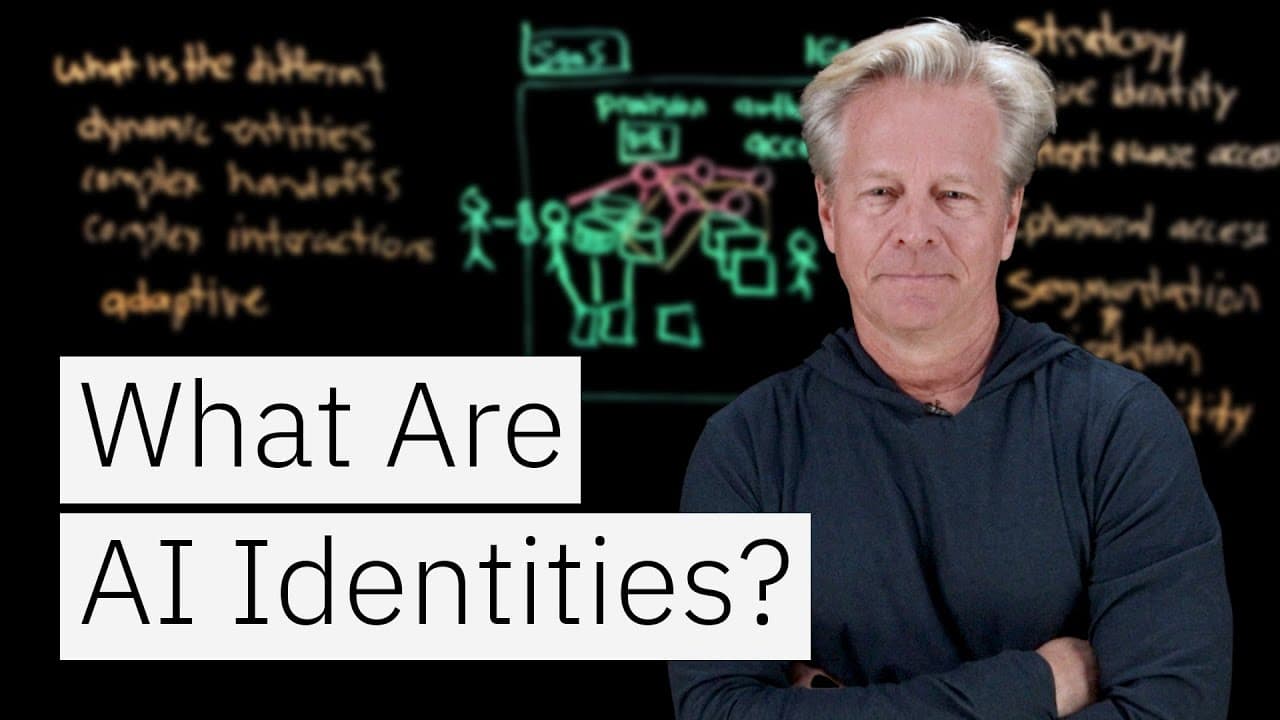
The key to governing AI agent identities is to give each agent a unique identity, evaluate access in context, and use ephemeral, just-in-time permissions. Segmentation and observability are essential to limit risk and enable auditability as agentic systems become more autonomous and interconnected.
Transcript
Howdy everyone. We are interacting more and more and every day with assistants and chatbots and agents. And with the rise of all these agents and agentic systems, how do we start thinking about governing agents and how do we express their identities? To actually address this question, we have to go back a little bit. And let's do a quick walk throu... Read More
Key Insights
- Unique identities are essential for agents, and they must be provisioned and authenticated to distinguish them from human or traditional non-human identities.
- Access must be context aware, ensuring that permissions align with the agent's current task and environment rather than static roles.
- Ephemeral, just-in-time access is necessary because agent behavior is dynamic and can shift between contexts or tasks.
- Agent governance requires segmentation and isolation to limit what any single agent can interact with, reducing potential damage from compromise.
- Observability is critical; continuous monitoring of agent actions enables auditing and rapid incident response.
- Agents are dynamic and adaptive, capable of complex handoffs across multiple agents, which requires governance that can handle unstructured flows.
- The governance strategy should define clear boundaries for agent capabilities to prevent rogue behavior while preserving operational flexibility.
- Identity governance for agents must consider both human and non-human interactions to ensure compliant and secure operations
Install to Summarize YouTube Videos and Get Transcripts
Explore YouTube Video Summarizer or Get YouTube Transcript Extractor
Questions & Answers
Q: How to assign a unique identity to an AI agent?
Assigning a unique identity to an AI agent involves registering the agent as a distinct entity within the enterprise identity system, ensuring it is labeled as an agent rather than a human. This includes creating a unique identifier, recording its purpose, and enabling authentication steps so that every interaction can be traced back to that specific agent. Continuous validation should occur to confirm the agent remains correctly identified across updates and exchanges.
Q: What does context aware access mean for agent governance?
Context aware access means evaluating the specific circumstances of each interaction before granting permissions. For agents, this implies considering the task at hand, the data being accessed, the systems involved, and the current environment. Since agents are adaptive, access decisions must reflect real-time context rather than relying on static role assignments, ensuring safer and more precise data usage.
Q: Why is ephemeral access important for agents?
Ephemeral access restricts permissions to the minimal necessary window for a given action, accommodating the dynamic nature of agent workflows. This reduces exposure by ensuring that even if an agent is compromised, its access is limited in time and scope. Just-in-time permissions align with the agent’s current activity, updating controls as the task evolves.
Q: How does segmentation and isolation reduce risk with agents?
Segmentation and isolation constrain an agent to a narrow set of tasks and data domains. By limiting interactions to predefined boundaries, the potential blast radius from a compromised agent is minimized. This approach also simplifies auditing and containment, making it easier to identify which components an agent can affect and to revoke access if needed.
Q: What role does observability play in agent governance?
Observability provides visibility into agent behavior, decisions, and data access. It enables auditing, compliance checks, and incident response by recording actions and outcomes. Continuous observability helps trace provenance, verify policy adherence, and detect anomalous or unauthorized activity early.
Q: How do agents differ from traditional identities in governance terms?
Agents differ from traditional identities because they are dynamic, autonomous, and capable of complex handoffs. Unlike static human or deterministic processes, agents adapt to environments and may interact with multiple other agents and data sources. Governance must therefore address ongoing context evaluation, adaptive permissions, and multi-agent workflows.
Q: What is the importance of unique identity and authentication for agents?
A unique identity and robust authentication establish trust and traceability for each agent. This enables accurate monitoring, accountability, and policy enforcement. It also helps comply with regulatory expectations by clarifying which entity performed which action, and it provides a clear baseline for detecting deviations from approved behaviors.
Q: How can organizations express agent identities within existing systems?
Organizations can express agent identities by extending their identity governance framework to include agent profiles, with clear labels such as agent type, capabilities, and data access boundaries. Integrating these profiles with access control mechanisms, logging, and audit tooling allows agents to operate within defined limits while remaining auditable across all interactions.
Summary & Key Takeaways
-
This summary outlines a governance framework for agent identities, emphasizing unique identification, context aware access, and time-limited permissions to manage dynamic, adaptive agents within complex environments.
-
It highlights the importance of segmentation and observability to reduce attack surfaces and maintain accountability as agents interact with private and public data.
-
The focus is on practical strategies to secure and govern agentic systems while enabling productive use within enterprises.
Read in Other Languages (beta)
Share This Summary 📚
Summarize YouTube Videos and Get Video Transcripts with 1-Click
Try YouTube Summary with ChatGPT & Claude or YouTube Transcript Generator
Explore More Summaries from IBM Technology 📚


Summarize YouTube Videos and Get Video Transcripts with 1-Click
Try YouTube Summary with ChatGPT & Claude or YouTube Transcript Generator