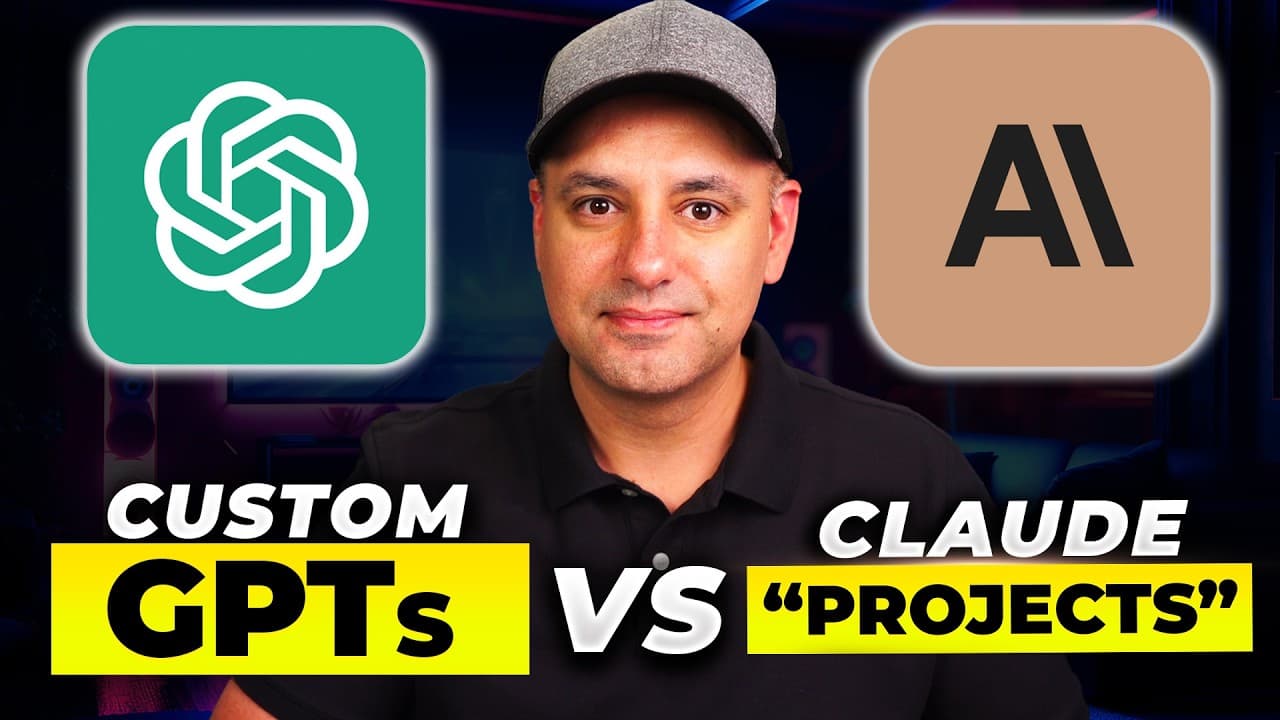
How to Choose Between Claude Projects and GPTs
TL;DR
Choose custom GPTs if you want guided setup, flexible sharing, built-in capabilities, and access through a public GPT Store. Choose Claude Projects if you are comfortable writing instructions manually and mainly need a specialized assistant with its own knowledge base, especially within a paid Claude team environment. Both tools become most valuable when configured for tasks you repeat frequently.
Transcript
from all the different AI tools available today I think custom gpts and clot projects are the two most practical and useful and in this video I wanted to show you both of them in action I wanted to compare both side by side and I want to give you an idea which one would be a better fit for you now first let me just explain what each one is if you h... Read More
Key Insights
- Custom GPTs are specialized versions of ChatGPT that use dedicated instructions, optional knowledge files, and selected capabilities to perform one specific task more consistently than the general chat experience.
- Claude Projects are specialized Claude environments that combine custom instructions with a project-specific knowledge base, giving users a reusable assistant for a narrow task instead of requiring a fresh prompt during every conversation.
- The GPT Builder is a conversational setup tool that asks questions, proposes a name, creates a logo, and generates instructions, making custom GPT creation more approachable for users who have limited experience designing detailed prompts.
- Claude Project creation is a manual process that requires users to name the project, add an internal description, and write custom instructions themselves, so effective setup depends more heavily on the user's ability to formulate clear directions.
- Custom GPT capabilities include web browsing, data analysis, and image generation, and each capability can be disabled when it is unnecessary, potentially improving speed or keeping responses focused on supplied text and knowledge files.
- Testing is an essential part of configuring a specialized assistant because an initial response may use the wrong perspective, tone, or length. The LinkedIn example required revisions after producing an overly long post written from Claude's perspective.
- Repeated workflows are strong candidates for specialized assistants because instructions can be refined once and reused later. The demonstrated LinkedIn assistant eliminates the need to construct a detailed prompt and repeat the same corrections for every new post.
- Sharing is a major difference between the platforms because custom GPTs can remain private, be shared with a team, be distributed by link, or appear in the GPT Store, while Claude Projects are described as lacking a comparable public store.
Install to Summarize YouTube Videos and Get Transcripts
Explore YouTube Video Summarizer or Get YouTube Transcript Extractor
Questions & Answers
Q: What is a custom GPT and how does it work?
A custom GPT is a specialized version of ChatGPT designed to perform a specific task. Its creator can provide dedicated instructions, upload a knowledge base containing documents ChatGPT might not otherwise access, and enable or disable capabilities such as web browsing, data analysis, and image generation. Once configured, it can be reused without recreating the same detailed prompt for each conversation.
Q: What is a Claude Project and what is it used for?
A Claude Project is a specialized environment within Claude that is configured for a particular task. Like a custom GPT, it can receive its own instructions and knowledge base so it performs a narrow workflow more consistently than the general Claude experience. The example in the comparison uses a project intended to transform supplied source text into a LinkedIn post.
Q: How do you create a custom GPT in ChatGPT?
To create a custom GPT, a paid ChatGPT user opens the Explore GPTs area and selects the create option. The conversational GPT Builder can ask questions about the desired task, response style, and tone, then propose a name, generate a logo, and create instructions. The creator can test results, request revisions, upload knowledge files, adjust capabilities, and edit configuration fields directly.
Q: How do you create a Claude Project?
To create a Claude Project, a paid Claude subscriber opens the Projects tab and selects the option to create a new project. The creator manually enters a project name and an internal description, then adds custom instructions and any relevant project knowledge. Unlike the demonstrated GPT workflow, Claude does not provide a builder chatbot that develops the initial configuration through a guided conversation.
Q: Why are custom GPTs easier for beginners to build?
Custom GPTs are easier for beginners in the demonstrated comparison because the GPT Builder conducts a plain-language conversation and develops much of the setup automatically. It asks about the intended behavior, creates draft instructions, suggests a name, and generates a logo. Claude Projects require the user to formulate and enter custom instructions manually, which can be harder without prior prompting experience.
Q: When should AI browsing and other capabilities be disabled?
Capabilities should be disabled when they are unnecessary for the assistant's assigned task. In the LinkedIn post example, web browsing and other tools were not needed because the assistant only had to transform text supplied by the user. Turning off unneeded capabilities can help with speed and can prevent the assistant from browsing externally when it should rely on the provided source or knowledge base.
Q: How can custom GPTs and Claude Projects improve repeated workflows?
Custom GPTs and Claude Projects can store the instructions needed for a recurring task, reducing the need to write a perfect prompt every time. A user can spend time testing and refining tone, perspective, length, and formatting once, then reuse the resulting assistant. The comparison argues that this setup can save hours each week when applied to work performed repeatedly.
Q: What sharing options distinguish custom GPTs from Claude Projects?
A custom GPT can be kept private, shared within a ChatGPT team, distributed to anyone with a link, or published in the GPT Store for public discovery. Claude Projects are described as harder to share because there is no comparable project store. Their sharing is presented as limited to other team members through the Claude teams plan.
Summary & Key Takeaways
-
Custom GPTs and Claude Projects are specialized versions of general AI chat tools. Each can receive task-specific instructions and a private knowledge base, allowing it to perform a narrow, recurring job more consistently than a general conversation. The demonstrated example turns source text into a LinkedIn post using predefined behavior and formatting preferences.
-
Custom GPT creation is more guided because the GPT Builder asks questions, proposes a name, generates a logo, and creates initial instructions. Users can test responses, revise behavior conversationally, edit the configuration directly, upload knowledge files, add conversation starters, and control web browsing, data analysis, and image generation capabilities.
-
Claude Projects provide similar core functions, including custom instructions and uploaded knowledge, but their setup is more manual. The user must supply a project name, internal description, and instructions without a builder chatbot. Sharing is also more restricted because projects lack a public store and are described as shareable only with team members.
Read in Other Languages (beta)
Share This Summary 📚
Summarize YouTube Videos and Get Video Transcripts with 1-Click
Try YouTube Summary with ChatGPT & Claude or YouTube Transcript Generator
Explore More Summaries from Skill Leap AI 📚

Summarize YouTube Videos and Get Video Transcripts with 1-Click
Try YouTube Summary with ChatGPT & Claude or YouTube Transcript Generator