How to Use a Simple 1-Minute Scalping Strategy

TL;DR
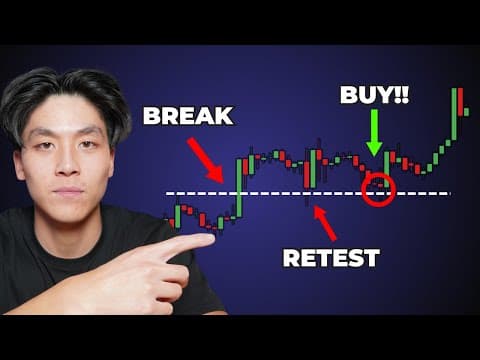
Use the first 5-minute candle after the New York session opens at 9:30 a.m. Eastern Standard Time to define a high-low range, then switch to the 1-minute chart and watch for an impulsive breakout. Wait for a retest with strong price action, set the invalidation point, and target a 1:2 risk-to-reward ratio. Read on for the complete three-step setup and its application to QQQ, SPY, and Tesla.
Transcript
There is one trading strategy that I use every single day. It's stupid simple, incredibly reliable, and the reason why I'm able to have days like this, this, and this. And in today's video, I'm going to show you exactly how to execute this strategy step by step. And then I'm going to show you real examples in real time. And by the end of the video,... Read More
Key Insights
- The strategy focuses on the first candle of the New York session, which has the most volume and volatility.
- Marking the high and low of the first 5-minute candle is crucial to identify market direction.
- An impulsive move above or below the 5-minute range signals potential continuation in that direction.
- The strategy avoids overcomplicated indicators, focusing on simplicity for better consistency.
- Waiting for a retest of the 5-minute range high or low with strong price action increases win rate.
- Strong price action can be identified by hammer candles, indicating buyer presence.
- A fixed 1:2 risk-to-reward ratio is recommended for managing trades and maximizing profits.
- Examples demonstrate the strategy's application on different markets like QQQ, SPY, and Tesla.
Install to Summarize YouTube Videos and Get Transcripts
Explore YouTube Video Summarizer or Get YouTube Transcript Extractor
Questions & Answers
Q: How do you use the simple 1-minute scalping strategy?
On the 5-minute chart, mark the wick high and wick low of the first New York-session candle at 9:30 a.m. Eastern Standard Time. Switch to the 1-minute chart, wait for an impulsive move outside that range, and look for a retest with strong price action before entering. Define a stop or invalidation point and use key pivot points for targets.
Q: Which candle defines the range for this scalping setup?
The setup uses the first 5-minute candle of the New York session, beginning at 9:30 a.m. Eastern Standard Time. Mark that candle’s wick high and wick low to create the range used on the 1-minute chart.
Q: What signals the likely market direction?
An impulsive move above the marked 5-minute high suggests potential continuation higher. An impulsive move below the 5-minute low suggests potential continuation lower.
Q: Why should traders wait for a retest after the breakout?
The strategy calls for waiting until price retests the high or low of the initial 5-minute range. Strong price action during that retest provides additional confirmation and is presented as a way to increase the setup’s win rate.
Q: What price action can confirm an entry?
A hammer candle during a retest can indicate buyer presence and serve as strong price-action confirmation. The entry should align with the impulsive move beyond the initial 5-minute range.
Q: How are stops and targets managed in this strategy?
The stop is placed at a key point of invalidation identified after entering the trade. Targets are based on key pivot points above, and the strategy recommends a fixed 1:2 risk-to-reward ratio.
Q: Why does the strategy avoid using many indicators?
Too many indicators can produce conflicting signals and create analysis paralysis. The strategy instead emphasizes price action, the opening 5-minute range, and a repeatable three-step process without requiring daily bias or fancy indicators.
Q: Can this 1-minute scalping strategy be applied to QQQ, SPY, and Tesla?
Yes, the examples apply the same process to QQQ, SPY, and Tesla. For each market, mark the first New York-session 5-minute range, move to the 1-minute chart, and evaluate the breakout, retest, entry, stop, and target.
Summary & Key Takeaways
-
The video presents a straightforward scalping strategy using the first candle of the New York session. By marking the high and low of the initial 5-minute candle, traders can determine market direction and execute trades with a 1:2 risk-to-reward ratio. This method emphasizes simplicity over complex indicators for consistent trading results.
-
Traders should focus on the first candle of the New York session, which is the most volatile. By marking the high and low of the initial 5-minute candle, they can identify potential market direction. The strategy relies on price action and avoids overcomplicated indicators, aiming for a 1:2 risk-to-reward ratio.
-
The key to this scalping strategy is simplicity and focusing on the first 5-minute candle of the New York session. Traders should mark the high and low, wait for an impulsive move, and look for a retest with strong price action. This approach offers a clear, repeatable method for consistent trading success.
Read in Other Languages (beta)
Share This Summary 📚
Summarize YouTube Videos and Get Video Transcripts with 1-Click
Try YouTube Summary with ChatGPT & Claude or YouTube Transcript Generator
Explore More Summaries from Jdub Trades 📚





Summarize YouTube Videos and Get Video Transcripts with 1-Click
Try YouTube Summary with ChatGPT & Claude or YouTube Transcript Generator