How to Choose the Right Trade Entry Confirmation

TL;DR
Choose an entry model according to the strength of the setup and the amount of confirmation required. A limit order offers the earliest entry and highest potential risk-to-reward ratio but produces more avoidable losses, while strong price action and confirmation candles delay entry until buyers show evidence of defending the key level.
Transcript
as a newer Trader have you ever entered into a position only for you to get immediately stopped out if that's the case chances are you don't understand how to enter a trade the right way an entry is a crucial part when it comes to trading and I believe that there are three different entry models that every single Trader should know in today's video... Read More
Key Insights
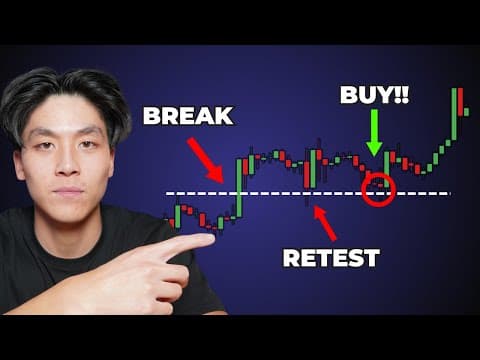
- A trade entry is a crucial part of execution because identical breakout-and-retest structures can produce opposite outcomes. One retest may attract buyers and continue toward the high of day, while another may close weakly, fall through the level, and trigger the planned stop.
- The three entry models are limit orders, strong price action, and confirmation candles. They form a progression from the most aggressive to the most conservative approach, allowing traders to choose between earlier execution and waiting for stronger evidence that price may continue with the existing trend.
- A limit order is the most aggressive entry because it rests at the planned breakout-and-retest level before price arrives. If the market touches that level, the order can execute regardless of whether buyers defend the area or price immediately continues through it.
- The advantages of a limit order are consistent participation, an early entry, the possibility of being filled on the bid, and the highest potential risk-to-reward ratio. These benefits result from entering near the retest level instead of waiting for additional candles to confirm buyer strength.
- The limit-order model has the lowest stated win rate, approximately 30–40 percent. Because every qualifying retest can trigger an entry, the trader is more exposed to fakeouts, sharp moves through support, and unnecessary losses that stronger price-action filters might have avoided.
- Strong price action is a conservative entry model that requires buyers to show activity around the key level. Lower candle wicks, a hammer-style candle, and closes back above former resistance turning into support are presented as signs that buyers are defending the retest.
- A strong-price-action entry can use a market or limit order as a bullish candle forms or closes. Instead of placing the stop beneath the broader structural level used for an aggressive limit entry, the trader can define risk beneath the newly formed swing pivot low.
- Trade targets are based on the setup rather than a single fixed destination. The examples use either a return to the high of day or a 1-to-2 risk-to-reward objective, with the latter used when the high of day does not satisfy the intended risk parameters.
Install to Summarize YouTube Videos and Get Transcripts
Explore YouTube Video Summarizer or Get YouTube Transcript Extractor
Questions & Answers
Q: What are the three trade entry confirmation models?
The three models are a limit order, strong price action, and a confirmation candle. A limit order is the most aggressive because it executes when price reaches the planned level. Strong price action is conservative because it waits for buyers to appear. A confirmation candle is the most conservative because it requires clearer evidence before entry.
Q: How does a limit-order trade entry work?
A limit-order entry places a resting buy order at a key breakout-and-retest level, such as previous resistance expected to become support. When price returns to that level, the order is filled regardless of the candle behavior. The stop is placed beneath the chosen structural level, while the target may be the high of day or a 1-to-2 objective.
Q: What are the advantages of using a limit-order entry?
A limit order provides participation whenever price returns to the planned retest level, so the trader is less likely to miss the opportunity. It can also provide the best available entry, allow a fill on the bid, and create the highest potential risk-to-reward ratio because execution occurs before additional confirmation moves price farther from support.
Q: What are the risks of aggressive limit-order entries?
Aggressive limit orders execute without checking whether buyers actually defend the level. That makes them vulnerable to fakeouts and sharp moves through expected support. The stated win rate for this approach is approximately 30–40 percent, and repeatedly entering every breakout and retest can create unnecessary losses that a more selective model might avoid.
Q: How do traders identify strong price action at support?
Strong price action appears when buyers visibly respond near the key support area. The examples highlight candles with lower wicks, a hammer-style formation, and closes back above former resistance that has become support. These behaviors indicate that buyers are stepping in, giving the trader more evidence than a limit order provides before committing to the position.
Q: Where should a stop be placed after a strong price-action entry?
After buyers create strong price action at the retest, the stop can be placed just beneath the new swing pivot low or beneath the confirming bullish candle. This differs from an aggressive limit entry, which may use a broader market-structure level. The newer pivot provides a clearly defined point where the immediate buyer response has failed.
Q: How should a trader choose between aggressive and conservative entries?
The choice depends on the strength of the broader thesis and the amount of evidence required before entering. A limit order suits a more aggressive approach when the higher-time-frame thesis is considered strong. Waiting for buyer activity or a confirmation candle is more conservative and can filter weak retests, although entry occurs later.
Q: How are profit targets selected for these trade entries?
The examples use either the high of day or a 1-to-2 risk-to-reward target. A return to the high of day is appropriate when it fits the planned risk parameters. If that level does not provide enough reward relative to the stop distance, the trade can instead target a 1-to-2 move toward the upside.
Summary & Key Takeaways
-
Three entry models offer different balances between timing and confirmation. A limit order is the most aggressive because it executes at the planned retest level regardless of subsequent price action. Strong price action is conservative because it waits for buyers to appear, while a confirmation candle is presented as the most conservative choice.
-
The limit-order approach places an order at previous resistance expected to become support after a breakout. A stop can sit below the relevant structural level, while the target can be the high of day or a 1-to-2 risk-to-reward objective. The approach provides an early fill but remains exposed to failed retests.
-
The strong-price-action model waits for evidence such as lower wicks, a hammer-style candle, and closes back above support. Entry can occur as the bullish candle forms or closes, with risk based on its swing low. This filters some weak retests, although the delayed entry can reduce the available reward relative to risk.
Read in Other Languages (beta)
Share This Summary 📚
Summarize YouTube Videos and Get Video Transcripts with 1-Click
Try YouTube Summary with ChatGPT & Claude or YouTube Transcript Generator
Explore More Summaries from Jdub Trades 📚




Summarize YouTube Videos and Get Video Transcripts with 1-Click
Try YouTube Summary with ChatGPT & Claude or YouTube Transcript Generator