How Did RSA Conference Topics Change Over Time?
TL;DR
RSA Conference session titles shifted from a strong early emphasis on cryptography and commerce toward a wider range of security concerns, including cyber, cloud, attacks, and detection. An analysis of titles from 1991 onward shows how conference language reflected changing industry problems, while Markov chains demonstrated that historical word patterns could generate convincing, machine-made session titles.
Transcript
Good morning, everyone. Oh, wow, sorry. I just threw the joke there. You didn't say, "Good." Good. All right, so it's 8:00 Wednesday. Thanks a lot for coming. Uh, this talk, I'll give you a little bit of background. What's happening? Here we go. I'll give you a little bit of background on what we're doing here. Um, and then I'll introduce the panel... Read More
Key Insights
- RSA Conference titles are a historical indicator of the security industry's interests because they record what presenters considered important, unresolved, or timely. Examining those titles across the conference's first 25 years reveals shifts in both technical priorities and the vocabulary used to describe security work.
- The 1991 RSA Conference had two sessions, and its earliest titles were dominated by cryptography. The analysis treats related forms, including cryptography, cryptographers, and cryptanalysis, as part of a combined crypto category so their collective prominence can be compared with later subjects.
- Cryptography and commerce were closely associated in the conference's early period because cryptographic work was discussed as a way to enable commerce while the web was rising. Their later decline in relative prominence suggests that conference attention moved toward different problems after commerce became established.
- Cyber and cloud became substantially more prominent than they had been in the early conference years. The panel interpreted this change as evidence that the security field branched beyond its crypto-centered beginnings and developed a broader identity encompassing attacks, infrastructure, and other concerns.
- Conference topic frequency reflects what practitioners are trying to understand, rather than merely what exists in the industry. Wendy Nather argued that commerce stopped being an intriguing conference problem once it was functioning, while newer unresolved subjects attracted more attention.
- Markov chains generate session titles by estimating the probability of a title's first word and the probability that one word follows another. Applied to historical RSA Conference titles, this approach produced new combinations whose wording resembled the structure and vocabulary of genuine submissions.
- Machine-generated titles were convincing enough to receive audience votes when presented alongside a real session title. The exercise showed that recurring title patterns can be statistically reproduced, even though the generated phrases were assembled from probabilities learned from earlier conference titles.
- RSA Conference participation and programming expanded dramatically from the two sessions recorded in 1991 to hundreds of sessions in later years. The panel also noted that attendees create important memories and professional connections in hallways, parties, and other settings outside formal conference rooms.
Install to Summarize YouTube Videos and Get Transcripts
Explore YouTube Video Summarizer or Get YouTube Transcript Extractor
Questions & Answers
Q: How did RSA Conference topics change over 25 years?
RSA Conference began in 1991 with two sessions and a program focused largely on cryptography. Across the following 25 years, crypto and commerce became less prominent relative to the full program, while terms such as cyber and cloud rose substantially. The changing titles suggest that the security industry broadened from crypto-centered concerns toward attacks, detection, infrastructure, and other developing problems.
Q: Why can conference session titles reveal security trends?
Session titles summarize the subjects that presenters, organizers, and attendees consider worth discussing at a particular time. When titles are examined across many years, repeated words and changing frequencies reveal which problems were attracting attention. The panel therefore treated RSA Conference titles as a window into the security industry, while acknowledging that they specifically reflect what participants were trying to understand or solve.
Q: Why did cryptography dominate early RSA Conference sessions?
Cryptography dominated the early conference because the security industry had strong crypto-based roots and was working through practical applications for the emerging web. The panel connected early discussions of cryptography with the need to enable commerce during the 1990s. Related words, including cryptography, cryptographers, and cryptanalysis, were combined into one crypto category to measure this emphasis consistently.
Q: Why did commerce become less prominent in later session titles?
Commerce became less prominent because it was no longer framed as an intriguing problem requiring the same level of conference attention. Wendy Nather said that the industry had solved the commerce problem in the sense that commerce was happening. As that challenge became established practice, session titles increasingly focused on newer or unresolved issues represented by terms such as cloud and cyber.
Q: What does the rise of cyber in RSA Conference titles indicate?
The rise of cyber indicates a change in the language and identity of the security field. The panel associated the term with discussions of attacks and with work that can span physical and logical security. Jay Jacobs also suggested that its growing popularity may reflect a period when the industry became more entrenched in a broader identity after years of varied topics.
Q: How were Markov chains used to generate conference titles?
The researchers calculated a probability distribution for the first word of a session title, then estimated the probability that each possible word would follow the current word. Repeating that process created a Markov chain capable of assembling a complete title. Because the model learned from actual RSA Conference titles, its generated results reproduced familiar word relationships and recognizable submission patterns.
Q: How convincing were the machine-generated RSA session titles?
The generated titles were convincing enough that audience members voted for them when asked to identify a genuine title among several choices. In one exercise, the real title was "Uncle Sam Meet the PKI," while the other options had been generated by the system. Every generated option appeared plausible enough to receive at least one audience vote.
Q: Who participated in the RSA Conference title analysis panel?
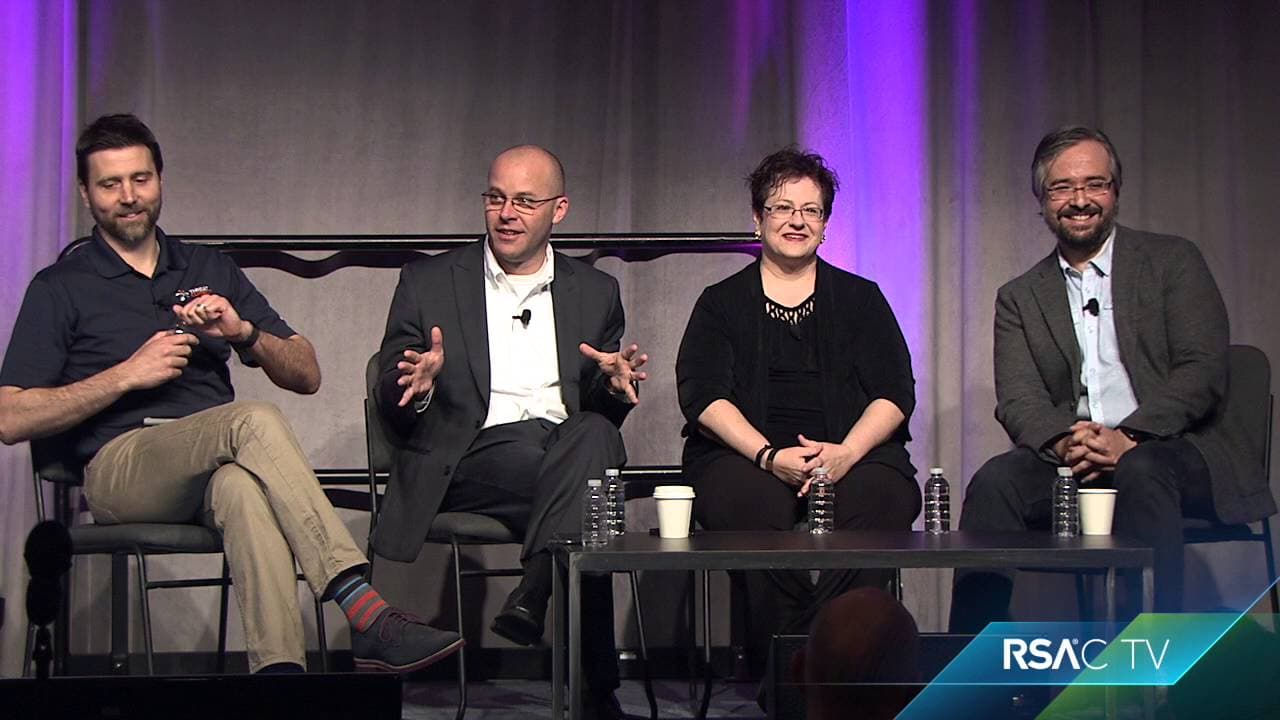
The panel featured Wade Baker, Director of Security, Strategy and Research at Verizon; Jay Jacobs, Senior Data Scientist at BitSight Technologies; Alex Pinto, Chief Data Scientist at Niddel; and Wendy Nather, Research Director at the Retail Cyber Intelligence Sharing Center. Their discussion combined security experience, data analysis, conference history, and observations about changing industry language.
Summary & Key Takeaways
-
RSA Conference titles provide a window into the security industry's changing priorities. The conference began in 1991 with two sessions and a strong concentration on cryptography. Over time, its program expanded substantially, while the relative prominence of crypto and commerce declined as cloud, cyber, attacks, detection, and other security subjects gained attention.
-
The panel analyzed word usage over time by grouping related terms, such as cryptography, cryptographers, cryptanalysis, and similar forms under crypto. Their trends suggested that conference attention follows unresolved problems. Cryptography once supported emerging web commerce, but commerce became less prominent as it moved from an intriguing challenge into routine activity.
-
Markov chains modeled how words connect within session titles. Starting-word probabilities and the likelihood of each following word allowed the system to generate plausible new titles based on the historical collection. Audience members sometimes selected generated examples as genuine, showing that recurring conference language and title structures were recognizable enough for machines to imitate convincingly.
Read in Other Languages (beta)
Share This Summary 📚
Summarize YouTube Videos and Get Video Transcripts with 1-Click
Try YouTube Summary with ChatGPT & Claude or YouTube Transcript Generator
Explore More Summaries from RSAC Cybersecurity 📚



Summarize YouTube Videos and Get Video Transcripts with 1-Click
Try YouTube Summary with ChatGPT & Claude or YouTube Transcript Generator