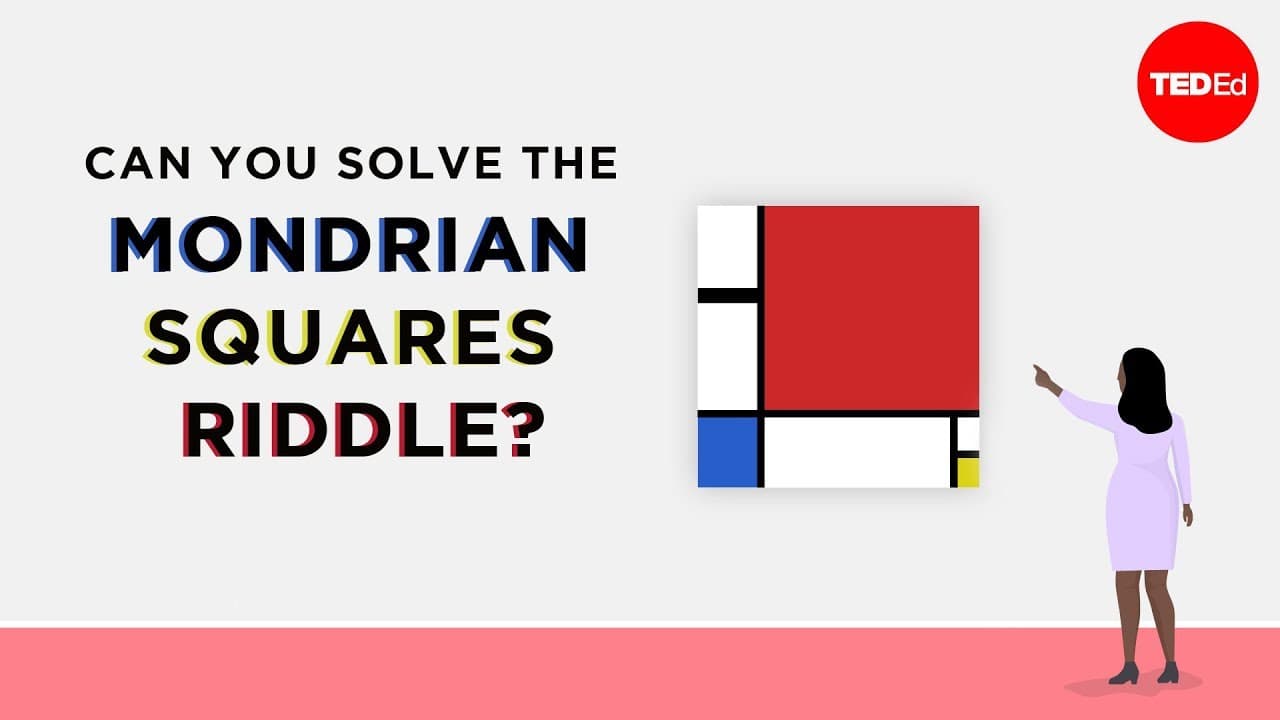
Can you solve the Mondrian squares riddle? - Gordon Hamilton
TL;DR
Mathematicians use Mondrian's artworks as inspiration for a challenge where they aim to cover a canvas with unique rectangles and minimize the difference in size between the largest and smallest rectangles.
Transcript
Dutch artist Piet Mondrian’s abstract, rectangular paintings inspired mathematicians to create a two-fold challenge. First, we must completely cover a square canvas with non-overlapping rectangles. All must be unique, so if we use a 1x4, we can’t use a 4x1 in another spot, but a 2x2 rectangle would be fine. Let’s try that. Say we have a canvas me... Read More
Key Insights
- 🚱 Mondrian's paintings inspire a mathematical challenge involving non-overlapping rectangles and minimizing the difference in their sizes.
- 😘 The challenge's objective is to achieve a low score by minimizing the difference between the largest and smallest rectangles' areas.
- ❓ Finding the optimal solutions to this challenge becomes more complex as the canvas size increases.
- ⚾ Certain rectangle sizes are excluded based on their compatibility with the canvas dimensions.
- 😘 Some intuitive decision-making is necessary to achieve lower scores, as there is no specific formula or trick.
- 🌥️ Expert mathematicians continue to explore and analyze potential solutions for larger canvas sizes.
- ❓ The challenge combines artistic inspiration with mathematical problem-solving.
Install to Summarize YouTube Videos and Get Transcripts
Explore YouTube Video Summarizer or Get YouTube Transcript Extractor
Questions & Answers
Q: How does the mathematical challenge inspired by Mondrian's paintings work?
The challenge requires covering a square canvas with non-overlapping rectangles, all of which must be unique in size. The objective is to minimize the difference in area between the largest and smallest rectangle.
Q: How is the score calculated in this mathematical challenge?
The score is calculated by subtracting the area of the smallest rectangle from the area of the largest rectangle. The goal is to achieve the lowest possible score.
Q: Can you provide an example of dividing a 4x4 canvas to minimize the score?
One possible division is to use a 1x4 rectangle and a 3x4 rectangle. The largest rectangle's area is 12, and the smallest rectangle's area is 4, resulting in a score of 8.
Q: Is there an optimal solution for all canvas sizes in this mathematical challenge?
Finding the optimal solution for larger canvases is challenging, and expert mathematicians are unsure if the lowest possible scores have been discovered.
Summary & Key Takeaways
-
Dutch artist Piet Mondrian's abstract, rectangular paintings serve as the inspiration for a mathematical challenge.
-
The challenge involves covering a square canvas with non-overlapping rectangles, each unique in size.
-
The goal is to minimize the difference in area between the largest and smallest rectangle, resulting in a low score.
Read in Other Languages (beta)
Share This Summary 📚
Summarize YouTube Videos and Get Video Transcripts with 1-Click
Try YouTube Summary with ChatGPT & Claude or YouTube Transcript Generator
Explore More Summaries from TED-Ed 📚





Summarize YouTube Videos and Get Video Transcripts with 1-Click
Try YouTube Summary with ChatGPT & Claude or YouTube Transcript Generator