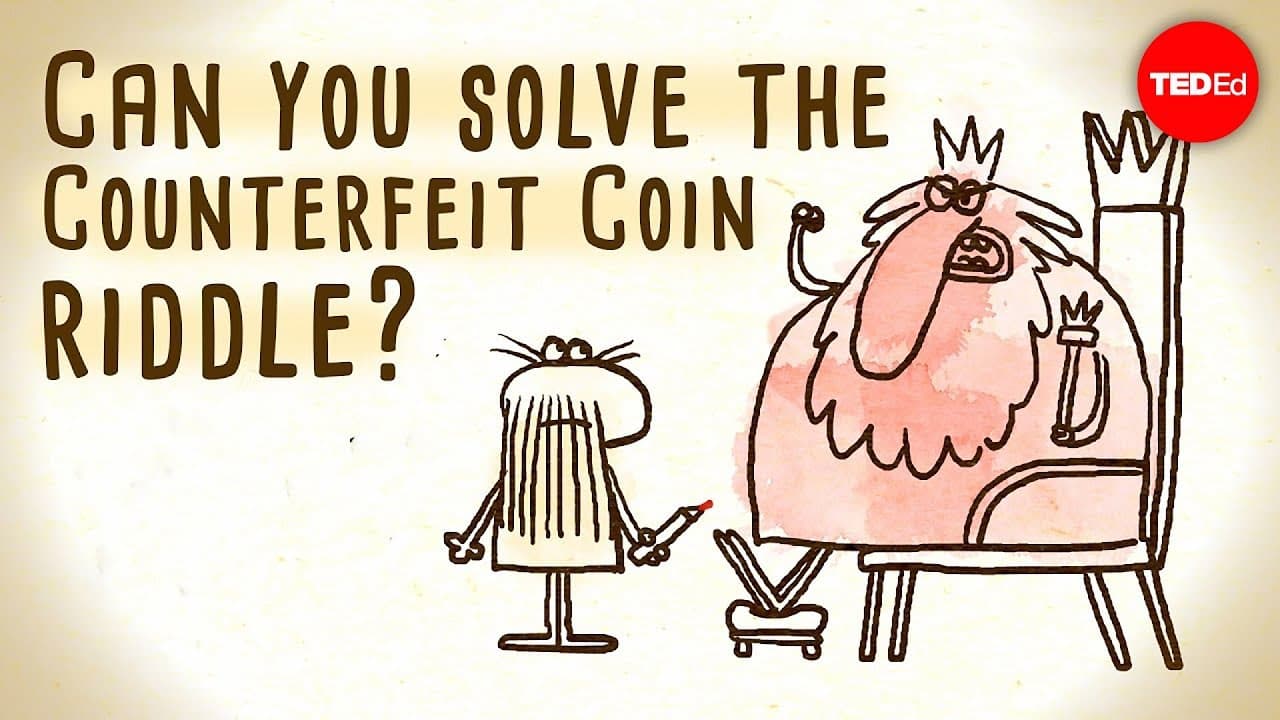
Can you solve the counterfeit coin riddle? - Jennifer Lu
TL;DR
To identify a counterfeit coin among 12 using a balance scale in just three weighings, divide the coins into three groups of four and weigh two groups. If they balance, the counterfeit is in the unweighed group. By strategically marking results and reweighing, you can pinpoint the counterfeit coin efficiently.
Transcript
You’re the realm’s greatest mathematician, but ever since you criticized the emperor's tax laws, you’ve been locked in the dungeon with only a marker to count the days. But one day you're suddenly brought before the emperor, who looks even angrier than usual. One of his 12 governors has been convicted of paying his taxes with a counterfeit coin, w... Read More
Key Insights
- 🪙 Use a systematic approach by dividing the coins into three piles of four each to efficiently identify the counterfeit coin.
- 👣 Employ a marker to track the results of each weighing and categorize the coins as authentic or potentially fake.
- 🪙 Re-weigh the coins strategically based on the initial marking to eliminate ambiguity and pinpoint the fake coin effectively.
- ⚖️ The balance scale is an essential tool in the puzzle, aiding in comparing the weights of different coin combinations.
- 🤔 Success in the puzzle requires precision, critical thinking, and strategizing to maximize the three allowed weighings.
- 😫 Adhering to the rules set by the emperor is crucial for the mathematician to secure freedom and avoid being thrown back into the dungeon.
- 🤔 The puzzle highlights the importance of logic, deduction, and methodical thinking in solving complex problems with limited resources.
Install to Summarize YouTube Videos and Get Transcripts
Explore YouTube Video Summarizer or Get YouTube Transcript Extractor
Questions & Answers
Q: How many coins must the mathematician identify as counterfeit to earn freedom?
The mathematician needs to identify just one counterfeit coin among the 12 coins to secure freedom.
Q: What role does the balance scale play in identifying the counterfeit coin?
The balance scale helps compare the weights of different coin piles, aiding in deducing the fake coin based on its weight variation.
Q: Why is it crucial to strategize and mark the coins during the process?
Strategizing and marking the coins help track the results of each weighing, ensuring a systematic approach to identifying the counterfeit coin efficiently.
Q: What happens if the mathematician fails to identify the counterfeit coin in three weighings?
Failure to identify the counterfeit coin within three weighings will result in being thrown back into the dungeon, as per the emperor's mandate.
Summary
In this video, the greatest mathematician in the realm is given a chance to earn his freedom by identifying a counterfeit coin. He is presented with 12 identical coins and a balance scale. The false coin is known to be slightly lighter or heavier than the rest. He is only allowed to use the scale three times. Through strategic weighing and marking, he is able to narrow down the possibilities and identify the counterfeit.
Questions & Answers
Q: How many times can the mathematician use the balance scale?
The mathematician can use the balance scale three times.
Q: What is the initial step in identifying the counterfeit coin?
The initial step is to divide the 12 coins into three equal piles of four.
Q: What do we do if the two sides balance when weighing two piles of coins?
If the two sides balance, all eight coins on the scale are real and the fake must be among the remaining four.
Q: How does the mathematician keep track of the results?
The mathematician can use a marker to mark the eight authentic coins with a zero.
Q: What does the mathematician do after marking the eight authentic coins?
After marking the eight authentic coins, the mathematician takes three of them and weighs them against three unmarked coins.
Q: What happens if the three marked coins and the three unmarked coins balance?
If the three marked coins and the three unmarked coins balance, the remaining unmarked coin must be the fake.
Q: How does the mathematician determine the fake coin if the three marked coins and the three unmarked coins do not balance?
If the three marked coins and the three unmarked coins do not balance, the mathematician checks the marks. If they are plus coins, the heavier one is the impostor. If they are marked with minus, it's the lighter one.
Q: What happens if the first two piles weighed do not balance?
If the first two piles weighed do not balance, the mathematician marks the coins on the heavier side with a plus and the coins on the lighter side with a minus. The remaining four coins can be marked with zeros.
Q: How can the mathematician remove all remaining ambiguity in just two more ways?
To remove all remaining ambiguity, the mathematician can reassemble the piles. One method is to replace three of the plus coins with three of the minus coins and replace those with three of the zero coins.
Q: What possibilities arise after reassembling the piles?
After reassembling the piles, there are three possibilities. If the previously heavier side of the scale is still heavier, the remaining plus coin on that side is actually the heavier one, or the remaining minus coin on the lighter side is actually the lighter one.
Takeaways
In this puzzle, the mathematician effectively uses the balance scale and strategic marking to narrow down the possibilities and identify the counterfeit coin. By cleverly dividing and reassembling the piles, he is able to remove ambiguity and make accurate conclusions. This demonstrates the importance of strategic thinking and problem-solving skills in finding solutions, even in challenging situations.
Summary & Key Takeaways
-
The realm's top mathematician must find a counterfeit coin among 12 identical coins using a balance scale in three weighings to gain freedom.
-
Divide the 12 coins into three piles of four each, weigh them, and track the results using a marker.
-
By strategically marking and re-weighing the coins, narrow down to the fake coin in three weighings to win freedom.
Read in Other Languages (beta)
Share This Summary 📚
Summarize YouTube Videos and Get Video Transcripts with 1-Click
Try YouTube Summary with ChatGPT & Claude or YouTube Transcript Generator
Explore More Summaries from TED-Ed 📚



Summarize YouTube Videos and Get Video Transcripts with 1-Click
Try YouTube Summary with ChatGPT & Claude or YouTube Transcript Generator