How to Lead a Company Through Crisis and Chaos
TL;DR
Effective leadership means facing painful realities, communicating honestly, making difficult decisions quickly, and concentrating on what can be controlled. CEOs also need trusted support, resilient teams, appropriate leadership for peacetime or wartime, and the endurance to keep learning and moving forward when every available option is difficult.
Transcript
What does it really take to lead a company through separates successful CEOs from those who collapse things, building a business when there are no easy venture capitalist, and co-founder of look at what it's really like to build and run a formulas and motivational quotes, the hard thing hard, messy, and full of impossible decisions. Horowitz draws ... Read More
Key Insights
- The struggle is a normal part of building a business, not automatic evidence of failure. When the team is losing confidence and nothing appears to work, leaders must acknowledge the fear and exhaustion, remain calm, and continue moving forward with purpose.
- Hard leadership decisions often have no painless solution. Great leaders accept that every available option may be bad, make the best decision they can under pressure, take responsibility for the consequences, and move forward instead of waiting for a perfect answer.
- The CEO role is psychologically isolating because some decisions can be made by no one else. Layoffs, strategic choices, and company-threatening problems create self-doubt, so effective CEOs develop support systems involving mentors, peers, and trusted people with whom they can discuss fear.
- Transparency is essential when a company misses targets or faces funding challenges. Teams can handle difficult news more effectively than unexplained uncertainty, so leaders should communicate honestly, preserve trust, and give employees a clear understanding of the problems the organization must confront.
- Layoffs should be handled quickly, clearly, and compassionately. Leaders must preserve the dignity of affected employees, show empathy, and provide as much support as possible, recognizing that dismissing people is among the most painful responsibilities a CEO may face.
- The CEO's job changes as a company grows. A leader must move beyond personally doing the work and hire executives who can scale with the organization, because building a durable company requires both a strong product and a capable leadership team.
- Fast, informed action is better than waiting for perfection during uncertainty. Leaders should use the information available, make a decisive call, study the result, and change direction when needed because delayed action can be fatal when conditions are changing quickly.
- Company culture is created through consistent leadership decisions, especially during crises. Whether leaders take responsibility, preserve trust, or cut corners reveals what the organization truly values, because culture is defined by repeated behavior rather than perks, slogans, or stated aspirations.
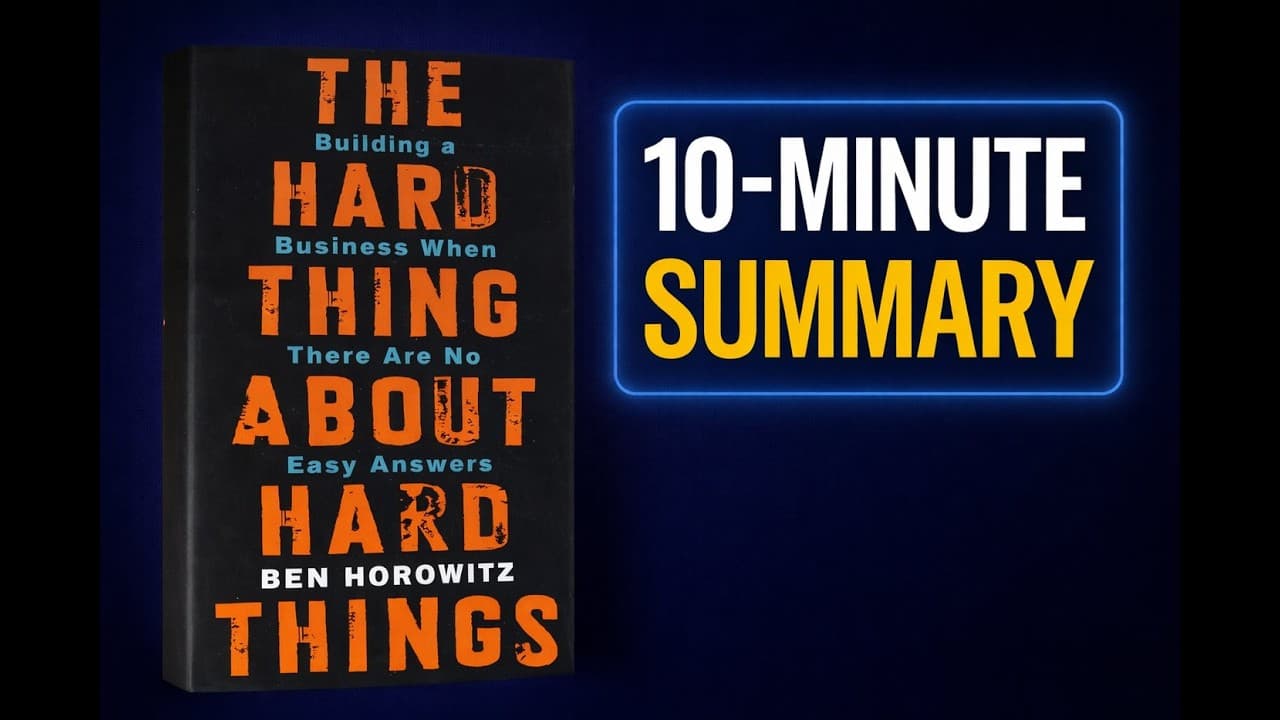
- Related book: The Hard Thing About Hard Things
- Export your Kindle highlights to Glasp: How to Download Highlights and Notes from Kindle
- More videos about this book:
- More videos with Ben Horowitz:
Install to Summarize YouTube Videos and Get Transcripts
Explore YouTube Video Summarizer or Get YouTube Transcript Extractor
Questions & Answers
Q: How should a CEO lead when nothing seems to work?
A CEO should first recognize that fear, exhaustion, and uncertainty are part of the struggle rather than conclusive signs of failure. The leader must remain calm, communicate honestly with the team, concentrate on controllable priorities, and keep making decisions. Trusted mentors, peers, and other support systems can also help the CEO manage isolation and self-doubt while continuing to move forward.
Q: How can leaders make decisions when every option is bad?
Leaders should accept that difficult situations may offer no painless or clearly correct choice. Their responsibility is to evaluate the available information, make the best call they can, accept responsibility for its consequences, and move forward decisively. They should then learn from the outcome and adjust quickly instead of delaying action while waiting for certainty or a perfect solution.
Q: Why is honesty important during a company crisis?
Honesty preserves trust when a company misses targets, faces funding problems, or confronts another serious threat. Employees can handle difficult news, but unexplained uncertainty can damage confidence and alignment. Leaders should clearly describe the situation, acknowledge its seriousness, and help the team understand what must happen next. Transparent communication also supports faster, more coordinated decisions during periods of chaos.
Q: How should a company conduct layoffs with dignity?
Layoffs should be carried out quickly, clearly, and compassionately rather than approached casually or allowed to drag on. Leaders should communicate the decision honestly, treat every affected employee with empathy and respect, and offer as much support as possible during the transition. The process should reflect the principle of being a human being first and a boss second.
Q: What is the difference between peacetime and wartime leadership?
Peacetime leadership focuses on growth, optimization, and scaling under relatively stable conditions. Wartime leadership is required when the company faces an existential threat and must survive. In wartime, a CEO needs to act with greater urgency, remain resilient, and make unpopular decisions when necessary. Effective leaders recognize which situation they are in and adapt their approach accordingly.
Q: How does a CEO's role change as a company grows?
As a company grows, the CEO must shift from personally doing much of the work to building an organization capable of operating at greater scale. This includes hiring executives who can grow with the company and creating a strong leadership team. A successful CEO does not focus only on building the product, but also develops the people and structure needed to sustain the business.
Q: How is company culture created during a crisis?
Company culture is created by the repeated choices leaders make, especially when circumstances are painful. Decisions about taking responsibility, communicating honestly, preserving trust, supporting employees, or cutting corners demonstrate the organization's real values. Perks and slogans do not define culture as strongly as consistent behavior. A crisis therefore exposes and reinforces what leaders and the company genuinely value.
Q: What responsibilities should remain with the CEO?
The CEO's central responsibilities are setting direction, making the most important strategic decisions, and keeping the team aligned. Many operational tasks can be delegated, but certain choices belong to the CEO because no one else can assume final responsibility for them. During uncertainty, the CEO must focus on these duties, act decisively with available information, and maintain the team's ability to move forward.
Summary & Key Takeaways
-
Building and leading a company involves an unavoidable struggle marked by fear, exhaustion, uncertainty, and moments when nothing seems to work. Successful leaders do not treat this pain as proof of failure. They remain calm, endure it with purpose, seek trusted support, and continue moving forward despite isolation and self-doubt.
-
Leadership becomes most demanding when every option is bad. CEOs must accept responsibility for decisions that cannot be delegated, including layoffs and strategic choices. They should communicate difficult news honestly, treat affected employees with dignity and compassion, act with available information, learn quickly, and adjust their course when circumstances change.
-
A company's needs change as it grows or enters an existential crisis. Leaders must build an executive team that can scale, create culture through consistent decisions, distinguish peacetime from wartime, and focus attention on controllable priorities. The CEO's central responsibilities remain setting direction, making strategic calls, and keeping the team aligned.
Read in Other Languages (beta)
Share This Summary 📚
Summarize YouTube Videos and Get Video Transcripts with 1-Click
Try YouTube Summary with ChatGPT & Claude or YouTube Transcript Generator