How to Lead a Company Through Its Hardest Times
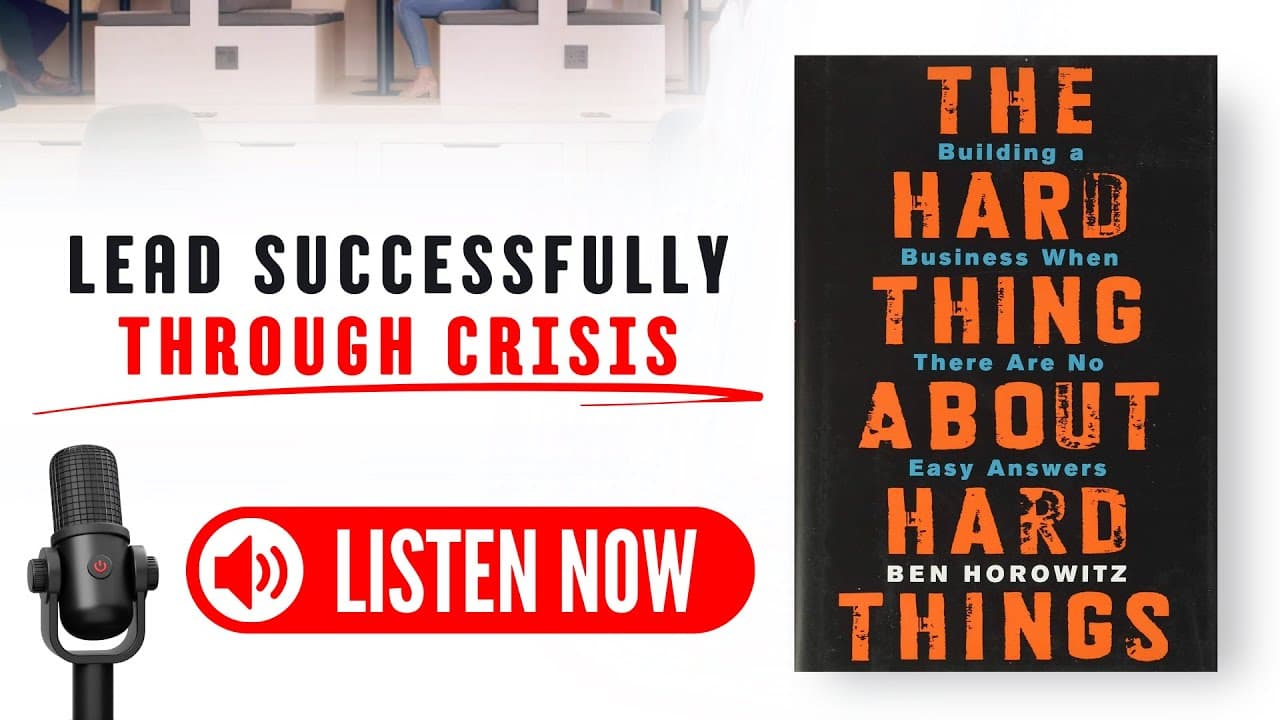
TL;DR
Effective leadership in difficult times requires making courageous decisions with incomplete information, communicating openly, and continuing to identify the next practical step. Entrepreneurs should treat struggle as a normal part of building a company, share burdens with their teams, protect trust during layoffs, and introduce processes only after confirming that the product has a stable market.
Transcript
Welcome to our summary of the hard thing about hard things by Ben Horowitz in this book Ben Horowitz talks about the tough realities of running a business and leading a team he focuses on the challenges that don't have easy answers horowitt starts by discussing the hard things in business those critical decisions and tough situations where leaders ... Read More
Key Insights
- The entrepreneurial struggle is an emotional and mental burden that can include self-doubt, fear of failure, loneliness, sleeplessness, loss of appetite, and self-blame. Experiencing these pressures does not necessarily mean the entrepreneur or company has already failed.
- The key to surviving difficult periods is to keep finding a next step, share responsibility with the team, and view setbacks as part of the entrepreneurial journey. Horowitz presents perseverance through hardship as a source of grit and stronger leadership.
- A CEO is responsible for guiding company direction and making consequential decisions even when information is incomplete. Effective leadership requires a clear but adaptable vision, ambition focused on company success, and the ability to unite people during unexpected challenges.
- Peacetime and wartime leadership require different approaches. A peacetime CEO can emphasize growth, creativity, and innovation, while a wartime CEO must respond to serious threats with focused, rapid, and sometimes painful decisions that protect the company.
- Courageous leadership is action taken despite fear, not the absence of fear. CEOs inevitably experience doubt, but they must remain calm, keep learning, adapt to changing conditions, and make necessary decisions even when those choices are unpopular.
- A healthy company culture depends on transparency, accountability, and psychological safety around difficult information. Employees should be able to report bad news, raise concerns, and challenge current practices without fear so that problems can be addressed before they grow.
- Respectful layoffs require clear communication, empathy, support for affected employees, and acknowledgment of leadership mistakes that contributed to the situation. This approach helps preserve trust and cultural integrity among both departing employees and those who remain.
- Sustainable scaling requires proven product-market fit, structured communication, thoughtful organizational design, and employee development. Processes should be designed with input from people doing the work, preserve useful startup flexibility, and support effective decisions as the organization becomes larger.
- Related book: The Hard Thing About Hard Things
- Export your Kindle highlights to Glasp: How to Download Highlights and Notes from Kindle
- More videos about this book:
- More videos with Ben Horowitz:
Install to Summarize YouTube Videos and Get Transcripts
Explore YouTube Video Summarizer or Get YouTube Transcript Extractor
Questions & Answers
Q: How can entrepreneurs handle the struggle of building a company?
Entrepreneurs can handle the struggle by recognizing that fear, doubt, loneliness, and setbacks are normal parts of pursuing ambitious goals. They should share burdens with their teams instead of carrying every problem alone, keep difficulties in perspective, and continue identifying the next practical step. Horowitz argues that perseverance through these experiences can build the grit and determination needed to lead successfully.
Q: What is the difference between a peacetime CEO and a wartime CEO?
A peacetime CEO leads when the company has room to concentrate on growth, creativity, and an environment that supports innovation. A wartime CEO operates when serious threats endanger the business and must shift toward urgent, focused action. In that setting, the leader may need to make rapid, unpopular, or painful decisions to keep the company operating and protect its future.
Q: How should a CEO make decisions with incomplete information?
A CEO should accept that important decisions often must be made quickly, under pressure, and without complete information. The leader must remain calm, evaluate the available facts, and act with courage even when the correct choice is unpopular. Continued learning and adaptation are essential because new information may require a change in direction, priorities, or leadership approach.
Q: Why is managing your own mind important for a CEO?
Managing the mind is important because constant pressure and unpredictable events can push a CEO toward despair, self-doubt, or poor judgment. The leader remains responsible for major decisions even when afraid or emotionally exhausted. Staying calm, separating setbacks from personal failure, sharing burdens, and continuing to seek a next step can help preserve the judgment needed to guide the company.
Q: How should leaders conduct layoffs while preserving trust?
Leaders should conduct layoffs with transparency, empathy, respect, and meaningful support for the employees who are losing their jobs. They should communicate clearly about what is happening and acknowledge leadership mistakes that contributed to the decision. This treatment matters to departing employees and to those who remain, because evasive or disrespectful behavior can damage morale, trust, and the company’s cultural integrity.
Q: How does open communication strengthen company culture?
Open communication allows employees to share bad news, express concerns, and challenge existing practices without fear. That openness helps the company identify and address problems before they become larger. Management practices that suppress difficult information can produce resentment, obstruct innovation, and hide serious issues. Transparency therefore serves as a foundation for accountability, informed decisions, trust, and organizational health.
Q: When should a startup begin scaling its operations?
A startup should scale after its product has demonstrated value, resonates with customers, and has a stable market with a clear path toward sustainable growth. Expanding before establishing that foundation creates the scale anticipation fallacy described in the summary. Premature growth can waste resources, create inefficiencies, and separate the company’s offering from what the market actually needs.
Q: How should processes and organizational structure change as a company grows?
As a company grows, informal communication and decision methods may become inefficient, so leaders should introduce clear processes and a deliberate organizational structure. Employees who perform the relevant work should help design those processes because they understand practical needs. The resulting communication architecture should support information flow, clarify decisions, align teams with strategy, place appropriate leaders, and preserve useful startup flexibility.
Summary & Key Takeaways
-
Entrepreneurship involves an intense struggle marked by uncertainty, fear of failure, loneliness, sleeplessness, and self-doubt. Horowitz advises leaders to share burdens with their teams, keep setbacks in perspective, and always search for the next step. Enduring these pressures can develop the grit required to continue building a company.
-
Effective CEOs guide company direction and accept responsibility for outcomes while making difficult decisions with limited information. They communicate an adaptable vision, place company success above personal achievement, manage their own emotions, and act despite fear. Their leadership style must also change according to the company’s circumstances.
-
Strong companies depend on capable people, deliberate culture, transparent communication, suitable processes, and effective organizational design. Leaders should handle layoffs respectfully, create safe channels for bad news, and invest in employee training. Before scaling, they should confirm product-market fit and establish systems that preserve flexibility while preventing organizational chaos.
Read in Other Languages (beta)
Share This Summary 📚
Summarize YouTube Videos and Get Video Transcripts with 1-Click
Try YouTube Summary with ChatGPT & Claude or YouTube Transcript Generator