
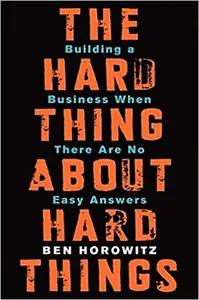
The Hard Thing About Hard Things: Building a Business When There Are No Easy Answers—Straight Talk on the Challenges of Entrepreneurship
About This Book
Ben Horowitz’s The Hard Thing About Hard Things is a management book for situations where standard business advice breaks down. Grounded in startup crises, it argues that the hardest leadership moments have no formula: layoffs, executive firings, broken products, collapsing markets, political infighting, and the private psychological burden of being the person who must decide anyway.
A major thread in the highlights is that CEOs and founders must confront reality without hiding behind odds, conventional wisdom, or overly optimistic storytelling. Horowitz insists that when a company is in trouble, the job is not to calculate the probability of success but to find a path forward. That means focusing when there are no good moves, resisting market consensus when it is wrong, and remembering that innovation often requires founders to ignore current customer requests and invent what the market cannot yet articulate.
The book also emphasizes operational clarity.
- Strong organizations let people do meaningful work with clear expectations.
- Weak organizations trap people in politics, broken processes, and unclear roles.
- Trust, honest communication, and the fast flow of bad news are essential to execution.
Another core theme is people management under stress. Horowitz argues that leaders must tell the truth, especially during layoffs, and that managers must personally handle hard conversations rather than outsourcing them to HR. Hiring should be for specific strengths needed now, not for generic prestige or lack of weaknesses. Training is presented as a high-leverage managerial duty, not an optional perk.
Across product, hiring, culture, and crisis, the book’s structure builds toward one consistent claim: leadership is less about charisma or theory than about making hard, often painful choices clearly, responsibly, and in time. A good company takes care of people first, because culture and trust determine whether the business survives when everything goes wrong.
Key Takeaways
- 1.There is no formula for the hardest leadership problems, so judgment under pressure matters more than generic best practices.
- 2.Founders and product leaders must own product strategy, because customers usually cannot specify the truly right product on their own.
- 3.In a crisis, CEOs should not fixate on probabilities; their job is to find the answer and keep the company alive long enough to reach it.
- 4.Trust is the foundation of execution, and trust grows when leaders tell the truth instead of projecting false positivity.
- 5.A strong company culture makes bad news travel fast, reduces politics, and lets people focus on meaningful work instead of organizational friction.
- 6.Hiring executives works best when you define the exact strengths needed for the current stage, not an abstract ideal leader.
- 7.Training is one of the highest-leverage jobs a manager can do, because better managers and clearer expectations compound across the organization.
Top Highlights
company, you must believe there is an answer and you cannot pay attention to your odds of finding
Highlighted by 14 people
figuring out the right product is the innovator’s job, not the customer’s job.
Highlighted by 13 people
There are no shortcuts to knowledge, especially knowledge gained from personal experience. Following conventional wisdom
Highlighted by 11 people
whenever a large organization attempts to do anything, it always comes down to a single person who can delay the entire project.
Highlighted by 11 people
Note to self: It’s a good idea to ask, “What am I not doing?
Highlighted by 10 people
most important rule of raising money
Highlighted by 8 people
Former secretary of state Colin Powell says that leadership is the ability to get someone to follow you even if only out of curiosity.
Highlighted by 7 people
hire for strength rather than lack of weakness.
Highlighted by 7 people
In good organizations, people can focus on their work and have confidence that if they get their work done, good things will happen for both the company and them personally.
Highlighted by 7 people
No matter who you are, you need two kinds of friends in your life. The first kind is one you can call when something good happens, and you need someone who will be excited for you. Not a fake excitement veiling envy, but a real excitement. You need someone who will actually be more excited for you than he would be if it had happened to him. The second kind of friend is somebody you can call when things go horribly wrong—when your life is on the line and you only have one phone call. Who is it going to be? Bill Campbell is both of those friends.
Highlighted by 6 people
AI Review
Glasp’s AI analysis of 28 reader highlights suggests a highly resonant leadership book with unusually strong consensus around its practical advice for crisis, product judgment, trust, and management. Readers most consistently highlighted its candid, experience-based lessons rather than abstract theory.
Pros
- +Highly quotable, high-consensus advice on hard leadership decisions
- +Strong emphasis on honesty and trust during crisis
- +Practical guidance on layoffs, executive hiring, and management training
- +Memorable framework for founder-led product judgment
- +Useful warnings about politics, bad news suppression, and management debt
- +Grounded in lived operating experience rather than generic formulas
Cons
- −Advice is heavily oriented toward startups and tech companies
- −Tone can be intense and confrontational
- −Less step-by-step than readers seeking neat frameworks may want
- −Some lessons depend on crisis scenarios more than steady-state management
Glasp AI analysis based on highlights from 28 readers.
Who Should Read This
This book is best for founders, startup CEOs, senior operators, product leaders, and first-time managers dealing with ambiguity, scale, or crisis. It is especially useful for people hiring executives, managing culture, leading reorganizations, or communicating through layoffs. Readers in venture-backed tech will get the most direct fit, but the lessons on trust, decision-making, and organizational politics also apply to leaders in any fast-moving company. Some familiarity with startups and management helps, but the core ideas are accessible to ambitious new leaders too.
Frequently Asked Questions
What is the book about?
Who is this book for?
What are the key lessons from the book?
Is it worth reading?
What does the book say about product strategy?
How does the book approach layoffs and firing?
What does the book say about company culture?
How to Apply What You Read
- 1.Add a recurring meeting question: "What are we not doing?" and use it to surface blind spots.
- 2.Audit whether bad news moves quickly in your team, and remove habits or slogans that discourage people from raising problems.
- 3.Clarify the exact strengths needed for your next hire before interviewing, especially for executive roles.
- 4.Teach one management expectation yourself, such as one-on-ones, feedback, or performance reviews, instead of delegating all training.
- 5.Review whether your organization rewards company-first ambition or political behavior, then tighten the processes that create gamesmanship.
Discussion Questions
- Q1.Which idea in the book feels most true in your own work: that there are no formulas, or that leaders still need disciplined operating habits?
- Q2.When should a founder ignore customer input or market consensus, and when does that become dangerous arrogance?
- Q3.What is the difference between healthy optimism and dishonest positivity in leadership communication?
- Q4.How can a company encourage bad news to travel fast without creating panic or blame?
- Q5.Have you seen organizations hire for lack of weakness rather than true strength? What were the consequences?
- Q6.What makes layoffs or executive firings feel fair or unfair to the people who remain?
- Q7.How much of great leadership can be taught through training, and how much only comes from experience?
Recommended Books
Revisit Your Highlights, Deepen Your Understanding
Import your Kindle highlights to review, organize, and share the ideas that matter most to you.
Get the free browser extension