How to Lead a Startup Through Its Hardest Times
TL;DR
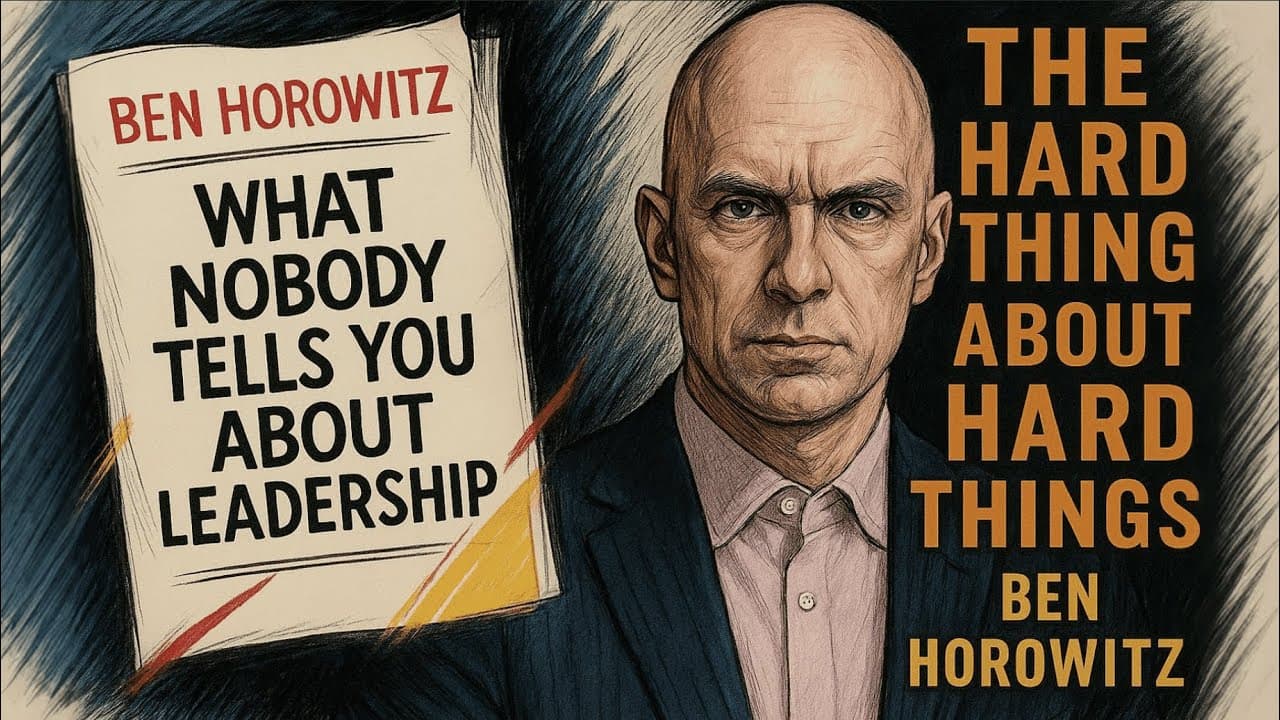
Startup survival depends on accepting hardship, addressing fundamental problems through persistent work, and protecting the people who make recovery possible. Ben Horowitz’s experiences suggest that leaders must decide with incomplete information, communicate the severity of a crisis honestly, improve products one problem at a time, and build loyalty by placing people before products and profits.
Transcript
What if I told you that the most successful CEOs in Silicon Valley wake up at 3 AM... not to meditate or exercise... but because they're having panic attacks about losing everything? Here's the shocking truth: A study of 242 tech CEOs found that 72% experienced severe anxiety, 39% battled depression, and nearly all felt completely alone. Yet th... Read More
Key Insights
- The Struggle is portrayed as a normal part of building a meaningful company, not as proof that a founder is uniquely failing. It forces leaders to make decisions with limited information, operate while frightened, and search for solutions that are not yet obvious.
- Loudcloud’s crisis combined corporate and personal pressure at the same time. The company had only 21 days of cash, the dot-com crash had eliminated 90% of its customers, and Horowitz continued an IPO roadshow while his wife was hospitalized after she stopped breathing.
- Lead bullets are repeated, concrete improvements that solve the underlying problem. When a competing Microsoft web server was described as 5 times faster than Netscape’s and free, partnerships, pivots, and platform strategies could not substitute for making the core product more competitive.
- Opsware’s response to BladeLogic was sustained execution rather than a single breakthrough. Engineers worked intensely for 6 months, improving the product one feature, one bug, and one customer at a time until the company began winning every competitive situation described in the transcript.
- Searching for a silver bullet can be an attempt to avoid painful work. The more useful leadership question is which specific lead bullets must be fired today, because competitors may continue executing while management waits for a perfect strategy.
- People, products, and profits should be prioritized in that order, according to the management principle attributed to Jim Barksdale. The reasoning is that committed people create stronger products, and stronger products provide the foundation for sustainable profits.
- Horowitz authorized $200,000 for the cancer treatment of John, the terminally ill CFO of Tangram, even though John would not join Opsware. The decision helped John’s widow and signaled to employees that the company’s stated concern for people involved real financial sacrifice.
- Culture is presented as a competitive advantage that cannot be copied as quickly as products, marketing strategies, or customer relationships. Employees who hear about meaningful acts of care may remain through difficult periods because they trust their work, their colleagues, or their leader.
- Related book: The Hard Thing About Hard Things
- Export your Kindle highlights to Glasp: How to Download Highlights and Notes from Kindle
- More videos about this book:
Install to Summarize YouTube Videos and Get Transcripts
Explore YouTube Video Summarizer or Get YouTube Transcript Extractor
Questions & Answers
Q: How should startup leaders handle severe business crises?
Startup leaders should accept that fear and uncertainty are part of the crisis, identify the company’s fundamental problems, and keep making decisions even when information is incomplete. Horowitz’s Loudcloud experience shows that corporate emergencies may coincide with intense personal pressure. Effective leadership therefore requires continued focus, honest recognition of the danger, and persistent action rather than waiting to feel confident.
Q: What does The Struggle mean for entrepreneurs?
The Struggle refers to the period when a founder’s plans deteriorate, failure appears likely, and every available choice carries serious consequences. The transcript presents it as a normal feature of entrepreneurship that teaches leaders to decide with limited information, lead while afraid, and develop solutions that do not already exist. Founders often experience this hardship privately and mistakenly believe they are suffering alone.
Q: What is the difference between lead bullets and silver bullets?
A silver bullet is a hoped-for move that supposedly fixes a company’s crisis at once, such as a partnership, pivot, or new platform strategy. Lead bullets are the many ordinary actions that correct the real problem, including improving features, repairing bugs, and serving customers. The lesson is that sustained execution usually matters more than finding a clever shortcut that avoids difficult work.
Q: How did Opsware compete against BladeLogic?
Opsware competed by committing its engineering organization to 6 months of intensive product improvement. The team worked on individual features, bugs, and customer needs instead of relying on one dramatic strategic solution. According to the transcript, this sustained effort eventually enabled Opsware to defeat BladeLogic in every competitive situation. The result illustrates how accumulated operational improvements can reverse a serious competitive disadvantage.
Q: Why should a company prioritize people before profits?
A company should prioritize people because their commitment determines whether products improve and whether the business can survive difficult periods. The transcript argues that employees may join during good times for opportunity, compensation, or career growth, but stay during bad times because they value their work or trust their leader. Genuine care can therefore strengthen retention, cooperation, and the company’s long-term ability to generate profits.
Q: How did Horowitz demonstrate a people-first leadership principle?
Horowitz found $200,000 to cover cancer treatment for John, the terminally ill CFO of Tangram, after Opsware acquired the company. John would not become an Opsware employee, and the business was already under financial pressure. The action helped John’s widow avoid deeper despair and showed existing employees that concern for people was more than a slogan, strengthening trust throughout the organization.
Q: Why is company culture difficult for competitors to copy?
Company culture is built through repeated decisions that show employees what leaders truly value, especially when those decisions are expensive or inconvenient. Competitors may reproduce a product, adopt a marketing strategy, or pursue the same customers, but they cannot instantly recreate relationships founded on sacrifice and trust. Horowitz’s decision to support a stranger’s medical treatment became powerful because employees viewed it as authentic evidence of the company’s principles.
Q: What leadership lessons does Ben Horowitz offer CEOs?
Horowitz’s lessons emphasize enduring The Struggle, solving core problems through lead bullets, and prioritizing people before products and profits. The description also identifies distinctions between peacetime and wartime leadership, the danger of management debt, the importance of one-on-one meetings, direct handling of executive dismissals, and the need to keep building despite outside indifference. Together, these principles focus on difficult managerial realities rather than simple formulas.
Summary & Key Takeaways
-
Entrepreneurial hardship is presented as an unavoidable test rather than evidence that a founder is uniquely cursed. During Loudcloud’s crisis, Ben Horowitz faced an approaching bankruptcy, a collapsing customer base, an IPO roadshow, and his wife’s medical emergency. The experience taught him to keep functioning despite fear, uncertainty, and incomplete information.
-
Companies rarely escape serious competitive problems through one clever strategic move. When Opsware struggled against BladeLogic, its team spent 6 months improving individual features, correcting bugs, and winning customers. The lesson is to identify the necessary lead bullets, perform the difficult work consistently, and stop waiting for a painless rescue.
-
The recommended priority is people first, products second, and profits third. Horowitz illustrated this principle by funding treatment for the terminally ill CFO of an acquired company, despite Opsware’s financial pressure. Employees interpreted the decision as evidence of genuine care, strengthening trust, loyalty, and a culture competitors could not easily reproduce.
Read in Other Languages (beta)
Share This Summary 📚
Summarize YouTube Videos and Get Video Transcripts with 1-Click
Try YouTube Summary with ChatGPT & Claude or YouTube Transcript Generator