How to Lead a Company Through Crisis and Chaos
TL;DR
Effective leaders act before certainty arrives, communicate harsh realities clearly, and keep decisions aligned with the organization’s mission. Surviving a crisis also requires a resilient culture built through accountability, consistent standards, hard conversations, careful advice, mental fortitude, and the humility to adapt when new information reveals that the original plan is failing.
Transcript
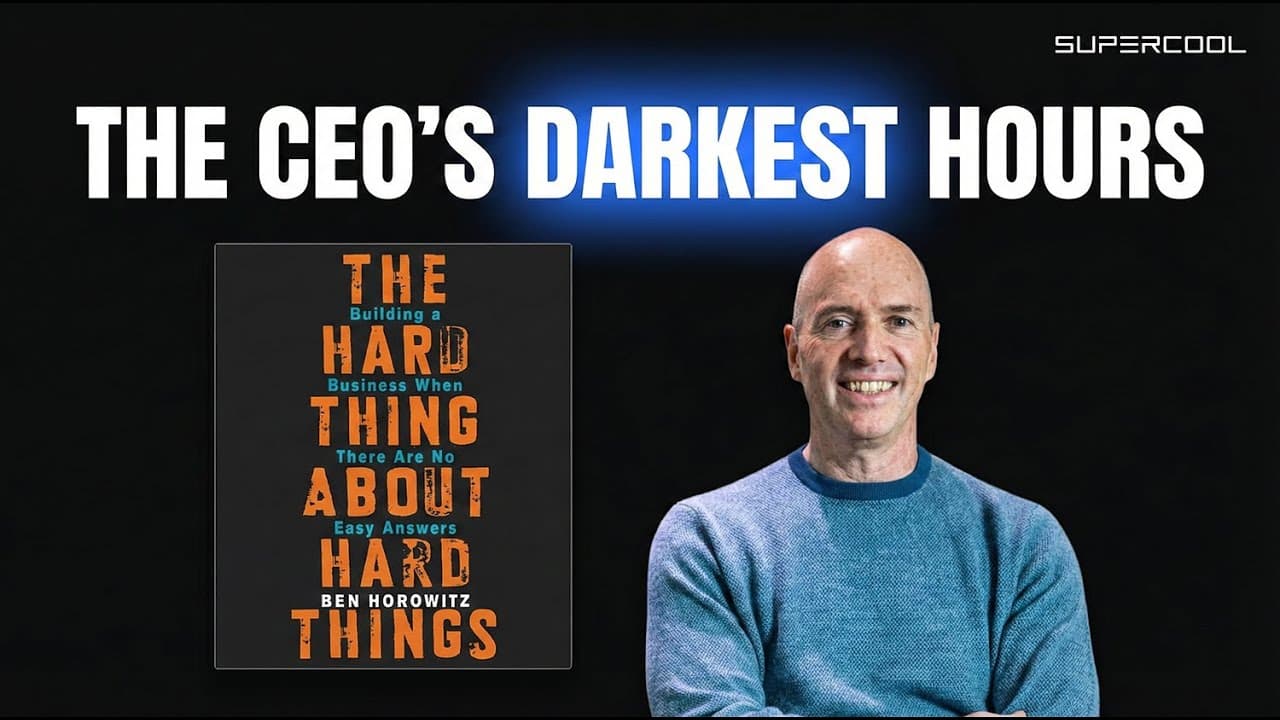
The Hard Thing About Hard Things by Ben Horowitz. Building a business is not a glamorous quest. It is a relentless battle that demands perseverance, clarity, and hard decisions. Ben Horowitz's The Hard Thing About Hard Things strips away illusions about entrepreneurship, focusing on the raw, unvarnished truth of leading a company through crises, pi... Read More
Key Insights
- Uncertainty is the natural terrain of leadership because major decisions rarely arrive with complete information. Leaders must assess what they know, consult experienced people, choose the path that offers the best chance of survival or progress, and remain prepared to adapt as circumstances change.
- The cost of inaction is often greater than the cost of an imperfect decision. LoudCloud’s existing direction was failing during a collapsing market, so Horowitz accepted the risk of transforming the business into Opsware rather than waiting for certainty while the company’s options continued to disappear.
- Decisive leadership is compatible with adaptation because commitment does not require ignoring new evidence. A leader can act firmly on the available information while recalibrating strategy as reality evolves, treating unsuccessful experiments as opportunities to strengthen judgment, resilience, and future execution.
- Transparent communication is essential during chaos because employees already recognize when an organization is in danger. Acknowledging difficult facts helps preserve trust, while sugarcoating conditions clouds judgment and leaves people without the clarity they need to understand priorities, risks, and necessary sacrifices.
- Consistency gives a team stability when external conditions are unstable. Horowitz changed structures and made painful decisions during LoudCloud’s crisis, but he continued reinforcing the company’s mission and values, showing that operational plans may change without abandoning the organization’s central purpose.
- Decisiveness prevents panic from filling the vacuum created by delayed leadership. Selling LoudCloud’s hosting operation and pivoting toward software was painful and uncertain, but the choice provided a clear direction when maintaining the existing business model appeared to offer no viable path forward.
- A resilient culture is built through repeated actions, shared values, and disciplined standards. At Opsware, accountability, ownership, focus, and high performance were treated as operational requirements that helped employees endure pressure rather than as slogans intended merely to make the workplace sound appealing.
- Culture must align with the practical demands of the business because contradictory norms weaken execution during crises. Leaders build organizational strength by setting clear expectations, rewarding excellent work, addressing mediocrity, resolving internal conflict, and ensuring that employees accept responsibility for outcomes.
- Related book: The Hard Thing About Hard Things
- 📥 Export your Kindle highlights to Glasp: How to Download Highlights and Notes from Kindle
- More videos about this book:
- 🎙️ More videos with Ben Horowitz:
Install to Summarize YouTube Videos and Get Transcripts
Explore YouTube Video Summarizer or Get YouTube Transcript Extractor
Questions & Answers
Q: How should leaders make decisions with incomplete information?
Leaders should accept that perfect clarity is rarely available when stakes are highest. They must evaluate the information they have, draw on their own experience and that of trusted colleagues, and select the option that offers the strongest chance of survival or progress. After committing to the decision, they should monitor reality and adapt when new evidence changes the situation.
Q: Why can inaction be more dangerous than a wrong decision?
Inaction allows deteriorating conditions to continue while opportunities, money, time, and organizational confidence disappear. LoudCloud could not safely remain on its existing course in a collapsing market, even though its alternative was uncertain. Acting created a possibility of survival, while waiting for complete information would have deepened the crisis and reduced the company’s remaining strategic options.
Q: How did Ben Horowitz respond to LoudCloud’s crisis?
Horowitz confronted dwindling cash, a collapsing technology market, retreating investors, reduced customer spending, and powerful competitors. He led painful measures that included layoffs and restructuring, then sold LoudCloud’s hosting business and transformed the company into the software business Opsware. The pivot was not guaranteed to work, but continuing with the failing model appeared certain to end badly.
Q: How can a leader provide clarity during organizational chaos?
A leader provides clarity by acknowledging conditions honestly, explaining the stakes, and communicating what the organization must do next. Pretending that everything is fine weakens trust and clouds judgment. Horowitz openly discussed LoudCloud’s dire circumstances while consistently reinforcing its mission, giving employees a stable purpose even as strategies, structures, and staffing changed under pressure.
Q: Why is consistency important when leading through a crisis?
Consistency gives employees a dependable point of reference when markets, plans, and organizational structures are changing. A leader’s tone, priorities, and actions should continue reflecting the company’s mission and values, even when difficult decisions are necessary. If leadership repeatedly wavers or sends conflicting messages, uncertainty spreads through the team and fear can interfere with disciplined execution.
Q: What makes an organizational culture resilient under pressure?
A resilient culture rests on clear expectations, shared values, accountability, disciplined behavior, and consistently high standards. Employees understand the mission, accept ownership of results, and remain focused when conditions become difficult. Leaders reinforce that culture by rewarding excellence, confronting mediocrity, addressing internal conflict, and ensuring that everyday behavior supports the company’s operational requirements.
Q: How should leaders balance conviction with adaptability?
Leaders should commit fully to the best decision supported by current information without treating that decision as permanently correct. Conviction gives the team direction and limits paralysis, while adaptability allows the organization to respond when reality changes. The goal is neither hesitation nor reckless risk-taking, but calculated action followed by close observation, learning, and timely strategic adjustment.
Q: What practical leadership lessons does the book summary emphasize?
The summary emphasizes embracing uncertainty, leading transparently through chaos, building a resilient culture, holding hard conversations, deciding with clarity and conviction, developing mental fortitude, selecting the right people, filtering advice carefully, and remaining humble during success. Together, these principles describe leadership as sustained judgment and disciplined action through crises rather than reliance on a guaranteed formula.
Summary & Key Takeaways
-
Leadership under uncertainty requires action based on incomplete information because waiting for perfect clarity can allow a crisis to deepen. Ben Horowitz’s decision to transform LoudCloud into Opsware illustrates the principle: remaining in a collapsing market meant likely failure, while a difficult pivot at least created a possibility of survival and progress.
-
Leading through chaos begins with acknowledging reality and communicating it without embellishment. During LoudCloud’s struggles, Horowitz combined transparency with decisive choices, including layoffs, restructuring, and selling the hosting business. Consistent communication about the mission helped provide stability even as circumstances changed and painful decisions placed the organization under pressure.
-
A resilient culture is an operational survival mechanism, not a decorative statement. Horowitz emphasized clear expectations, personal ownership, high performance, and confronting mediocrity. Culture must support the company’s actual business demands, especially during crises, when misaligned behavior, unresolved conflict, inconsistent standards, and weak accountability can undermine collective execution and organizational endurance.
Read in Other Languages (beta)
Share This Summary 📚
Summarize YouTube Videos and Get Video Transcripts with 1-Click
Try YouTube Summary with ChatGPT & Claude or YouTube Transcript Generator