How to Scale Data Pipelines Without Crashing
TL;DR
Scale Python and Pandas data pipelines without crashing by chunking records during both read and write phases, converting limited-value strings to categorical types, using optimized Pandas aggregations, validating schemas early, and adding retry logic. These techniques help ETL pipelines absorb traffic volumes three times larger than expected while controlling memory use and recovering automatically from failures; read on for practical guidance on each technique.
Transcript
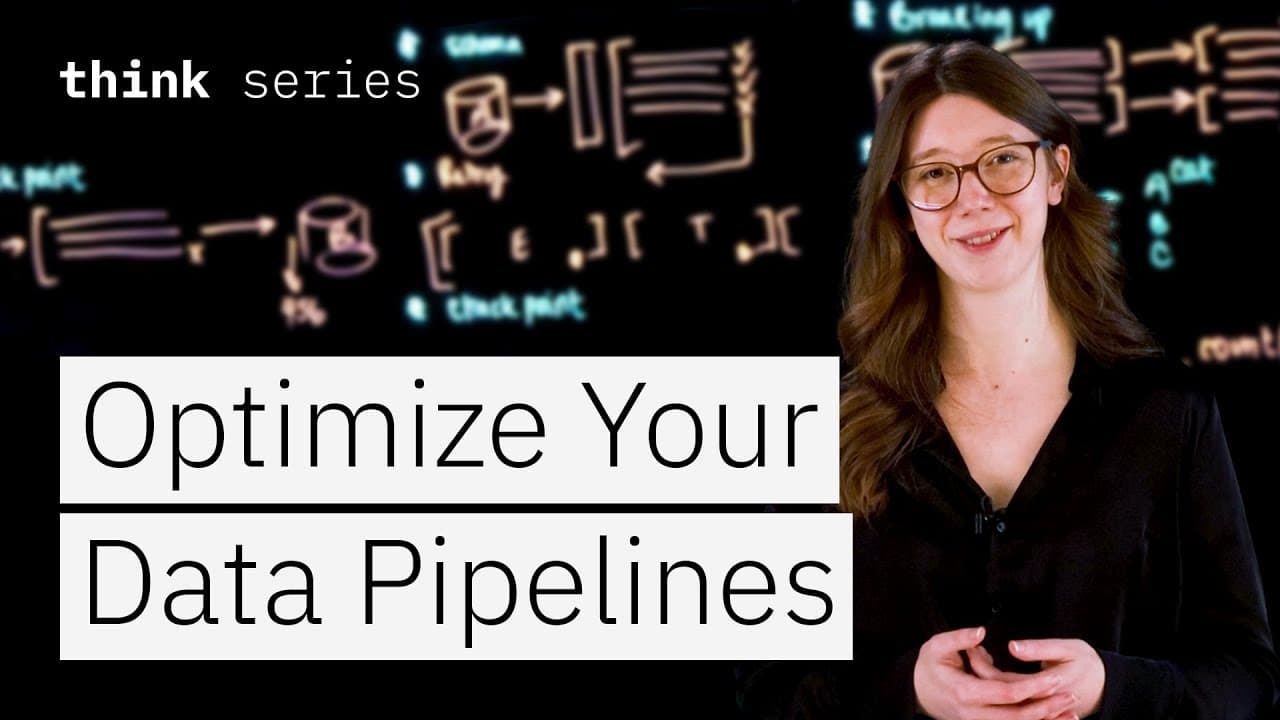
Data pipelines are the backbone of every data-driven company, but too many fail to scale properly. They crash under pressure or waste precious resources. AI models and big data isn't going to wait for slow data pipelines. They demand continuous real-time processing, which requires pipelines that can scale to handle millions and even billions of rec... Read More
Key Insights
- Data pipelines are fundamentally an ETL process that extracts, transforms, and loads data to move it from point A to point B, and they must scale to millions or billions of records for AI training, real-time predictions, and analytics.
- Chunking is the core memory optimization technique: break data into smaller pieces at the extract or read phase, defined either by physical memory used or by number of rows or transactions.
- Chunking must be mirrored on the load or write phase, because applying it only to reads still hits the memory limit when all the transformed data is loaded at once.
- Converting string data into categorical data types saves memory when values fall into a limited set of known categories, since Python and Pandas process predictable categories faster and sort them more easily than mystery strings.
- Recursive loops should be avoided for aggregation tasks like counting or grouping; Pandas pre-built aggregation functions inherit built-in optimization and can reduce roughly ten lines of loop code down to one.
- Schema validation at the pipeline entry point acts as a gate that kicks back incomplete or poor-quality data early, which also saves memory by avoiding wasted transform and load work on bad rows.
- All data pipelines should be treated as ephemeral, deployed in containerized environments that can spin up and down and restart automatically without manual intervention when they fail.
- Retry logic should be built into each of the three ETL parts rather than splitting them into three separate pipelines, since separating them creates interdependencies and roughly triples job complexity.
Install to Summarize YouTube Videos and Get Transcripts
Explore YouTube Video Summarizer or Get YouTube Transcript Extractor
Questions & Answers
Q: How do you scale a data pipeline without crashing?
Break data into chunks during both extraction and loading so the pipeline never reads or writes the entire dataset at once. Also reduce memory use with categorical data types and Pandas aggregation functions, reject invalid rows through schema validation, and build automatic retries into each ETL stage.
Q: How does chunking optimize memory in a data pipeline?
Chunking divides incoming data into smaller subsets instead of loading everything into memory simultaneously. A chunk can be defined by physical memory usage, such as a number of gigs, or by a specified number of rows or transactions.
Q: Why must chunking cover both the read and write phases?
Chunking only during reads can still cause a memory failure when all transformed data is loaded at once. Mirroring the chunking logic during writes creates an end-to-end pipeline that can process volumes three times larger than expected in smaller pieces without redeploying the code.
Q: How do categorical data types reduce Pandas memory usage?
Strings with a limited set of known values, such as A, B, and C, can be converted into categorical data types. Categories are more predictable, easier to sort, and can be processed by Python and Pandas in a more optimized way, saving memory overall.
Q: Why should Pandas aggregations replace loops when possible?
Loops may iterate over every row to count or group values, such as calculating total sales for a product. Pandas provides optimized aggregation functions for these tasks, potentially reducing about ten lines of loop code to one while making the pipeline easier to read.
Q: How does schema validation make a data pipeline more resilient?
Defining the expected schema at the pipeline entry point creates a gate that checks incoming rows. Incomplete or poor-quality data is rejected early, preventing wasted memory and processing during the transform and load phases.
Q: Why should data pipelines restart automatically after failure?
Pipelines should be designed with the expectation that failures will occur. Deploying them as ephemeral workloads in containerized environments allows them to spin up, shut down, and restart without manual intervention.
Q: Where should retry logic be added in an ETL pipeline?
Retry logic should be built into each of the extract, transform, and load parts, with three attempts as the stated default. Keeping those parts in one resilient pipeline avoids the interdependencies and roughly tripled job complexity created by separating them into three pipelines.
Summary & Key Takeaways
-
Data pipelines are the backbone of data-driven companies but often fail to scale, crashing or wasting resources under increased load. Because AI and big data demand continuous real-time processing of millions to billions of records, robust pipelines are essential for delivering high-quality data on time for training, predictions, and analytics.
-
Memory optimization centers on chunking data into smaller subsets at both the read and write phases so tripled traffic volumes are handled in pieces without redeploying code. Further savings come from converting limited-value strings into categorical data types and replacing aggregation loops with optimized Pandas functions.
-
Failure control assumes pipelines will fail and must restart automatically. Schema validation gates out poor-quality data early, and retry logic (defaulting to three attempts) is built into each ETL part while keeping them in one resilient pipeline rather than three interdependent ones.
Read in Other Languages (beta)
Share This Summary 📚
Summarize YouTube Videos and Get Video Transcripts with 1-Click
Try YouTube Summary with ChatGPT & Claude or YouTube Transcript Generator
Explore More Summaries from IBM Technology 📚





Summarize YouTube Videos and Get Video Transcripts with 1-Click
Try YouTube Summary with ChatGPT & Claude or YouTube Transcript Generator