How to Educate Yourself Using Tesla's Habits
TL;DR
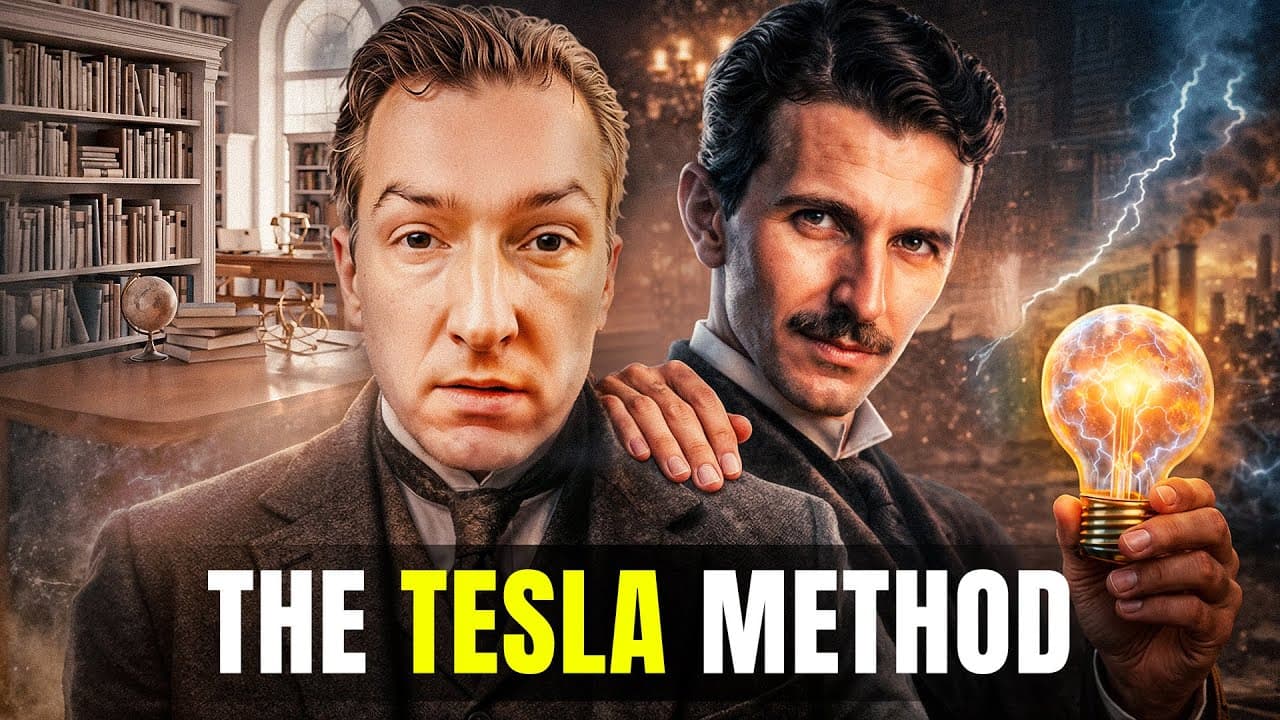
Organize self-education around one stubborn problem, then use prediction, sustained attention, mastery checks, and active recall to deepen understanding. Tesla's approach treated imagination as a disciplined testing tool, made internal coherence more important than approval, and combined deep expertise with relevant ideas from other domains. These habits can improve learning, but intense focus and perfectionism may also carry costs.
Transcript
Nicola Tesla wasn't a genius by accident. He trained his mind deliberately, often outside of formal education, using methods modern cognitive science is only now beginning to understand. In this video, I'll draw upon my more than 13 years as a peer-reviewed [music] scholar and educator to break down the five habits Tesla used to educate himself, wh... Read More
Key Insights
- Problem-based learning organizes knowledge around resolution rather than coverage. Tesla pursued stubborn questions that demanded causal explanations, and a practical learner can imitate this by selecting one well-defined problem, studying only relevant material for several weeks, and regularly rewriting an explanation from memory.
- High-fidelity mental simulation works by turning imagination into structured internal experimentation. Tesla described building, operating, and correcting machines in his mind, while the practical goal for other learners is not equally vivid imagery, but increasingly precise predictions that can be compared with actual outcomes.
- Prediction-first learning makes errors useful because each mismatch reveals weaknesses in an internal model. Before checking an answer, testing a solution, or entering an important interaction, a learner can predict what will happen and why, observe the result, and revise the next prediction accordingly.
- Sustained cognitive engagement develops through prolonged attention to narrowly defined challenges. Tesla repeatedly carried important problems through daily activities and revisited them from several angles, suggesting that confusion should sometimes be endured long enough for understanding to reorganize instead of being escaped through constant topic switching.
- Mastery-oriented evaluation measures whether an explanation is coherent, predictive, and complete. Tesla valued long-term correctness more than immediate recognition, which allowed him to remain privately wrong while refining his ideas instead of shaping his thinking primarily around grades, approval, or other external outcomes.
- Active recall produces more durable learning than passive rereading. After finishing a chapter or section, the learner should close the source, reconstruct its mechanisms, arguments, implications, and core ideas from memory, then reopen the material to identify omissions, correct errors, and revise the explanation.
- Elaborative encoding strengthens both understanding and communication by connecting remembered ideas to mechanisms and implications. Tesla did not merely consume books, and the recommended reconstruction-first reading rule requires learners to explain material in their own structure before comparing that explanation with the original text.
- Cross-domain exposure supports creative combinations when it is integrated with deep expertise. Tesla read literature and poetry alongside science and engineering, and the transcript connects his rotating magnetic field insight with a walk during which he was reciting Faust from memory, illustrating the value of an enriched imaginative range.
Install to Summarize YouTube Videos and Get Transcripts
Explore YouTube Video Summarizer or Get YouTube Transcript Extractor
Questions & Answers
Q: How can I organize self-education around problems?
Choose one well-defined problem that genuinely bothers you and let it determine what you study for several weeks. Read or watch only material that helps resolve that question. Once each week, write your current explanation entirely from memory, identify causal gaps, and revise it after checking your sources. This structure shifts attention from covering a broad subject to building an interconnected explanation that can resolve the original problem.
Q: How can I practice Tesla-style mental simulation?
Start with a process you understand well enough to predict in detail. Before checking the answer or taking action, imagine what should happen, in what order, and for what reason. Commit to a concrete prediction, observe the real outcome, and focus on every mismatch. Replay the process afterward and update your internal model. The goal is not immediate accuracy, but progressively higher-fidelity simulation through repeated prediction and feedback.
Q: Why does making a prediction improve learning?
Making a prediction forces the learner to expose the structure of an internal model before receiving the answer. When reality differs from the prediction, the discrepancy directs attention toward a specific misunderstanding or missing variable. The transcript states that even incorrect predictions enhance learning when feedback follows. Error therefore becomes a useful signal for revising how causes, conditions, and outcomes are represented, rather than merely evidence of failure.
Q: How can sustained focus produce deeper understanding?
Sustained focus gives the mind time to revisit one difficult question from several perspectives and gradually reorganize its understanding. Tesla carried major problems with him while walking, eating, and resting, sometimes for months or years. A practical version is to choose one central question for a month, revisit it daily, and resist abandoning it whenever confusion appears. The resulting tension can precede conceptual change and insight.
Q: What is mastery-oriented learning?
Mastery-oriented learning evaluates progress through internal standards such as coherence, explanatory depth, accurate prediction, and awareness of failure conditions. Instead of asking whether work earned approval or recognition, ask whether you can explain the mechanism without notes, predict how it changes under different conditions, and identify where the explanation breaks down. This approach supported Tesla's willingness to tolerate uncertainty and remain wrong privately while pursuing long-term correctness.
Q: How should I use active recall while reading?
After reading a chapter or meaningful section, close the book before reviewing or highlighting it again. Write the central ideas, mechanisms, arguments, and implications from memory. Then compare your reconstruction with the source, mark missing or inaccurate elements, and rewrite the explanation. The transcript describes passive rereading as producing fragile memory traces, while reconstruction strengthens retrieval, understanding, and the ability to communicate what was learned.
Q: Why did Tesla read outside science and engineering?
Tesla's reading in literature and poetry enriched his symbolic thinking and imaginative range rather than serving as breadth for its own sake. The transcript presents cross-domain exposure as useful when it is integrated with deep expertise in a central field. It also links his insight about the rotating magnetic field to a walk in a park while reciting Faust from memory, illustrating how distant material can participate in novel combinations.
Q: What are the risks of following Tesla's learning habits?
Tesla's approach should be applied with awareness of its costs. The transcript notes that his intense internal orientation sometimes made collaboration difficult and that his methods included perfectionism. Sustained immersion, private standards, and mental experimentation can support deep work, but they should not automatically replace external testing, communication, or cooperation. A learner can pursue coherence while still seeking feedback and preserving the ability to work effectively with others.
Summary & Key Takeaways
-
Tesla's intellectual development was driven less by credentials than by a demand for explanations that made causal and mechanical sense. He organized learning around difficult problems instead of conventional subject coverage, allowing each unresolved question to determine what he studied and helping him connect knowledge through mechanisms rather than isolated facts.
-
Tesla used precise mental imagery as a form of internal experimentation, imagining machines, observing their behavior, and correcting flaws before physical construction. A practical version is to predict an outcome before checking it, compare the prediction with reality, and use every mismatch as feedback for refining the underlying mental model.
-
His remaining habits supported long-term depth: sustained engagement with a narrow challenge, evaluation through mastery rather than approval, and reconstruction of ideas from memory. Tesla also integrated literature and poetry with scientific expertise, showing how cross-domain material can contribute to creative combinations when it remains connected to a core field.
Read in Other Languages (beta)
Share This Summary 📚
Summarize YouTube Videos and Get Video Transcripts with 1-Click
Try YouTube Summary with ChatGPT & Claude or YouTube Transcript Generator
Explore More Summaries from Stephen Petro 📚
Summarize YouTube Videos and Get Video Transcripts with 1-Click
Try YouTube Summary with ChatGPT & Claude or YouTube Transcript Generator