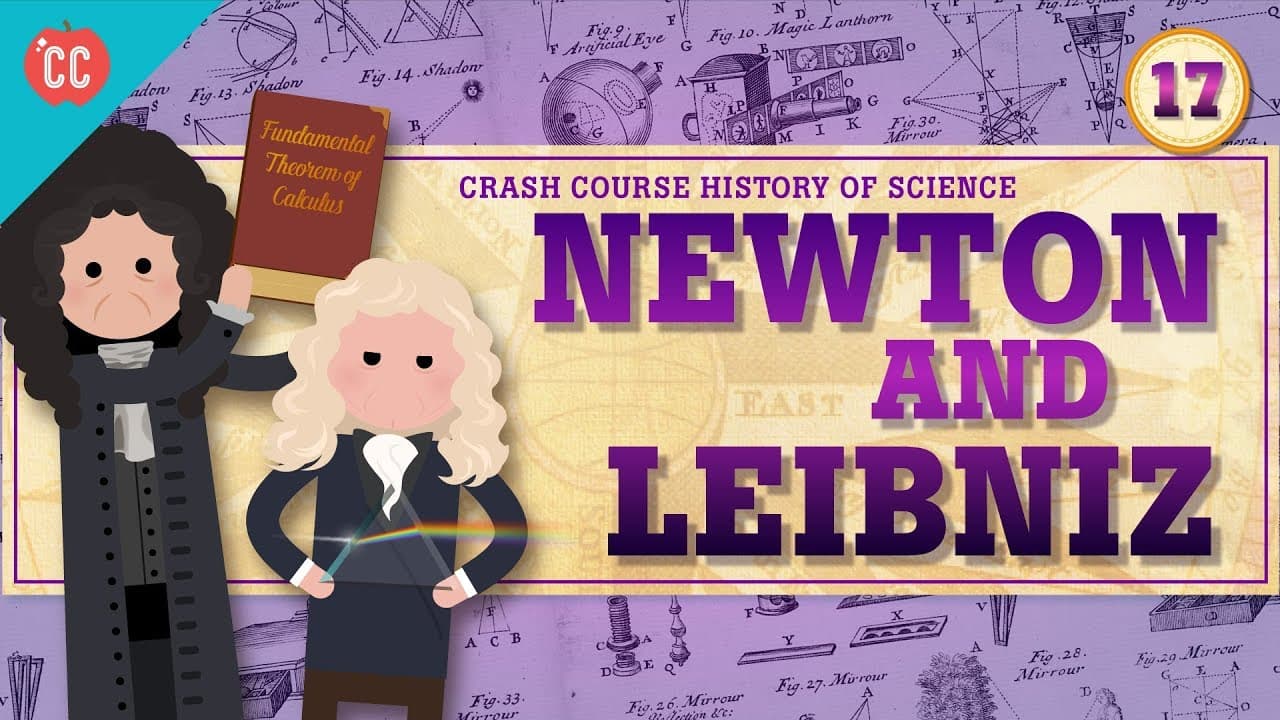
Newton and Leibniz: Crash Course History of Science #17
TL;DR
Newton and Leibniz revolutionized science and mathematics with calculus.
Transcript
The standard story of the Scientific Revolution culminates with the long life of one man: Sir Isaac Newton—a humble servant of the Royal Mint, two-time parliamentarian, and a scientific titan whose name, along with Einstein’s, is synonymous with physics today. But there was also another Isaac Newton. I mean, it was the same guy, but this Newton was... Read More
Key Insights
- Isaac Newton, known for his contributions to physics, was also deeply involved in alchemy and the occult, reflecting a complex personality beyond his scientific achievements.
- Newton's 'miracle year' in 1666 saw the development of his ideas on calculus, gravity, and optics, marking a pivotal moment in scientific history.
- Newton's work on optics, including his crucial experiment with prisms, laid the foundation for understanding light as composed of different colors.
- The publication of 'Principia' in 1687 by Newton provided a comprehensive mathematical framework for understanding celestial mechanics and gravity.
- Gottfried Wilhelm von Leibniz independently developed calculus, introducing notation still used today, but faced controversy over the priority of discovery with Newton.
- Scientific societies like the Royal Society of London played a crucial role in the dissemination and debate of scientific ideas during the Scientific Revolution.
- The rivalry between Newton and Leibniz over calculus exemplifies the competitive nature of scientific discovery and the influence of national pride.
- Newton's influence extended beyond his lifetime, shaping the paradigm of scientific knowledge production and moving away from Aristotelian views.
Install to Summarize YouTube Videos and Get Transcripts
Explore YouTube Video Summarizer or Get YouTube Transcript Extractor
Questions & Answers
Q: What were some of Isaac Newton's major contributions to science?
Isaac Newton made significant contributions to science, including the development of calculus, the formulation of the laws of motion and universal gravitation, and groundbreaking work in optics. His book 'Principia' mathematically described how gravity works and unified the work of Copernicus, Kepler, and Galileo, providing a comprehensive framework for classical mechanics.
Q: How did Newton's views on light differ from his contemporaries?
Newton believed that light was composed of particles or 'corpuscles,' whereas contemporaries like Robert Hooke thought of light as a wave. Newton's crucial experiment with prisms demonstrated that light is made of different colors, which can be refracted and recombined, laying the foundation for the modern understanding of optics.
Q: What was the significance of Newton's 'miracle year' in 1666?
In 1666, Newton experienced what is known as his 'miracle year,' during which he developed key ideas that would lead to the invention of calculus, the formulation of the laws of gravity, and foundational work in optics. This year marked a turning point in his career and significantly advanced the field of science.
Q: What role did scientific societies play during the Scientific Revolution?
Scientific societies, such as the Royal Society of London, were instrumental during the Scientific Revolution. They provided platforms for natural philosophers to share and debate ideas, publish groundbreaking works, and foster a collaborative environment that advanced scientific knowledge. These societies also helped secure government patronage and demonstrated the practical applications of scientific discoveries.
Q: How did Leibniz's approach to calculus differ from Newton's?
Leibniz developed calculus independently of Newton and introduced a notation system that is still in use today, including the integral sign and differentials. His approach focused on the inverse relationship between integration and differentiation, known as the fundamental theorem of calculus, which differed in presentation from Newton's geometric approach.
Q: What was the nature of the dispute between Newton and Leibniz over calculus?
The dispute between Newton and Leibniz over calculus centered on who first developed the mathematical framework. Although both worked independently, national pride and rivalry led to accusations of plagiarism. The Royal Society, favoring Newton, ruled against Leibniz, overshadowing his contributions and highlighting the competitive nature of scientific discovery.
Q: What impact did Newton's 'Principia' have on science?
Newton's 'Principia' had a profound impact on science by providing a mathematical explanation for gravity and unifying the work of earlier astronomers. It laid the foundation for classical mechanics, influencing scientific thought and methodology. The book's comprehensive approach to celestial mechanics marked a shift from Aristotelian views to a new scientific paradigm.
Q: How did Newton's personal beliefs influence his scientific work?
Newton's personal beliefs, including his interest in alchemy and the occult, influenced his scientific work by driving his quest for understanding the universe. Although these interests were unconventional, they reflected his broader pursuit of knowledge. His belief in a hidden wisdom passed down through history informed his scientific inquiries and philosophical perspectives.
Summary & Key Takeaways
-
Isaac Newton and Gottfried Wilhelm von Leibniz were pivotal figures in the Scientific Revolution, both contributing to the development of calculus. Newton's work extended beyond mathematics to include optics and celestial mechanics, profoundly impacting science.
-
Newton's 'Principia' unified the work of previous astronomers and philosophers, providing a mathematical explanation for gravity and planetary motion. Despite his achievements, Newton's eccentric interests in alchemy and the occult reveal a multifaceted character.
-
Leibniz developed calculus independently of Newton, introducing notation still used today. However, a priority dispute over calculus with Newton overshadowed his achievements, highlighting the competitive and nationalistic aspects of scientific discovery.
Read in Other Languages (beta)
Share This Summary 📚
Summarize YouTube Videos and Get Video Transcripts with 1-Click
Try YouTube Summary with ChatGPT & Claude or YouTube Transcript Generator
Explore More Summaries from CrashCourse 📚


Summarize YouTube Videos and Get Video Transcripts with 1-Click
Try YouTube Summary with ChatGPT & Claude or YouTube Transcript Generator