How Does Continuous Product Discovery Work?
TL;DR
Every item in a product backlog is a bet, and discovery exists to make that bet better rather than to precede delivery. Teams should keep shipping while building a discovery habit in parallel, because treating discovery and delivery as sequential phases kills organizational appetite for it. The opportunity solution tree adds structure by branching from an outcome into opportunities, then solutions, then assumption tests.
Transcript
everything in our backlog is a bet everything whether we do Discovery or not everything is a bet Discovery is helping us make a better bet now sometimes in our organizations we need to do a lot of Discovery and make as good of a bet as we can but there's other times we can make a risky bet like there's times in business where it makes sense to make... Read More
Key Insights
- Everything in a product backlog is a bet, whether or not a team does discovery. Discovery does not remove the bet; it improves the odds. Organizations that do zero discovery are not avoiding bets, they are making every bet a risky one.
- Risky bets are legitimate in business at certain moments. The problem is not risk itself but unexamined risk: if every bet a company makes has been risky because no discovery is happening, the risk was never a choice.
- The fastest way to kill appetite for discovery is to announce that the team will stop making bets until discovery is done. Torres advises the opposite: keep shipping, and start doing discovery in parallel so the bets improve over time.
- Discovery and delivery are not phases. Teams are always delivering and always discovering simultaneously, and the benefit of doing both continuously is that the quality of bets compounds as the discovery habit strengthens.
- The opportunity solution tree is a decision tree with an outcome at the root, branching into the opportunity space, then into solutions, and sometimes into assumption tests below that. Its purpose is to add structure to an unstructured problem.
- Most product teams have learned their job as being told to build specific features, which is a highly structured task. Shifting from output focus to outcome focus asks them to do a fundamentally different job, which is why they need scaffolding.
- An opportunity is an unmet need, pain point, or desire. Torres estimates 98 percent of people who try to write opportunities write disguised solutions instead, because staying in the problem space runs against how brains are wired.
- Torres recommends structuring the opportunity space with an experience map covering the broader activity, not just your product. For a Netflix team, that means mapping how people entertain themselves with streaming generally, including adjacent platforms.
Install to Summarize YouTube Videos and Get Transcripts
Explore YouTube Video Summarizer or Get YouTube Transcript Extractor
Questions & Answers
Q: What is an opportunity solution tree?
The opportunity solution tree is a simple visual, structured like a decision tree. It starts with an outcome at the root, branches into the opportunity space, and then branches further into solutions and sometimes assumption tests. Teresa Torres created it because most product teams shifting from an output focus to an outcome focus do not know how to manage the complex, unstructured problem of starting from an outcome and figuring out what to build. The tree provides scaffolding for that wide open, messy problem. Torres notes that although the visual looks simple, using it in practice is genuinely complex.
Q: Why should discovery and delivery happen at the same time?
Torres argues that discovery and delivery are not sequential phases. You are always delivering and always discovering. The mistake people make is thinking they first discover and then deliver. The benefit of always doing both is that with time you make better bets, because the discovery habit strengthens as you practice it. Sequencing them creates a stop-and-wait dynamic that damages the practice. Torres is explicit: do not say let's stop making bets until we discover. Instead, keep making bets while starting discovery in parallel, so those bets improve over time.
Q: How do you introduce product discovery to a team that does none?
Do not stop delivery to make room for discovery. Torres says the best way to kill any appetite for discovery is to announce that the team will stop making bets until it has discovered. Instead, keep making bets in parallel and start doing some discovery alongside them, so that eventually those bets get better. This preserves the organization's momentum and confidence while the discovery habit builds. Because discovery is a habit that compounds, the improvement shows up over time rather than immediately, which is why parallel adoption works better than a hard stop.
Q: What is the difference between an opportunity and a solution?
An opportunity is an unmet need, pain point, or desire. A solution is something you build to address it. Torres says that while the definition is easy to state, 98 percent of people who write opportunities actually write disguised solutions. Teams consistently struggle with the distinction between the problem space and the solution space. She argues the heart of good product work is getting comfortable in the problem space and taking the time to frame a problem properly before jumping to solutions. The difficulty is that staying in the problem space runs counter to how brains are wired, so tolerating that discomfort has to be taught.
Q: How should you structure the opportunity space in an opportunity solution tree?
Torres recommends structuring the opportunity space using an experience map. Rather than listing opportunities arbitrarily, you map the overall experience the customer is having. Her example is streaming entertainment: for a team trying to increase engagement with Netflix, the relevant experience is how someone entertains themselves with streaming generally, which may include adjacent platforms like YouTube TV. That map might begin with the trigger of deciding to watch something, then move into how the person decides what to watch, which is often intertwined with which platform they watch it on.
Q: Why is the opportunity solution tree harder to use than it looks?
The visual itself is simple, but Torres says using it in practice is really complex, and she gained a new appreciation for this by teaching it repeatedly and seeing where people struggle. The hard parts are defining what an opportunity actually is and structuring the opportunity space correctly. She has seen blog posts where people describe using the tree but their entire opportunity space consists of solutions. Her response is to publish good examples rather than criticize bad ones, since she does not want misleading examples circulating while she is trying to teach the practice well.
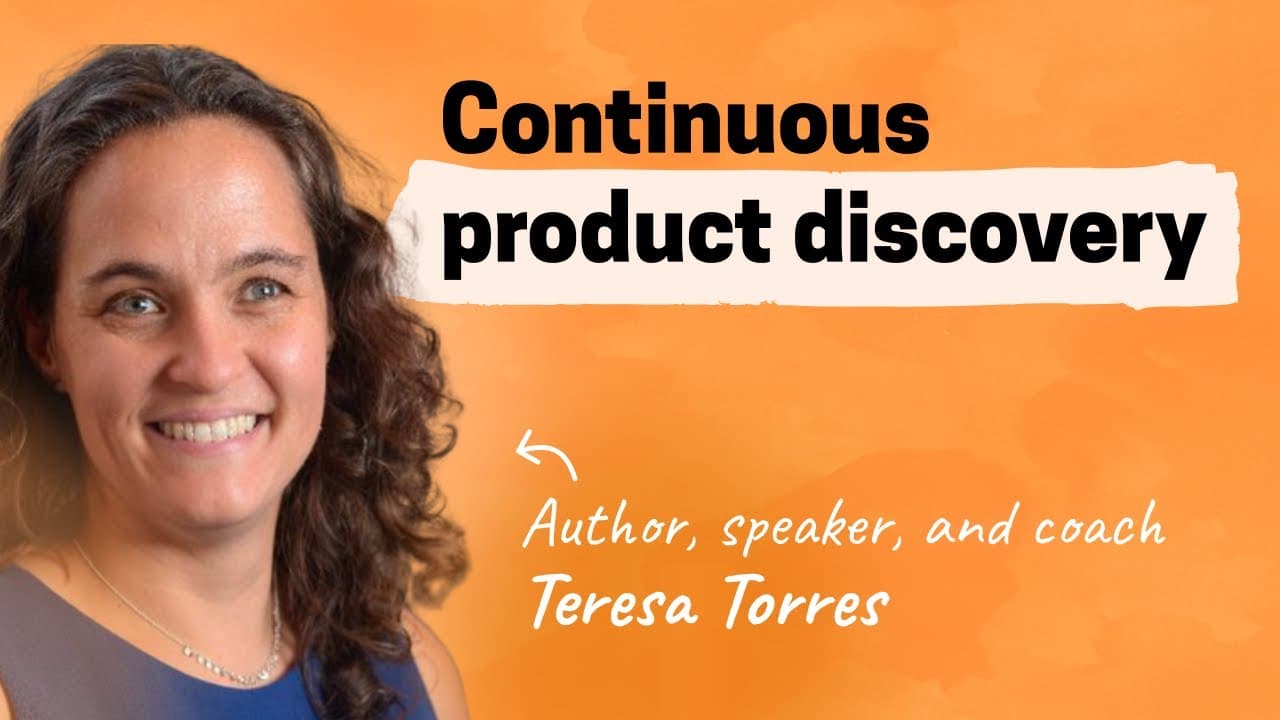
Q: Who is Teresa Torres and what has she taught?
Teresa Torres is a speaker, teacher, consultant, and product coach, and the author of Continuous Discovery Habits. She has taught roughly 11,000 students through Product Talk Academy and coached hundreds of teams directly, from early-stage startups to global enterprises across many industries, putting her total impact at around twelve thousand product people. Lenny Rachitsky notes that her book is consistently the number one most recommended book in his newsletter Slack community. Her work centers on a structured, sustainable system for continuous discovery that infuses daily product decisions with customer input.
Q: Where can you learn more about continuous discovery from Teresa Torres?
Torres publishes at producttalk.org, where the blog puts out two articles a month, and offers a range of discovery-related courses at learn.producttalk.org. She has a dedicated page explaining the opportunity solution tree on the same site. Her book, Continuous Discovery Habits, is available on Amazon. She is also findable on LinkedIn and Twitter as ttorres. The full transcript of this conversation is published on lennyspodcast.com, and the episode covers both the opportunity solution tree framework and how to build a system for talking to customers regularly.
Summary & Key Takeaways
-
Teresa Torres frames every backlog item as a bet, arguing discovery's role is to improve the quality of those bets rather than to gate them. Some business situations justify risky bets, but organizations doing zero discovery are making every bet risky without realizing it, which compounds over time.
-
The worst way to introduce discovery is to halt delivery until discovery finishes, because that framing kills any appetite for the practice. Discovery and delivery are not sequential phases: teams are always delivering and always discovering, and the habit compounds so bets improve with time.
-
The opportunity solution tree starts with an outcome at the root, branches into the opportunity space, then into solutions and possibly assumption tests. It gives teams scaffolding for the unstructured problem of moving from an outcome to a decision about what to build, a fundamentally different job from being handed features.
-
Torres recommends structuring the opportunity space with an experience map rather than a list. Using streaming entertainment as an example, she maps the full experience of entertaining yourself, starting from the trigger of deciding to watch something, through deciding what to watch and which platform to watch it on.
-
Torres has taught roughly 11,000 students through Product Talk Academy and coached hundreds of teams directly, putting her total at around twelve thousand product people. She writes two articles a month at producttalk.org and offers discovery courses at learn.producttalk.org.
Read in Other Languages (beta)
Share This Summary 📚
Summarize YouTube Videos and Get Video Transcripts with 1-Click
Try YouTube Summary with ChatGPT & Claude or YouTube Transcript Generator
Explore More Summaries from Lenny's Podcast 📚




Summarize YouTube Videos and Get Video Transcripts with 1-Click
Try YouTube Summary with ChatGPT & Claude or YouTube Transcript Generator