Energy, Work & Power (4 of 31) Kinetic Energy, Its Relationship to the Square of the Velocity
TL;DR
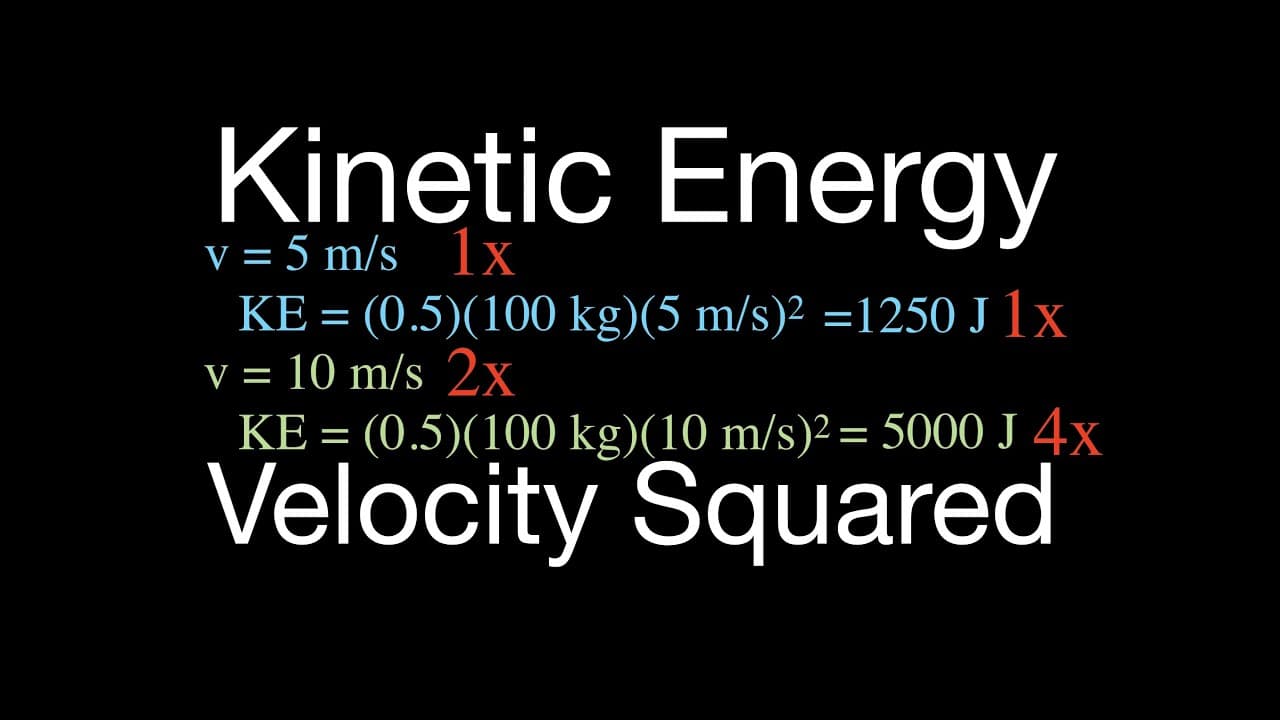
Kinetic energy is directly proportional to velocity squared, so doubling an object’s speed quadruples its kinetic energy and tripling its speed increases it ninefold. Using a 100-kilogram object, the calculation gives 1,250 joules at 5 meters per second, 5,000 joules at 10 meters per second, and 11,250 joules at 15 meters per second. Read on to see how the equation explains these increases and the danger of speeding.
Transcript
okay in today's video we're going to go over one of the most interesting things about the kinetic energy and only that one thing which is that the kinetic en is directly proportional to the square of the speed of the object now in a previous video I went over an explanation and more General explanation of kinetic energy which you can link to right ... Read More
Key Insights
- 💆 Kinetic energy is directly proportional to the mass and the square of the velocity.
- 🧑🏭 Doubling the velocity quadruples the kinetic energy, whereas tripling the velocity increases it by a factor of nine.
- 🥺 The increase in kinetic energy with velocity shows why speeding is dangerous and can lead to greater damage in accidents.
- 👻 The kinetic energy equation, KE = 1/2 * mass * velocity^2, allows for the calculation of an object's energy in motion.
- 💆 Choosing a standard mass simplifies calculations when exploring the relationship between kinetic energy and velocity.
- 🐎 Understanding the relationship between kinetic energy and speed is crucial for driving safely and avoiding accidents.
- 💦 Kinetic energy is a measure of an object's ability to do work or cause damage.
Install to Summarize YouTube Videos and Get Transcripts
Explore YouTube Video Summarizer or Get YouTube Transcript Extractor
Questions & Answers
Q: What is the relationship between kinetic energy and the square of velocity?
Kinetic energy is directly proportional to the square of velocity. If velocity changes by a factor, kinetic energy changes by the square of that factor.
Q: What equation is used to calculate kinetic energy?
The equation is kinetic energy = 1/2 × mass × velocity². Only the velocity is squared before it is multiplied by the mass and one-half.
Q: What happens to kinetic energy when velocity doubles?
Doubling velocity increases kinetic energy by a factor of four because 2² equals 4. In the example, raising the speed from 5 to 10 meters per second increases the energy from 1,250 to 5,000 joules.
Q: What happens to kinetic energy when velocity triples?
Tripling velocity increases kinetic energy by a factor of nine because 3² equals 9. For the 100-kilogram object, a speed of 15 meters per second produces 11,250 joules, nine times the energy at 5 meters per second.
Q: What happens to kinetic energy when velocity quadruples?
Quadrupling velocity increases kinetic energy by a factor of 16. This follows directly from squaring the fourfold increase in velocity.
Q: How much kinetic energy does a 100-kilogram object have at 5 meters per second?
A 100-kilogram object traveling at 5 meters per second has 1,250 joules of kinetic energy. The calculation is 1/2 × 100 × 5².
Q: How does mass affect kinetic energy?
Kinetic energy is directly proportional to mass. If mass rises while velocity remains the same, kinetic energy rises; if mass falls, kinetic energy falls.
Q: Why does the relationship between speed and kinetic energy make speeding dangerous?
The energy of a moving car rises with the square of its speed, rather than increasing at the same rate as speed. The transcript explains that doubling speed gives the car four times as much kinetic energy and requires the brakes and road to do four times as much work, increasing stopping time and distance.
Summary & Key Takeaways
-
The kinetic energy equation is KE = 1/2 * mass * velocity^2, and it is directly proportional to the mass.
-
The focus of this video is on the relationship between kinetic energy and the square of the velocity.
-
The video discusses the calculation of kinetic energy for an object at different speeds (5m/s, 10m/s, 15m/s, and 20m/s) using a chosen mass of 100kg.
Read in Other Languages (beta)
Share This Summary 📚
Summarize YouTube Videos and Get Video Transcripts with 1-Click
Try YouTube Summary with ChatGPT & Claude or YouTube Transcript Generator
Explore More Summaries from Step by Step Science 📚
Summarize YouTube Videos and Get Video Transcripts with 1-Click
Try YouTube Summary with ChatGPT & Claude or YouTube Transcript Generator