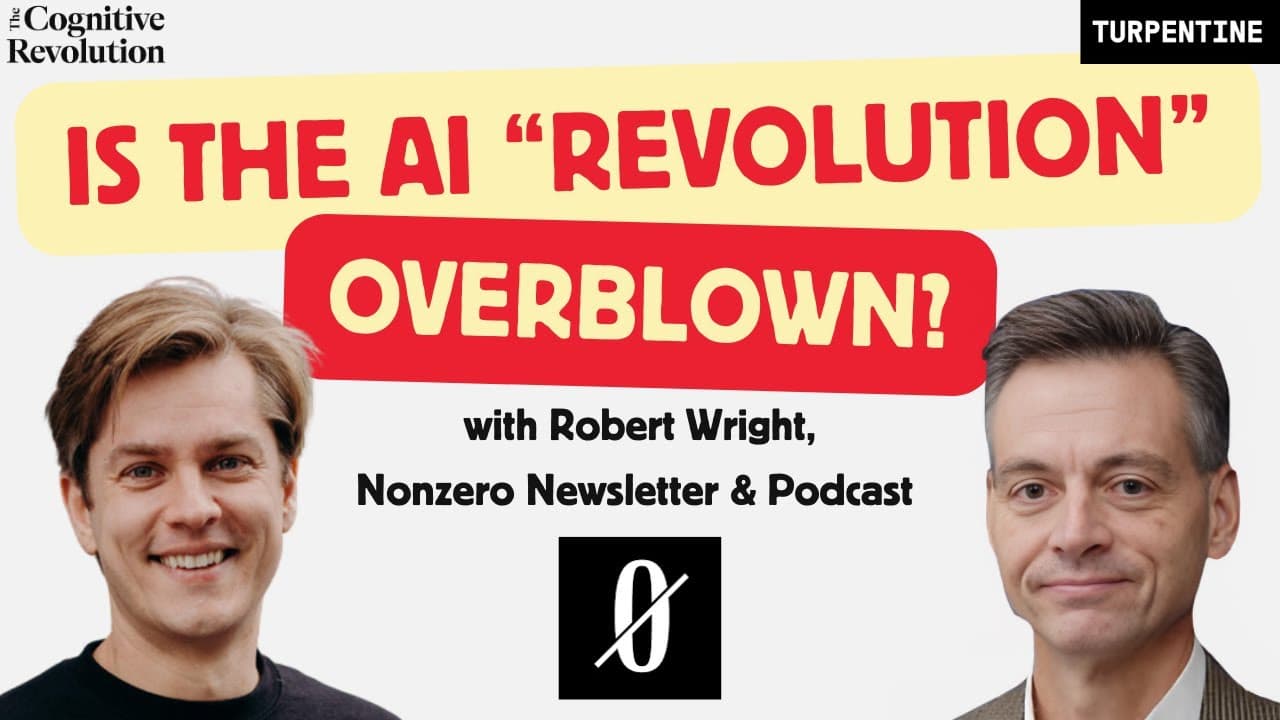
How Does AI “Understand” and Model the World? Robert Wright of Nonzero Newsletter & Podcast
TL;DR
AI understands and models the world by representing concepts in high-dimensional spaces and, in multimodal systems, combining text, audio, and visual data. These capabilities support paraphrasing, reasoning, and increasingly robust world models, but questions remain about superhuman performance, human values, open-source risks, and an international AI arms race. Read on to explore how these capabilities work and why their development demands careful judgment.
Transcript
hello and welcome to the cognitive Revolution where we interview Visionary researchers entrepreneurs and Builders working on the frontier of artificial intelligence each week we'll explore their revolutionary ideas and together we'll build a picture of how AI technology will transform work life and Society in the coming years I'm Nathan lens joined... Read More
Key Insights
- AI models represent concepts in high-dimensional spaces, allowing them to process and understand language in a way that is functionally similar to humans.
- Multimodal AI systems, which integrate text, audio, and visual data, may develop intuitive physics, enabling them to model real-world scenarios effectively.
- The potential for AI to surpass human intelligence is debated, with arguments for both leveling off at human-like capabilities and achieving superhuman performance.
- Open-source AI models provide opportunities for widespread research and development but pose risks if not managed carefully, especially in international contexts.
- The US-China relationship in AI development is complex, with concerns about an AI arms race and the implications of open-sourcing powerful models.
- AI's understanding of human values is improving, but it remains a critical area for ensuring alignment and preventing harmful outcomes.
- The future of AI may involve new architectures that enhance reasoning and problem-solving capabilities beyond current Transformer models.
- Balancing the benefits of AI adoption with the risks of rapid advancement is essential, with some advocating for a pause in hyperscale AI development.
Install to Summarize YouTube Videos and Get Transcripts
Explore YouTube Video Summarizer or Get YouTube Transcript Extractor
Questions & Answers
Q: How do AI models understand and represent meaning?
AI models represent concepts and semantics in high-dimensional spaces, where relationships between words can be captured through their positions. Learning these representations from human-generated text enables models to perform tasks such as paraphrasing and contextual reasoning.
Q: How do multimodal AI systems model the world?
Multimodal systems integrate text, audio, and visual data to build more robust representations of real-world situations. This combination may help them develop intuitive physics and improve their ability to simulate or predict events.
Q: Can AI surpass human intelligence?
Whether AI will surpass human intelligence remains debated. Some expect its capabilities to level off near the human range because it learns heavily from human-generated data, while others believe simulation, optimization, system integration, and architectural advances could produce superhuman performance.
Q: How could AI accelerate scientific discovery and technological progress?
More capable AI systems could accelerate scientific discovery and technological progress by improving reasoning and problem-solving. Their impact may grow as researchers develop stronger world models and architectures beyond current Transformer models.
Q: How well does AI understand human values and ethics?
Large language models demonstrate a remarkable degree of understanding of human values and ethics. That capability should not be taken for granted, and consistently aligning AI behavior with human values remains critical for preventing harmful outcomes.
Q: What are the benefits and risks of open-sourcing powerful AI models?
Open-source models can broaden access to AI research, experimentation, and innovation. Powerful models with open weights can also be misused or produce unintended consequences, particularly amid tensions between the US and China and concerns about an international AI arms race.
Q: Why is a pause in AI development not currently being advocated?
Nathan Labenz says he is not advocating for a pause in AI development right now. He remains open to reversing that position if future developments change the balance between AI’s benefits and the risks of rapid hyperscale advancement.
Q: What new AI architectures could shape future reasoning capabilities?
Future systems may use architectures beyond current Transformer models, including state space models. These approaches could affect how AI systems reason, solve problems, and develop more sophisticated understanding and decision-making abilities.
Summary & Key Takeaways
-
AI systems, particularly large language models, develop understanding by representing concepts in high-dimensional spaces. This allows them to process language in a way that is functionally similar to humans, enabling them to perform tasks like paraphrasing and reasoning. Multimodal AI systems, integrating text, audio, and visual data, are beginning to exhibit intuitive physics, modeling real-world scenarios effectively.
-
The potential for AI to surpass human intelligence is a topic of debate. While some argue that AI may level off at human-like capabilities, others believe it could achieve superhuman performance. Open-source AI models present opportunities for research but also pose risks, especially in international contexts, such as the US-China relationship, where concerns about an AI arms race persist.
-
AI's understanding of human values is improving, which is crucial for alignment and preventing harm. Future AI developments may involve new architectures that enhance reasoning and problem-solving. Balancing the benefits of AI adoption with the risks of rapid advancement is essential, with some advocating for a pause in hyperscale AI development to ensure safety and ethical considerations are addressed.
Read in Other Languages (beta)
Share This Summary 📚
Summarize YouTube Videos and Get Video Transcripts with 1-Click
Try YouTube Summary with ChatGPT & Claude or YouTube Transcript Generator
Explore More Summaries from Cognitive Revolution "How AI Changes Everything" 📚






Summarize YouTube Videos and Get Video Transcripts with 1-Click
Try YouTube Summary with ChatGPT & Claude or YouTube Transcript Generator