How to Ensure AI Model Reliability with Guardrails
TL;DR
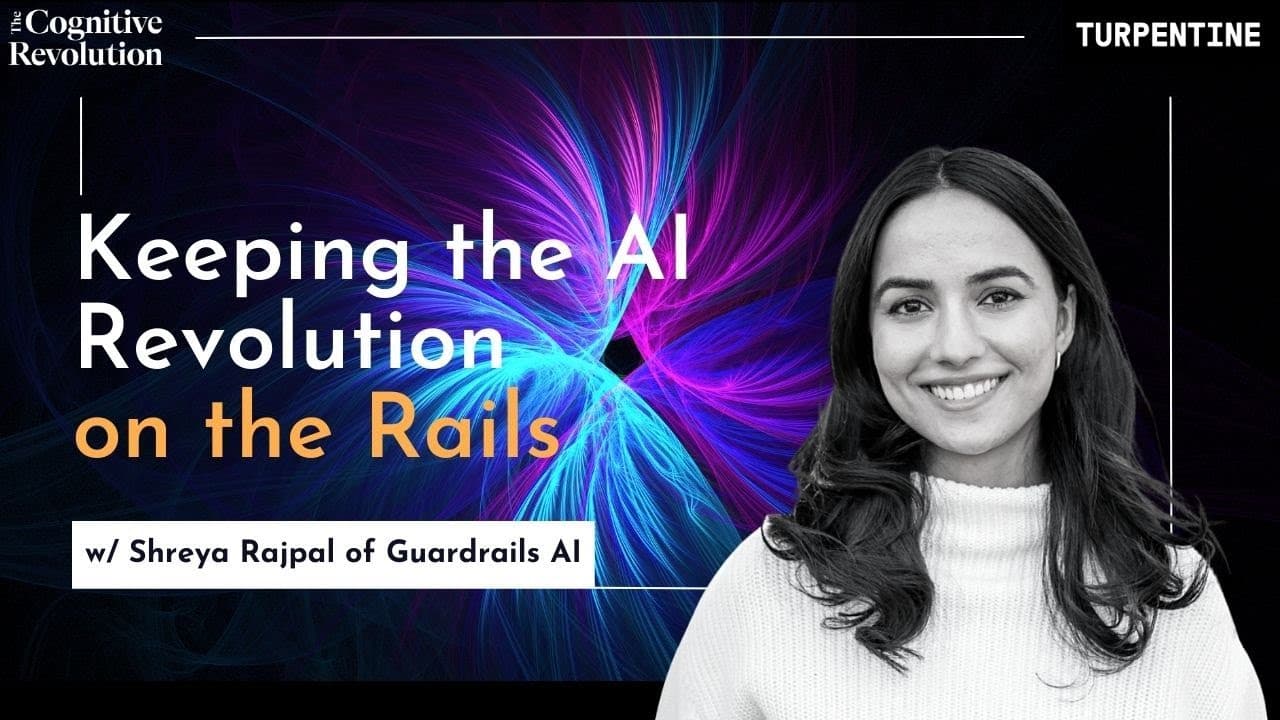
Guardrails AI is a Python library that enhances the reliability of AI models by adding a layer of output validation and correction. It allows developers to ensure that language models produce outputs that meet specified criteria, addressing common issues like unpredictability and errors. This tool is crucial for applications where reliability and correctness are essential, enabling developers to use AI models more effectively and safely.
Transcript
it's kind of insane to see just the amount of like activity and excitement around the space like there's you know people training and fine-tuning deep learning models you know weren't even in the space like a few months ago and that's really awesome right and that I had like people who were like oh I I really like guardrails I really like open my e... Read More
Key Insights
- Guardrails AI is a Python library designed to enhance the reliability of AI model outputs by adding validation and correction layers.
- It addresses common issues with language models, such as unpredictability and errors, by allowing developers to specify output criteria.
- The library supports structured prompting, reducing the complexity of prompt engineering and making it easier to achieve desired output formats.
- Guardrails can work with various AI models, offering flexibility in terms of cost and performance by enabling the use of open-source models.
- The tool is particularly valuable for applications requiring high reliability and correctness, such as automated coding or summarization tasks.
- It provides a framework for developers to configure validation checks and handle failures, offering options like re-asking, filtering, or logging errors.
- Guardrails supports the evolving landscape of AI by accommodating different language model providers and ensuring interoperability.
- The library's approach to validation and correction can help mitigate security risks, such as prompt injection, by implementing input and output checks.
Install to Summarize YouTube Videos and Get Transcripts
Explore YouTube Video Summarizer or Get YouTube Transcript Extractor
Questions & Answers
Q: How does Guardrails AI improve the reliability of AI models?
Guardrails AI improves the reliability of AI models by adding a layer of output validation and correction. It allows developers to specify criteria for outputs, ensuring that the AI model produces results that meet these criteria. This addresses common issues such as unpredictability and errors, making AI models more dependable and suitable for applications where correctness is crucial.
Q: What are common issues with language models that Guardrails AI addresses?
Common issues with language models that Guardrails AI addresses include unpredictability, errors in output, and the inability to consistently produce results that meet specific criteria. By allowing developers to define validation checks and handle failures, Guardrails ensures that models adhere to desired output formats and standards, improving their reliability and usefulness.
Q: How does structured prompting in Guardrails AI reduce complexity?
Structured prompting in Guardrails AI reduces complexity by allowing developers to define output criteria in a markup language rather than relying solely on natural language prompts. This abstraction simplifies the process of achieving desired output formats, as developers can focus on specifying the structure and constraints of outputs rather than crafting intricate prompts.
Q: What flexibility does Guardrails AI offer in terms of AI model usage?
Guardrails AI offers flexibility in AI model usage by supporting various models, including open-source ones. This allows developers to choose models based on cost, performance, and specific application needs. By providing a consistent validation framework, Guardrails enables the use of different models while maintaining output reliability and correctness.
Q: Why is Guardrails AI valuable for applications requiring high reliability?
Guardrails AI is valuable for applications requiring high reliability because it ensures that AI model outputs meet specified criteria, reducing the risk of errors and unpredictability. This is crucial in contexts where correctness is essential, such as automated coding or summarization tasks, as it provides a framework for validating and correcting outputs before they are used.
Q: How does Guardrails AI handle output validation and failure?
Guardrails AI handles output validation and failure by providing a framework for developers to configure checks and specify how to address failures. Options include re-asking the model to generate a corrected output, filtering out invalid parts, or logging errors for further analysis. This flexibility allows developers to tailor the validation process to their specific needs and tolerance for errors.
Q: How does Guardrails AI support interoperability among different AI model providers?
Guardrails AI supports interoperability among different AI model providers by allowing developers to define validation criteria that are independent of the underlying model. This means that developers can switch between models or use multiple providers without having to reconfigure their validation framework, ensuring consistent output reliability across different systems.
Q: What security risks can Guardrails AI help mitigate?
Guardrails AI can help mitigate security risks such as prompt injection by implementing input and output validation checks. By ensuring that only valid inputs are processed and that outputs meet specified criteria, Guardrails reduces the likelihood of malicious or unintended behavior in AI models, providing an additional layer of security for applications using these technologies.
Summary & Key Takeaways
-
Guardrails AI is a Python library that enhances AI model reliability by adding validation and correction layers to model outputs. It allows developers to specify criteria for outputs, addressing common issues like unpredictability and errors. This tool is essential for applications where reliability and correctness are critical, enabling developers to use AI models more effectively and safely.
-
The library supports structured prompting, reducing the complexity of prompt engineering and making it easier to achieve desired output formats. It works with various AI models, offering flexibility in terms of cost and performance by enabling the use of open-source models. Guardrails is particularly valuable for applications requiring high reliability and correctness, such as automated coding or summarization tasks.
-
Guardrails AI provides a framework for developers to configure validation checks and handle failures, offering options like re-asking, filtering, or logging errors. It supports the evolving landscape of AI by accommodating different language model providers and ensuring interoperability. The library's approach to validation and correction can help mitigate security risks, such as prompt injection, by implementing input and output checks.
Read in Other Languages (beta)
Share This Summary 📚
Summarize YouTube Videos and Get Video Transcripts with 1-Click
Try YouTube Summary with ChatGPT & Claude or YouTube Transcript Generator
Explore More Summaries from Cognitive Revolution "How AI Changes Everything" 📚





Summarize YouTube Videos and Get Video Transcripts with 1-Click
Try YouTube Summary with ChatGPT & Claude or YouTube Transcript Generator