How to Evaluate LLMs: Metrics, Biases, and Benchmarks
TL;DR
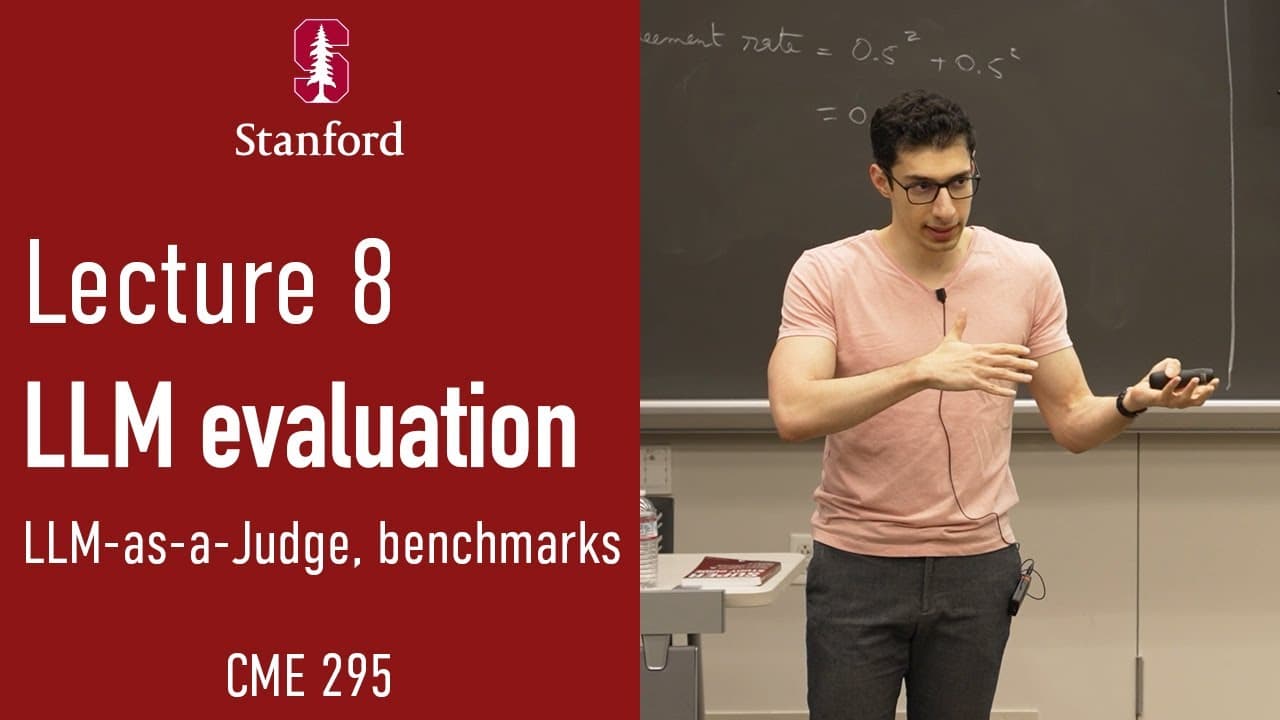
Evaluating large language models (LLMs) involves using LLM-as-a-Judge, a method that leverages LLMs to assess responses based on criteria like coherence and factuality. Key biases include position, verbosity, and self-enhancement biases, which can affect evaluation outcomes. Employing benchmarks such as MMLU, AIME, and SWE-bench helps measure LLM performance across knowledge, reasoning, and coding tasks, ensuring comprehensive LLM evaluation.
Transcript
Hello, everyone, and welcome to lecture 8 of CME 295. So today's topic will be LLM evaluation. And I think this class is probably one of the most important classes of this quarter because the idea is if we don't how to measure the performance of our LLM, we don't really know what to improve. And so this class will focus on how we can quantify how t... Read More
Key Insights
- LLM-as-a-Judge is a method for evaluating LLM outputs without human ratings by using another LLM to score responses.
- Position bias occurs when the order of responses affects LLM judgment, potentially skewing evaluation results.
- Verbosity bias leads LLMs to prefer longer responses, even if they are not more accurate.
- Self-enhancement bias happens when an LLM prefers its own generated outputs, affecting impartiality.
- Benchmarks like MMLU test LLM knowledge across diverse domains, ensuring comprehensive evaluation.
- AIME and PIQA benchmarks assess LLM reasoning abilities, focusing on math and common sense reasoning.
- SWE-bench evaluates LLM coding skills by testing their ability to solve GitHub issues using Python.
- Tau-Bench measures agent performance by simulating user-agent interactions in tool-rich environments.
Install to Summarize YouTube Videos and Get Transcripts
Explore YouTube Video Summarizer or Get YouTube Transcript Extractor
Questions & Answers
Q: How does LLM-as-a-Judge work in evaluating LLM outputs?
LLM-as-a-Judge involves using an LLM to evaluate responses based on specific criteria, such as coherence or factuality. The process includes providing the LLM with the prompt, the response, and evaluation criteria, and then receiving a score and rationale. This method eliminates the need for human ratings and leverages the LLM's understanding of human preferences.
Q: What are some common biases in LLM evaluation?
Common biases in LLM evaluation include position bias, where the order of presented responses influences judgment; verbosity bias, which leads to a preference for longer responses; and self-enhancement bias, where the LLM favors its own outputs over potentially better alternatives. These biases can skew evaluation results and require mitigation strategies.
Q: What is the purpose of benchmarks like MMLU in LLM evaluation?
Benchmarks like MMLU are designed to assess the knowledge retention of LLMs across various domains. MMLU includes tasks spanning different fields, such as law and medicine, and uses a multiple-choice format to evaluate how well LLMs can recall and apply factual information. This helps ensure comprehensive evaluation of LLM capabilities.
Q: How do AIME and PIQA benchmarks evaluate LLM reasoning abilities?
AIME evaluates LLMs on math reasoning by presenting problems that require step-by-step solutions, while PIQA focuses on common sense reasoning in everyday scenarios. Both benchmarks test the LLM's ability to process information logically and arrive at correct conclusions, providing insights into their reasoning capabilities.
Q: What role does SWE-bench play in evaluating LLM coding skills?
SWE-bench assesses LLM coding skills by requiring them to solve GitHub issues using Python. The benchmark involves evaluating the LLM's ability to generate patches that fix code errors, with success measured by the passing of tests introduced in pull requests. This ensures LLMs can effectively read and write code.
Q: How does Tau-Bench evaluate agent performance in LLMs?
Tau-Bench evaluates agent performance by simulating user-agent interactions in domains like airlines and retail. It provides tasks and tool policies, assessing the agent's ability to achieve user goals through tool usage. The benchmark measures success based on task completion and database state changes, ensuring reliable agent performance.
Q: What are best practices for using LLM-as-a-Judge in evaluations?
Best practices for LLM-as-a-Judge include using a binary scoring system for simplicity, ensuring clear evaluation criteria, and having the LLM provide rationale before scoring. It's also important to correlate LLM evaluations with human ratings to ensure alignment and address biases like position and verbosity bias.
Q: Why is it important to consider data contamination in benchmarks?
Data contamination can skew benchmark results if the LLM has seen the benchmark data during training. Ensuring benchmarks are unseen by the LLM is crucial for accurate evaluation. Techniques like using hash values and blocklists help prevent contamination, maintaining the integrity of benchmark assessments.
Summary & Key Takeaways
-
LLM evaluation leverages methods like LLM-as-a-Judge, which uses LLMs to assess outputs based on predefined criteria. Key biases such as position, verbosity, and self-enhancement can affect the evaluation process, necessitating strategies to mitigate them. Best practices include using structured outputs and correlating LLM evaluations with human ratings.
-
Benchmarks play a crucial role in evaluating LLMs across various domains. MMLU assesses knowledge retention, AIME and PIQA focus on reasoning, while SWE-bench evaluates coding abilities. These benchmarks provide a standardized way to measure LLM performance, ensuring models meet diverse user needs.
-
Agent evaluation, as demonstrated by Tau-Bench, involves assessing LLMs in tool-rich environments where they simulate user interactions. This approach helps identify potential errors in tool usage and response synthesis, ensuring LLMs perform reliably in real-world applications.
Read in Other Languages (beta)
Share This Summary 📚
Summarize YouTube Videos and Get Video Transcripts with 1-Click
Try YouTube Summary with ChatGPT & Claude or YouTube Transcript Generator
Explore More Summaries from Stanford Online 📚

Summarize YouTube Videos and Get Video Transcripts with 1-Click
Try YouTube Summary with ChatGPT & Claude or YouTube Transcript Generator