How Do o3 and o4-mini Improve AI Reasoning?
TL;DR
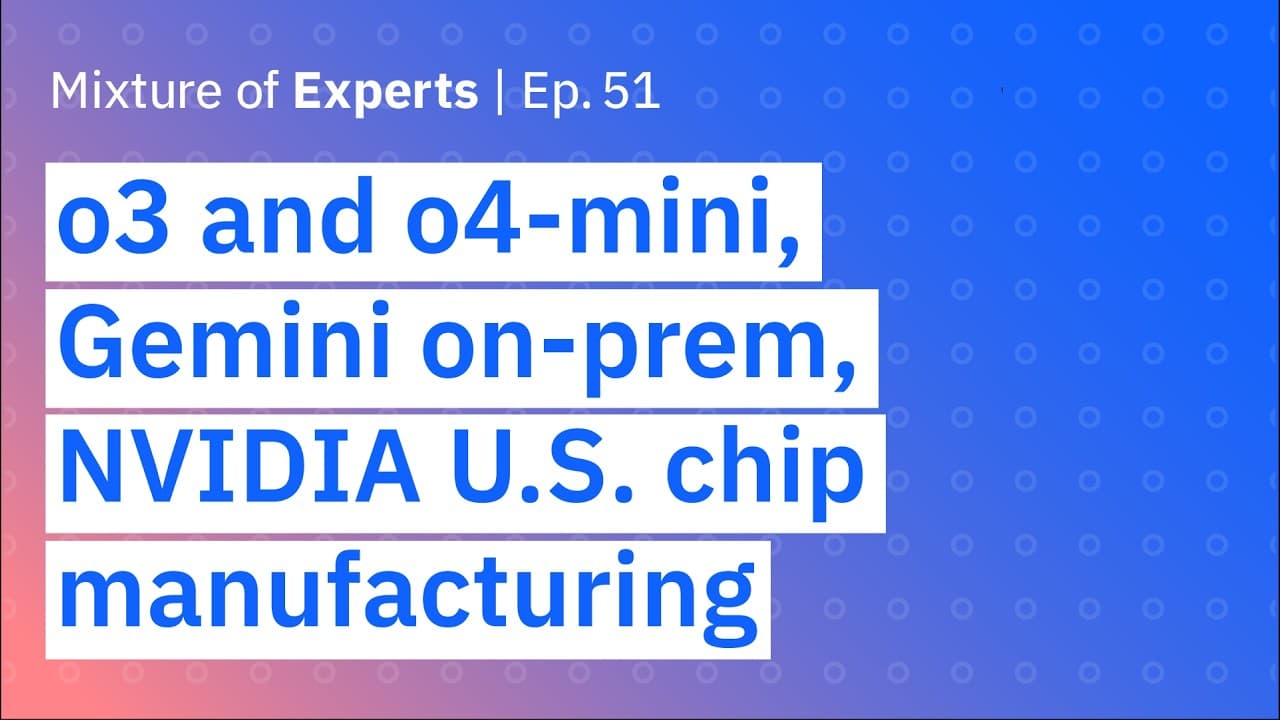
OpenAI’s o3 is presented as strong at code architecture and refactoring, while o4-mini handles quick tasks such as unit-test creation and code refactoring with notable speed. The panel also highlights longer reasoning, more relevant answers, visual reasoning, and improved tool use, while arguing that practical evaluation should focus on the specific problems a model must solve.
Transcript
o3, o4, o4-mini, o4-mini high, GPT-4o, GPT-4.5. What model are you using? Chris Hay is a Distinguished Engineer and CTO of Customer Transformation. Uh, Chris, welcome back to the show. And, uh, what's your preferred model? Oh, you missed 4.1, Tim, so that's gonna be my model. I'm picking 4.1, the one Tim didn't pick. Very nice. Thank you Chris. Vyo... Read More
Key Insights
- o3 is presented as particularly useful for coding analysis because it can return substantive suggestions about refactoring and improving software architecture. Chris Hay also reports that the model’s personality feels improved, based on his initial experimentation with the release.
- o4-mini is described as a fast option for focused coding work, including creating unit tests and refactoring code. The panel’s experience suggests that model selection can depend on whether the user prioritizes deeper analysis or rapid completion of a clearly bounded task.
- Longer reasoning time can produce more relevant answers, according to Vyoma Gajjar’s early testing of the new models. She avoids treating relevance as an unrestricted claim of accuracy, but reports that the additional reasoning appears to improve how closely answers address the request.
- Visual reasoning is presented as the ability to interpret supplied images within a broader reasoning process. Examples include comparing wedding-decoration references and examining a screenshot of a pivot table before helping the user produce a report that reflects the visible information.
- Agentic tool use is identified as an important improvement in o3 and o4-mini. The discussion connects this capability with completing multi-step tasks, reading files, conducting searches, and reasoning about what action should be performed rather than merely returning a one-shot interpretation.
- Model quality is best judged against the specific problem a user needs to solve, according to John Willis. For DevOps, infrastructure, and software-engineering work, he looks first at relevant benchmarks and then considers whether the model can address real customer problems.
- Software-engineering benchmarks are useful signals but still require practical verification. John Willis points to the reported movement on SW Bench and an AI Polyglot benchmark, while explicitly noting that he had not yet personally verified the o3 and o4-mini benchmark results.
- The episode’s broader enterprise agenda includes Google Gemini running on premises, AI evaluation tools, and NVIDIA’s planned United States chip manufacturing. The description frames these as questions about enterprise adoption, reliable model assessment, and whether domestic manufacturing plans can be executed.
Install to Summarize YouTube Videos and Get Transcripts
Explore YouTube Video Summarizer or Get YouTube Transcript Extractor
Questions & Answers
Q: How do o3 and o4-mini differ for coding tasks?
o3 is described as strong at deeper coding analysis, especially suggesting refactoring approaches and improvements to software architecture. o4-mini is presented as a fast choice for focused work such as creating unit tests or refactoring code quickly. These are initial judgments from hands-on use, not universal rankings, so the preferred model depends on the task being completed.
Q: What improvements did the panel notice in OpenAI o3?
The panel highlights stronger refactoring suggestions, useful software-architecture feedback, and an improved personality in o3. Vyoma Gajjar also observes longer reasoning and answers that appear more relevant to the question. The discussion further identifies visual reasoning and improved agentic tool use as important parts of the new model generation, particularly for tasks involving images and multiple actions.
Q: Why does o3 take longer to produce some answers?
Vyoma Gajjar reports that the model spends more time reasoning than earlier options she tested. In her assessment, that additional reasoning helps it return answers that are more relevant to the request. She deliberately avoids using accuracy too broadly, framing the observed benefit as improved relevance rather than proof that every generated answer is factually correct.
Q: How does visual reasoning work in o3 and o4-mini?
Visual reasoning is discussed as more than describing a supplied picture. The model can examine images, relate their details to the user’s question, compare visual references, and reason toward a requested result. Examples in the discussion include evaluating wedding-decoration images and interpreting a pivot-table screenshot before helping generate a report based on the visible information.
Q: What does thinking in images mean for an AI model?
Thinking in images is presented as incorporating visual material into the reasoning process. Instead of only producing an interpretation of an uploaded image, the model can analyze relevant visual details, compare representations, and connect them with the requested task. The panel associates this capability with image-based planning, report generation, and agentic workflows that require several reasoning steps.
Q: How should companies compare competing AI models?
Companies should compare models according to the problems they actually need to solve, rather than treating online reactions or a single general ranking as decisive. John Willis applies this approach to DevOps, infrastructure, and software engineering. He begins with benchmarks related to those domains, then considers whether the results translate into solutions for practical customer requirements.
Q: Why are AI evaluation tools and benchmarks important?
AI evaluation tools and benchmarks help users assess whether a model fits a particular type of work. John Willis points to software-engineering and polyglot benchmarks because they relate to the DevOps and infrastructure problems his customers face. He also distinguishes reported benchmark improvements from personal verification, showing why published scores should be followed by direct task testing.
Q: What broader enterprise AI topics does the episode cover?
The episode covers four announced areas: OpenAI’s o3 and o4-mini models, Google Gemini running on premises, AI evaluation tools, and NVIDIA’s plan for United States chip manufacturing. The description frames the Gemini segment around enterprise adoption, the evaluation segment around why assessment tools are needed, and the manufacturing segment around whether NVIDIA can execute its stated plan.
Summary & Key Takeaways
-
OpenAI’s o3 and o4-mini receive positive initial assessments from the panel. Chris Hay finds o3 effective at suggesting code refactoring and architectural improvements, while o4-mini performs quick coding jobs such as generating unit tests. Vyoma Gajjar observes longer reasoning time, more relevant responses, and stronger reasoning across supplied images.
-
The panel rejects broad claims that OpenAI’s releases are merely incremental or evidence that the company is falling behind. John Willis argues that model comparisons should begin with the problem being solved. For his DevOps and infrastructure work, software-engineering benchmarks and practical customer problems matter more than generalized online reactions.
-
The episode also introduces three broader industry questions: running Google Gemini on premises, selecting AI evaluation tools, and NVIDIA’s plan for United States chip manufacturing. The supplied transcript primarily develops the OpenAI model discussion, while the description identifies the remaining segments without providing their detailed arguments, evidence, or final conclusions.
Read in Other Languages (beta)
Share This Summary 📚
Summarize YouTube Videos and Get Video Transcripts with 1-Click
Try YouTube Summary with ChatGPT & Claude or YouTube Transcript Generator
Explore More Summaries from IBM Technology 📚

Summarize YouTube Videos and Get Video Transcripts with 1-Click
Try YouTube Summary with ChatGPT & Claude or YouTube Transcript Generator