Yuval Noah Harari on Hamas, Peace, and Populism
TL;DR
Hamas sought not only to kill Israelis but also to destroy prospects for peace by spreading terror and hatred, according to Yuval Noah Harari. He argues that Israelis must recognize both Palestinian dignity and their own suffering, while political leaders must accept responsibility for years of division and institutional corrosion that left the state unprepared.
Transcript
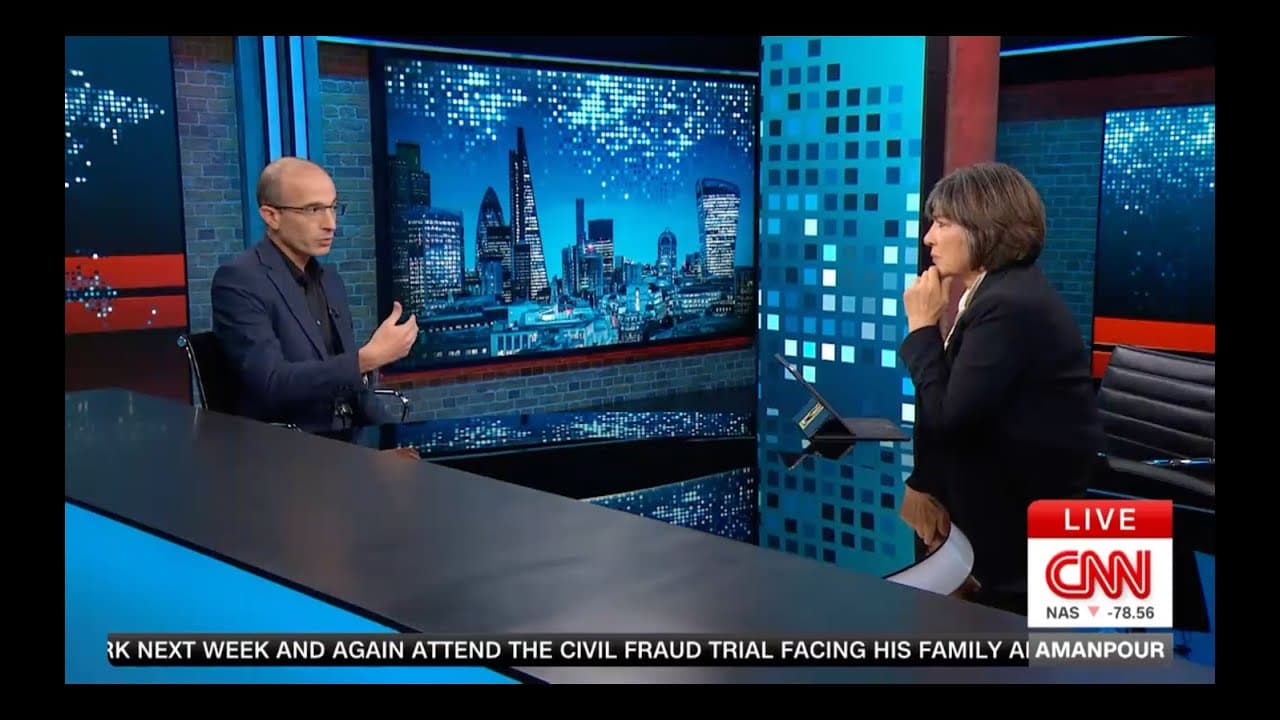
Questions are being asked about the ramifications of this crisis and how the region got here in the first place and where it is going to end up. So let's get some perspective now. Yuval Noah Harari is a historian and a public intellectual, best-selling author behind books like 'Sapiens', and he joins me now here in London. Welcome back to our p... Read More
Key Insights
- The October 7 assault targeted entire civilian communities, according to Harari, rather than focusing only on military units or bases. He says attackers moved systematically through villages, killing families while residents waited for Israeli forces that did not reach them in time.
- The attack evoked memories of the Holocaust and centuries of pogroms among Israelis because communities were subjected to systematic slaughter. Harari distinguishes this reaction from initial comparisons with the Yom Kippur War, which occurred almost exactly 50 years earlier.
- Hamas used recorded atrocities as psychological warfare, Harari argues, deliberately distributing images through social media instead of concealing the violence. He believes this strategy sought to spread terror and plant hatred capable of sustaining the conflict across generations.
- The attack sought to eliminate prospects for peace, according to Harari, amid movement toward an Israel-Saudi Arabia agreement that was expected to include some improvement for Palestinians. He connects this goal to Hamas's longstanding rejection of Israel's existence and peace efforts.
- Victimhood and responsibility can coexist, Harari says, because nations may be victims, perpetrators, or both at the same time. He argues that recognizing the massacre of Israelis should remain compatible with supporting the rights, dignity, and legitimate aspirations of Palestinian people.
- Reconciliation can emerge from conscious political choices, even after histories of slaughter and deportation. Harari cites Poland's early 1990s decision to relinquish historical claims to Vilnius and Lviv and pursue cooperation with Lithuania and Ukraine as evidence that societies can prioritize a shared future.
- Divisive populism corrodes state institutions, Harari argues, by turning citizens against one another, attacking institutions that resist government policies, spreading conspiracy theories, and branding public servants as traitors. He links this long-term corrosion to the Israeli state's failure during its citizens' greatest need.
- Political recovery must begin with responsibility and apology, according to Harari. He says Israeli leaders, particularly Benjamin Netanyahu, should acknowledge what went wrong before debating resignation or government restructuring, citing the education minister's admission that the government had focused on nonsense during the preceding year.
Install to Summarize YouTube Videos and Get Transcripts
Explore YouTube Video Summarizer or Get YouTube Transcript Extractor
Questions & Answers
Q: Why does Harari say Hamas wanted to destroy peace?
Harari argues that Hamas intended not only to destroy Israeli communities but also to eliminate opportunities for reconciliation. He places the attack against the background of movement toward an Israel-Saudi Arabia peace agreement that was expected to include some improvement for Palestinians. Because Hamas had never accepted Israel's existence or peace efforts, he interprets the violence as an attempt to create enduring hatred and prevent diplomatic progress.
Q: How did the October 7 attack affect Israeli society?
Harari says the attack produced profound shock because entire civilian communities were systematically assaulted and the army failed to reach them in time. Israelis began comparing the events with the Holocaust and historical pogroms rather than with recurring rounds of regional violence. The deliberate torture, killing, hostage-taking, and online distribution of recorded atrocities intensified fear and created a sense that this attack was fundamentally different.
Q: What happened to Harari's relatives in Kibbutz Be'eri?
Harari says his 99-year-old uncle and 89-year-old aunt lived in Kibbutz Be'eri, where Hamas took control and moved from house to house for hours. The couple hid inside their home and survived. He contrasts their survival with the devastating news received by many of his friends and relatives, while emphasizing the shock caused by the army's inability to reach affected villages quickly.
Q: Why were recordings of the attacks posted online?
Harari interprets the filming and online publication of atrocities as deliberate psychological warfare. The attackers did not try to conceal their conduct and instead wanted people to witness it through social media. In his analysis, the purpose was broader than causing immediate terror. It was also meant to cultivate hatred so intense that Israelis and Palestinians would remain trapped in conflict for generations.
Q: Can Israeli suffering and Palestinian rights be recognized together?
Harari says both realities can and should be recognized simultaneously. The slaughter of Israeli civilians can be condemned without denying Palestinian rights, dignity, or legitimate aspirations. He explains that people and nations may be victims and perpetrators at different times, or even at the same time. However, he acknowledges that holding these complex ideas together is psychologically difficult for people directly experiencing violence.
Q: How does Harari believe reconciliation can happen after violence?
Harari says reconciliation may require planting ideas that produce no immediate results but become meaningful decades later. He identifies the release of all hostages as a starting point and argues that historical enemies can choose cooperation. His example is Poland's early 1990s decision to set aside territorial claims involving Vilnius and Lviv and build a shared future with Lithuania and Ukraine.
Q: How does populism weaken democratic institutions?
Harari argues that populism weakens democracy by dividing a nation against itself, attacking institutions that resist a leader's policies, promoting conspiracy theories, and describing public servants or established elites as deep-state traitors. He says these practices corroded Israel's basic institutions over several years, contributing to a situation in which the state was missing when citizens faced their greatest need.
Q: What should Israel's political leaders do after the attack?
Harari says the first step is for leaders to accept responsibility and apologize to Israelis for their conduct during the preceding years. He does not prescribe a specific replacement government or insist that resignation must come first. Instead, he calls for a basic acknowledgment that serious mistakes were made, noting that the education minister had already admitted the government spent the previous year dealing with nonsense.
Summary & Key Takeaways
-
Harari describes the October 7 attack as a systematic assault on civilian communities that evoked memories of pogroms and the Holocaust among Israelis. His elderly aunt and uncle survived by hiding in their Kibbutz Be'eri home, while many other families suffered devastating losses before the army arrived.
-
Harari argues that Hamas used extreme violence, hostage-taking, recordings, and social media as psychological warfare. In his view, the intention was to spread terror, cultivate lasting hatred, and undermine emerging prospects for regional peace, including a possible agreement between Israel and Saudi Arabia that might have improved Palestinian conditions.
-
Harari says historical reconciliation remains possible, even after severe violence, and cites Poland, Lithuania, and Ukraine as an example of choosing a shared future over territorial grievances. He also blames years of divisive populist politics for corroding Israeli institutions and calls on government leaders to acknowledge responsibility and apologize.
Read in Other Languages (beta)
Share This Summary 📚
Summarize YouTube Videos and Get Video Transcripts with 1-Click
Try YouTube Summary with ChatGPT & Claude or YouTube Transcript Generator
Explore More Summaries from Yuval Noah Harari 📚



Summarize YouTube Videos and Get Video Transcripts with 1-Click
Try YouTube Summary with ChatGPT & Claude or YouTube Transcript Generator