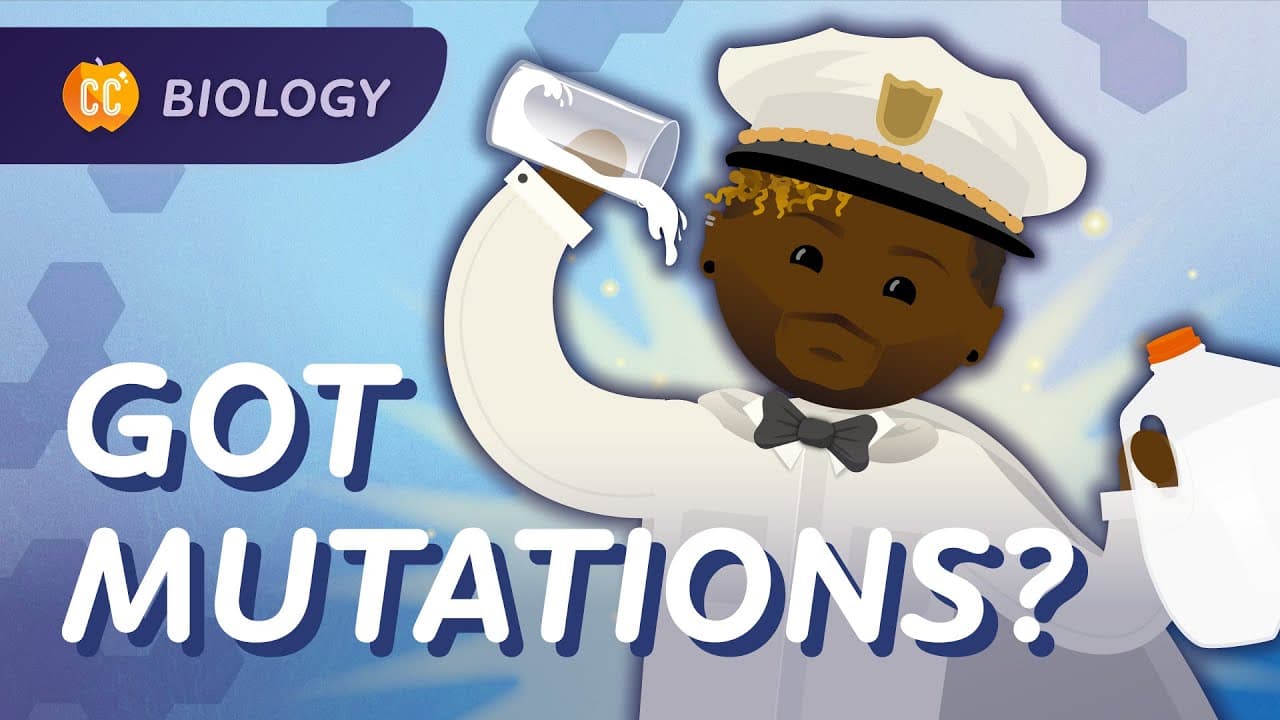
Genetic Mutations: Is Drinking Milk a Super Power?: Crash Course Biology #37
TL;DR
A genetic mutation is a change in an organism’s DNA that can be helpful, harmful, or neutral. Mutations may arise during DNA replication, result from mutagens such as UV radiation or tobacco chemicals, or be inherited from a parent. Their effects depend partly on where they occur and how they alter DNA, so read on to compare mutation types and their consequences.
Transcript
From X-Men to Ninja Turtles to the meta-humans of Static Shock, science fiction is full of mutants, complete with laser eyes, weather control, and telekinesis. And in these media, mutations seem to be the thing separating the humans — or, uh, turtles — from the superhumans — or superturtles. But the truth is, everyone has mutations. These comple... Read More
Key Insights
- Mutations are changes in an organism's genetic code, which can be beneficial, harmful, or neutral, affecting various bodily functions.
- Mutations can result from errors during DNA replication or exposure to mutagens like UV radiation and chemicals in tobacco.
- Inherited mutations can be passed down from parents to offspring, while somatic mutations occur after conception and aren't inherited.
- Gene therapy and CRISPR are promising techniques for controlling mutations, potentially treating diseases like cancer and sickle cell anemia.
- Pharmacogenomics is the study of how genes affect drug efficacy, enabling personalized medicine based on genetic profiles.
- Silent mutations, once thought harmless, can affect protein production timing and frequency, impacting organism functions.
- Frameshift mutations, caused by nucleotide insertions or deletions, disrupt protein synthesis, leading to nonfunctional proteins.
- Mutations are inevitable due to aging and environmental factors, but scientific advancements offer potential for reversing harmful mutations.
Install to Summarize YouTube Videos and Get Transcripts
Explore YouTube Video Summarizer or Get YouTube Transcript Extractor
Questions & Answers
Q: What is a genetic mutation, and how does it happen?
A genetic mutation, also called a variation, is a change in an organism’s genetic code. It can result from an error during DNA replication or exposure to a mutagen such as UV radiation, nuclear radiation, or chemicals in tobacco products.
Q: Are genetic mutations always harmful?
No. Mutations can be helpful, harmful, or neutral, and changes in non-protein-coding DNA often have no real effect. Some mutations help people metabolize caffeine more efficiently or feel rested with less sleep, while others impair bodily functions or shorten life expectancy.
Q: What determines the effect of a mutation?
Two main factors are the mutation’s location and how it changes the DNA. The same mutation can have different effects in cells that create heart muscle than in cells coding for proteins in the brain, while different alterations can change, truncate, or leave a protein unchanged.
Q: What is the difference between somatic and de novo mutations?
A somatic mutation occurs after conception somewhere other than an egg or sperm cell, so it is not passed on genetically. A mutation that develops in an egg or sperm cell is called a de novo mutation and can be passed to all of the offspring’s cells.
Q: What is a missense mutation?
A missense mutation is a nucleotide substitution that causes a cell to add a different amino acid to a protein. The transcript gives the example of G-A-A changing to G-U-A, replacing glutamic acid with valine; this one-letter mutation causes sickle cell anemia.
Q: What is a nonsense mutation?
A nonsense mutation changes a DNA instruction into a stop codon, telling the cell to end protein production before the protein is complete. The result is a protein fragment, and this mutation type has been linked to serious diseases including cystic fibrosis.
Q: What is a silent mutation?
A silent mutation is a substitution that does not change the amino acid specified because the genetic code contains redundancy. For example, both G-A-A and G-A-G code for glutamic acid, although the existing page notes that research has challenged the assumption that such mutations have no impact.
Q: How can studying mutations help human health?
Understanding how mutations arise and affect proteins can help researchers address conditions that impair critical bodily functions. The page identifies gene therapy, CRISPR, and pharmacogenomics as approaches for treating genetic disorders or tailoring drug treatment to a person’s genetic profile.
Summary & Key Takeaways
-
Mutations are genetic variations that occur naturally or due to environmental factors, impacting organisms in diverse ways, from beneficial adaptations to serious health conditions. Understanding mutations helps in developing medical interventions.
-
Gene therapy and CRISPR are cutting-edge techniques that allow scientists to edit genes, potentially offering treatments for genetic disorders. These methods are still in development but hold promise for future medical applications.
-
Pharmacogenomics enables personalized medicine by tailoring drug treatments to individuals' genetic profiles, improving efficacy and reducing side effects. This approach represents a significant advancement in healthcare.
Read in Other Languages (beta)
Share This Summary 📚
Summarize YouTube Videos and Get Video Transcripts with 1-Click
Try YouTube Summary with ChatGPT & Claude or YouTube Transcript Generator
Explore More Summaries from CrashCourse 📚


Summarize YouTube Videos and Get Video Transcripts with 1-Click
Try YouTube Summary with ChatGPT & Claude or YouTube Transcript Generator