How to use Python if statements effectively in code
TL;DR
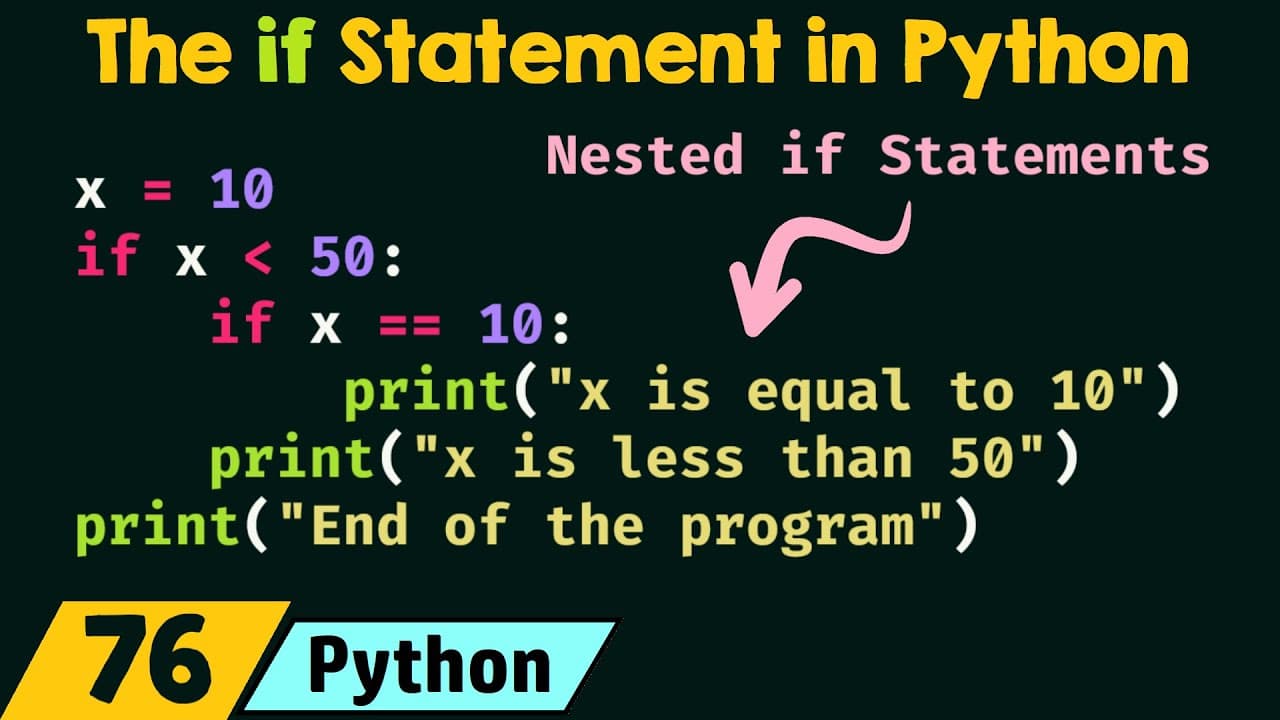
An if statement runs a block of code only when a condition is true. The condition is followed by a colon and relies on indentation to define the executed block. Short-hand if lets a single statement run on the same line, and nested ifs enable multiple condition checks.
Transcript
foreign we will understand the concept of the if statement so without any further delay let's get started with this lecture the topics of this lecture are introduction to the if statement the statement outside if block the shorthand is and the nested if statements let's get started with the first topic that is Introduction to the if statement so wh... Read More
Key Insights
- The if statement decides whether a block of code runs based on a condition that evaluates to true or false.
- The condition uses a colon and must be followed by an indented block of statements to be executed when true.
- Indentation is crucial in Python for defining the scope of the if block.
- The statement outside the if block executes regardless of the condition.
- Short-hand if allows a single statement to run on the same line as the condition.
- Nested if statements enable multiple levels of condition checks.
- The example uses X set to 10 to illustrate a true condition leading to printed output.
- The tutorial also covers how to create and run code in an editor like Visual Studio Code to practice these concepts.
Install to Summarize YouTube Videos and Get Transcripts
Explore YouTube Video Summarizer or Get YouTube Transcript Extractor
Questions & Answers
Q: What is the primary role of an if statement in Python?
The primary role of an if statement in Python is to decide whether a specific block of statements should be executed based on a condition. If the condition evaluates to true, the code inside the if block runs; if it evaluates to false, the block is skipped. This enables conditional execution of code.
Q: Why is indentation important in Python if statements?
Indentation is important in Python if statements because it defines the scope of the block that should be executed when the condition is true. The statements inside the indented block are the ones that run when the condition holds, while statements outside the block are not controlled by the if condition.
Q: What happens to the statement outside the if block?
The statement outside the if block executes regardless of whether the if condition is true or false. This separation allows developers to place code that should always run after the conditional check, ensuring a predictable flow of execution.
Q: How does the shorthand if work in Python?
The shorthand if works by placing a single statement on the same line as the if condition. If the condition is true, that one statement executes; otherwise, nothing happens for that line. This form is useful for concise conditional actions when only one operation is needed.
Q: What is a nested if statement and why use it?
A nested if statement is an if inside another if block. It allows multiple condition checks in sequence, enabling more precise control over which code runs. This is useful when there are several related conditions that must be satisfied in order to execute a particular block.
Q: What syntax element follows the condition in a Python if statement?
After the condition in a Python if statement, a colon is mandatory. This colon signals the start of the indented block that should execute when the condition evaluates to true, making the syntax clear and consistent across Python code.
Q: How is the output determined when the condition is true in the example with X set to 10?
When X is set to 10, the condition X less than 50 evaluates to true, so the corresponding print statement within the if block runs, producing output. This demonstrates how the value of the condition directly controls whether the code inside the block executes.
Q: What is the purpose of explaining the external example involving end of program?
The external example with an end of the program statement illustrates that some statements are not part of the if block and will execute regardless of the condition. This helps learners distinguish between code that is conditionally executed and code that always runs, clarifying program flow.
Summary & Key Takeaways
-
The video covers the purpose and syntax of the if statement in Python, emphasizing that a condition must be true for the nested code to execute and that indentation defines the block scope. It also explains that code outside the if block runs regardless of the condition and introduces shorthand and nested forms.
-
The tutorial demonstrates the importance of the colon after the condition and shows a practical example where a variable X is compared to a value to decide whether to print a message.
-
The lesson concludes with guidance on using inside versus outside blocks, how indentation signals code blocks, and how nested and shorthand forms extend basic conditional logic.
Read in Other Languages (beta)
Share This Summary 📚
Summarize YouTube Videos and Get Video Transcripts with 1-Click
Try YouTube Summary with ChatGPT & Claude or YouTube Transcript Generator
Explore More Summaries from Neso Academy 📚





Summarize YouTube Videos and Get Video Transcripts with 1-Click
Try YouTube Summary with ChatGPT & Claude or YouTube Transcript Generator