How AI Changes Music Creation and Creativity
TL;DR
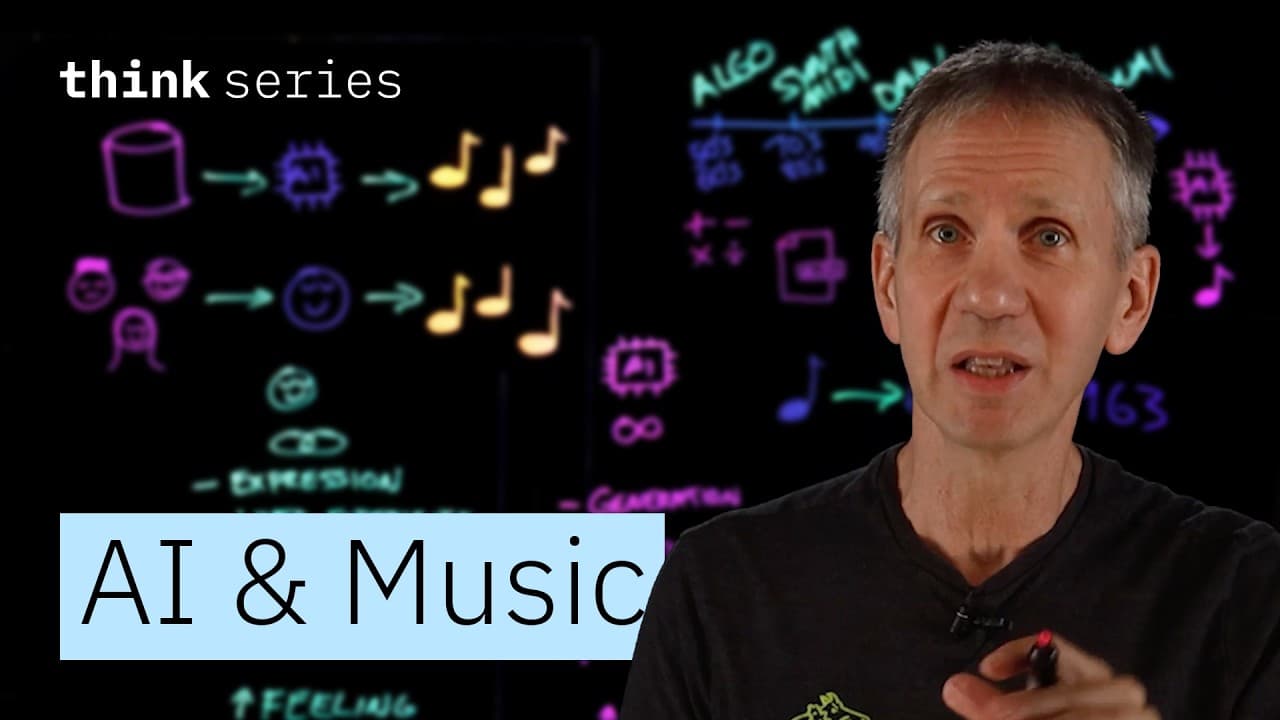
AI acts as a collaborative partner in music, accelerating idea generation, lyric writing, and sonic production while enabling rapid iteration and blending influences across genres. It supports modeling voices, mastering, arranging, and real time improvisation, which shifts the creative process rather than replacing human musicians.
Transcript
Quick experiment. I'm going to play a short musical idea. Don't judge whether it's good or bad, just ask yourself this question. Where do you think it came from? Okay, was that something that was composed? In other words, I wrote that years ago. Was it something that improvised? I made it up just right there in the moment. while we were doing the r... Read More
Key Insights
- AI changes music by acting as a collaborative partner rather than a replacement, enabling faster idea generation and iteration.
- Music has always evolved with technology; AI is the latest step that expands scale and speed while preserving human influence in the creative loop.
- AI can write lyrics using large language models, offering many alternatives quickly to help human writers move past blocks.
- AI can model singing voices and perform vocal style transfer, enabling backing vocals without needing additional singers.
- AI tools can clean audio, separate vocals, auto-master tracks, and suggest chord progressions, acting as powerful assistants to engineers.
- The technology can generate music in real time in response to movements, voice, or playing, enabling live machine-human improvisation.
- A key point is that all notes exist and AI rearranges them in new patterns, blending influences rather than creating entirely new notes.
- There are multiple AI-human collaboration models, from AI writing and performing to human-led revisions with AI as a creative partner
Install to Summarize YouTube Videos and Get Transcripts
Explore YouTube Video Summarizer or Get YouTube Transcript Extractor
Questions & Answers
Q: What is the core idea behind AI’s role in music creation?
The core idea is that AI can act as a collaborative partner that augments human creativity, providing rapid ideas, lyrics, and musical textures while the human guides, selects, and finalizes the direction. This approach emphasizes collaboration over replacement, highlighting how AI can accelerate iteration and exploration across styles and genres.
Q: How has music tech historically influenced creation, and where does AI fit?
Historically, music technology such as the piano, electric guitar, synthesizers, MIDI, and digital audio workstations shaped how music was created and produced. AI fits as the next stage, enabling full songs, harmonies, and multi-instrument arrangements with the ability to iterate instantly, expanding possibilities beyond traditional tools.
Q: Can AI generate lyrics and melodies, and how is this useful?
Yes, AI can generate lyrics using large language models and compose melodies, which is useful for brainstorming phrases, exploring themes, and providing dozens of options in seconds. This helps writers overcome blocks and accelerates the creative process by offering varied directions to refine into a final song.
Q: What are some practical AI tools mentioned for music production?
Practical tools include AI for lyric generation, voice modeling and style transfer, vocal separation, audio cleaning, auto-mastering, and chord progression suggestions. These tools act as assistants to musicians and engineers, enabling more efficient workflows and the ability to experiment with different textures and arrangements.
Q: How does AI affect live performance and real time collaboration?
AI can generate music in real time, react to a performer’s movements or voice, and enable human-machine improvisation. This creates new forms of collaboration where the human musician interacts with adaptive AI, potentially expanding improvised performance while preserving the human element in decision making.
Q: What does the video say about originality and influence in AI music?
The video argues that originality in music often comes from recombining influences rather than creating something entirely new. AI makes this recombination faster and more scalable, allowing artists to blend genres and ideas from a wide range of sources while maintaining personal interpretation and ownership of the final work.
Q: What collaboration variations with AI does the speaker describe?
The speaker describes several variations, including human write and perform with AI assistance, human write and AI revise with human performing, AI write then humans revise and perform, and AI writing, revising, and performing in a purely AI-driven workflow. The emphasis is on hybrid approaches where humans curate and guide AI output.
Q: Why is the future of AI in music framed as partnership rather than replacement?
The future is framed as partnership because AI expands human capabilities, offering fast generation, experimentation, and new sonic possibilities, while humans provide direction, taste, and emotional intent. This balanced view suggests AI will expand the toolkit for musicians and producers, not erase human creative roles.
Summary & Key Takeaways
-
The video argues that AI did not invent recombination in music but speeds up the process, scales it, and adds opacity, allowing artists to iterate quickly and explore new ideas without losing human input. It emphasizes that AI can act as a creative partner rather than a replacement.
-
Historical context shows music technology has always shaped creation, from piano and synthesizers to MIDI and digital audio workstations, with AI as the latest stage enabling full songs, lyrics, and multiple instrument arrangements.
-
The speaker outlines a matrix of AI and human collaboration options, including AI writing, revising, and performing, and emphasizes hybrid models where humans guide or veto AI output to maintain artistic direction.
Read in Other Languages (beta)
Share This Summary 📚
Summarize YouTube Videos and Get Video Transcripts with 1-Click
Try YouTube Summary with ChatGPT & Claude or YouTube Transcript Generator
Explore More Summaries from IBM Technology 📚
Summarize YouTube Videos and Get Video Transcripts with 1-Click
Try YouTube Summary with ChatGPT & Claude or YouTube Transcript Generator